
SEO for Personal Injury Attorneys and Law Firms
Ranking a personal injury site in 2026 is a math problem, not a keyword problem. Every top ranking page competes on the same signals, the same schema types, the same intent classes. What separates the firms that sign cases from organic search is a system that lowers the cost Google spends to crawl the site, captures the full path a claimant follows before they type “car accident lawyer near me,” reinforces the attorneys as named entities in the Knowledge Graph, and converts intent into intake at the moment the reader is ready. What follows is the playbook I use.
Table of contents
- Why personal injury SEO is a different problem
- The PI Organic Authority Engine at a glance
- The types of SEO a personal injury firm actually runs
- Phase 1: Technical stability and the Cost of Retrieval
- Phase 2: Intent capture across the query network
- Phase 3: Authority and entity reinforcement
- Phase 4: Case acquisition and Function First design
- The local pack layer: Google Business Profile mechanics
- Personal injury SEO by state and metro
- AI Overview and GEO for personal injury queries
- What personal injury SEO costs in 2026
- How long personal injury SEO takes
- Bar compliance guardrails for personal injury SEO
- How to evaluate a personal injury SEO partner
- Frequently asked questions
- If you want a diagnosis before another quarter of guesswork
- Closely Related Topics
- References
Why personal injury SEO is a different problem
Personal injury SEO is a different problem because the query is regulated, the vertical is among the most expensive in paid search, and the reader is often in crisis when they type it. A dog bite claimant searches from an emergency room. A wrongful death family searches from a funeral home parking lot. An MVA claimant searches from the passenger seat of a rideshare on the way to urgent care. That is not a marketing audience in the traditional sense. That is a legal service with a two hour window before the claimant retains someone else.
The supply side is crowded too. The American Bar Association’s 2023 to 2024 National Lawyer Population Survey counts 1,322,649 active lawyers in the US as of January 1, 2024, and personal injury is among the most heavily advertised practice areas inside that population. Every metro your firm serves has a bench of competitors bidding on the same crisis moment.
Personal injury is also a Your Money or Your Life category. Google’s own Search Quality Rater Guidelines, updated September 11, 2025, apply the highest Page Quality standard to legal content, and pages that provide inaccurate legal information are treated as high risk to the searcher. Your competitors know this. The top ten organic results across “SEO for personal injury attorneys” and its variants are a closed set of five or six agency guides that update their “2026 edition” every quarter. The reader arrives with a mental prototype of what a PI SEO article looks like. My job is to break it.
“In personal injury SEO, ranking without signed cases is a vanity metric,”
I tell every firm on our first call.
Most PI firms I audit chase traffic without a matching Source Context. They publish informational content on “back pain after a car accident” because they read a keyword report that said the query was high volume. Six months later the page ranks and generates zero retainers. The article had no bridge back to the commercial intent that funds the firm.
The Cost of Retrieval frame
Ranking is a probabilistic evaluation, not a deterministic keyword score.
Google’s ranker weighs a document’s expected relevance against the compute cost of returning it. That cost includes crawling the site, parsing the HTML, extracting the entities, matching them to a query, and delivering the result to the user. Every wasted crawl request, every 404, every duplicate parameter URL raises the price of ranking your firm’s pages. The higher the cost, the less often Google refreshes them.
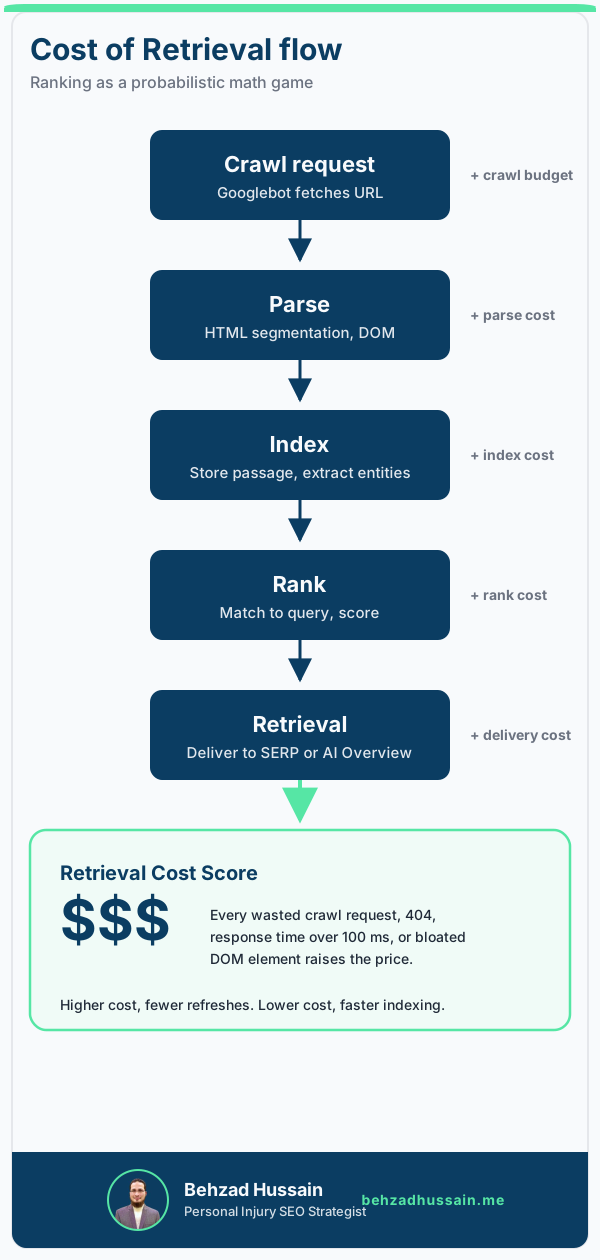
I call this the Cost of Retrieval frame. It is the load bearing idea behind the PI Organic Authority Engine, the four phase operating model I use with every client. A firm that carries 10,000 URLs and 500 quality nodes is paying rent on 9,500 pages that dilute the PageRank of the ones that matter. A firm that returns clean 200 status codes on 99 percent of crawler hits and holds response time under 100 milliseconds, the field target I hold every client site to, is a firm Google crawls and refreshes far more often. Two of Google’s own patents show how literally the index treats efficiency and duplication. The 2000 Detecting Query-Specific Duplicate Documents patent, US Patent 6,615,209, describes comparing only the query relevant portions of documents to catch near duplicates that whole page comparison misses. The 2004 Phrase-Based Indexing in an Information Retrieval System patent, US Patent 7,536,408, describes indexing documents by the phrases they use and the phrases that co-occur with them, not by single keywords. The math rewards firms that lower their retrieval cost and punishes firms that do not.
Why generic law firm SEO fails on personal injury queries
Generic law firm SEO fails on personal injury queries for four reasons that show up in almost every audit I run.
- Practice area pages that read like Wikipedia entries. No intake function above the fold, no jurisdictional specificity, no attorney byline that Google can bind to a Person entity.
- Location pages that are copies of each other with the city name swapped. Google’s own 2000 Detecting Query-Specific Duplicate Documents patent, US Patent 6,615,209, describes exactly this mechanic: when the portions of two pages that answer a query are near identical, Google treats them as query specific duplicates and filters all but one from the result set. The site cannibalizes itself.
- Backlinks that come from general marketing directories rather than local news, bar associations, and legal directories with topical proximity. The links do not carry the geographic or subject relevance the vertical needs.
- Zero coverage of the informational Query Path that precedes the commercial one. The firm shows up for “car accident lawyer Miami” and misses everything the claimant typed before.
I had a multi state PI firm come to me last year with 4,200 indexed URLs and 46 signed cases per quarter from organic. We consolidated to 780 quality nodes across three practice areas and four metros. Two quarters later the case count from organic was 118. The site did not need more content. It needed to stop being expensive to rank.
The PI Organic Authority Engine at a glance
The PI Organic Authority Engine is a four phase operating model that I built for personal injury firms. Each phase corresponds to a distinct mechanic in the search engine’s evaluation of the site, and each phase produces a measurable output that feeds the next.
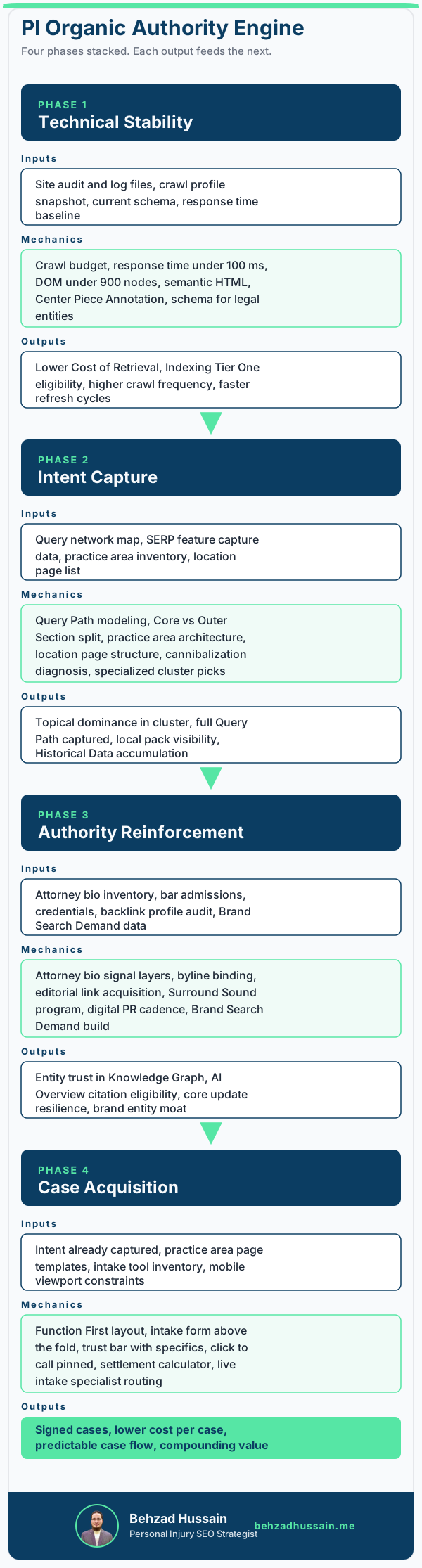
The four phases are listed below.
- Phase 1: Technical Stability. Reduce the site’s Cost of Retrieval so Google prioritizes it for indexing and refresh.
- Phase 2: Intent Capture. Map the firm’s practice areas and jurisdictions to the full Query Path that a claimant follows.
- Phase 3: Authority and Entity Reinforcement. Reinforce the attorneys and the firm as named entities across the Knowledge Graph.
- Phase 4: Case Acquisition Optimization. Make every ranked page a Function First page that satisfies the query with an actionable intake path.
This is the same four phase system my team executes inside the PI Authority Growth System, the monthly retainer for firms building a system rather than shopping for tactics. What follows is the phase by phase view.
The four phases in one image
The diagram above reads top to bottom. Each phase is a block. Inputs on top, mechanics in the middle, outputs on the bottom. Arrows show how the output of one phase feeds the input of the next. You do not skip phases. Skipping Phase 1 means every downstream investment sits on unstable infrastructure. Skipping Phase 3 means the intent you capture in Phase 2 never converts because the reader does not trust the firm’s attorneys.
The types of SEO a personal injury firm actually runs
There are 5 types of SEO a personal injury firm actually runs: On page SEO, Off page SEO, Technical SEO, Local SEO, and Generative Engine Optimization (GEO). Every serious PI firm runs a mix of all five, not one or two. SEO is not a single discipline; it is a family of five. The PI Organic Authority Engine is how I organize the execution across the five types. Covering all five is how Google’s ranker recognizes the breadth.
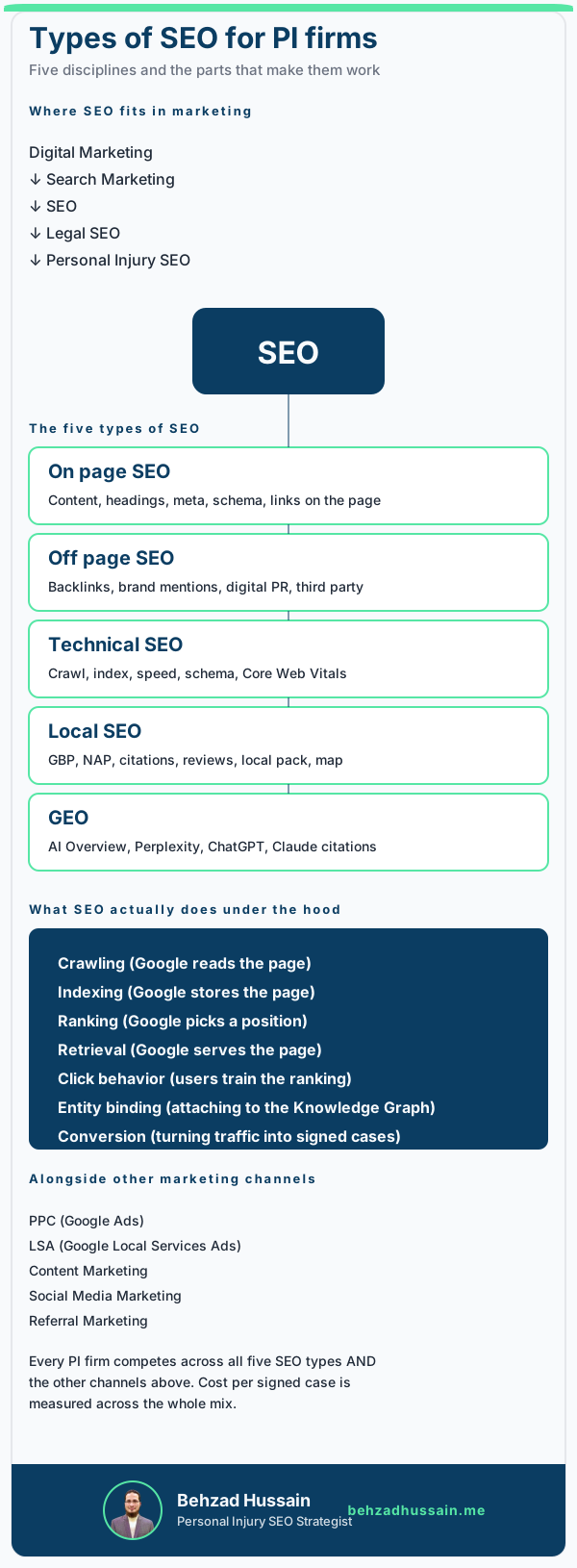
Underneath the types sits a shorter list of parts, the mechanics that compose SEO as a discipline. They cut across the types and appear inside every one. Each term below, and the rest of the vocabulary this guide uses, is defined in the personal injury SEO glossary.
- Crawling: Googlebot reaches and reads the pages.
- Indexing: Google decides to store the page inside the index.
- Ranking: the ranker assigns the page a position for a query.
- Retrieval: Crawler retrieves information from the pages.
- Click behavior: user signals calibrate the ranking over time.
- Entity binding: the page and its authors attach to Knowledge Graph entities.
- Conversion: the session becomes a signed case.
“You cannot pick and choose from this list. Every part of SEO shows up on every practice area page you publish,”
I tell every firm we onboard.
On page SEO for personal injury firms
On page SEO for personal injury firms is the discipline of shaping what lives on the page itself: the H1 and subheadings, the practice area copy, the attorney byline, the internal links to other Core Section pages, the meta title and description, the schema markup embedded in the HTML, and the semantic structure of the content. It is where the reader meets the firm and where Google reads the entity relationships.
On a PI site, on page SEO does the heavy lifting for two of the four PIOAE phases. It handles Intent Capture by making the practice area page semantically responsive to the query network. It contributes to Authority Reinforcement by carrying the attorney byline, the case results, and the disclaimers that establish E E A T.
The mistake I see most often is treating on page SEO as keyword insertion. It is not. It is entity architecture. Every fact you emit on the page teaches Google what the firm handles, where it handles it, and who is qualified to handle it.
Off page SEO for personal injury firms
Off page SEO for personal injury firms covers the signals produced away from the site: editorial backlinks from local news, legal directories like Avvo and Justia, community sponsorships that earn a mention on a school district page, guest commentary on a trial lawyer association blog, and third party review signals from Google, Avvo, and Yelp. These signals are the endorsement layer.
The link mix that matters for PI is local, topical, and editorial. A single link from a local NBC affiliate covering a verdict your firm won carries more ranking value than 40 general marketing directory listings. Brand mentions without a link still count because Google’s entity recognition binds the co occurrence.
Off page SEO drives Phase 3, Authority and Entity Reinforcement. It is also the compounding force behind Brand Search Demand. A well run off page program at year one is a moat by year three.
Technical SEO for personal injury firms
Technical SEO for personal injury firms controls whether Google can efficiently crawl, render, index, and rank the site at all. It covers crawl budget, response time, DOM size, semantic HTML, schema markup, XML sitemap health, canonical logic, redirect discipline, and mobile viewport handling. In a YMYL vertical, weak technical SEO caps everything else.
I have watched competitive PI firms lose organic case flow for months because their site’s response time drifted above 400 milliseconds after a plugin update. Technical SEO is the least visible layer to the firm owner and the most sensitive to neglect.
Technical SEO drives Phase 1 directly. It also carries mobile SEO. Google announced back in 2015 that more than half of its searches happen on mobile devices, and in personal injury the skew runs heavier because claimants search from accident scenes, emergency rooms, and hospital waiting rooms. The response time budget is tighter on a phone.
Local SEO for personal injury firms
Local SEO for personal injury firms controls whether the firm appears in the Google local pack, the map results, and the location aware blue link results. It covers Google Business Profile category selection, NAP consistency across citations, review acquisition and response, location pages on the site, and citation hygiene across the legal directories that reinforce geographic identity.
Local SEO is a distinct discipline from organic SEO because the ranking factors are different. Proximity to the searcher is the single largest driver. Whitespark’s 2026 Local Search Ranking Factors Report, published November 6, 2025, gives Google Business Profile signals 32 percent of local pack ranking weight, review signals 20 percent, on page signals 15 percent, behavioral signals 9 percent, link signals 8 percent, citation signals 6 percent, personalization 6 percent, and social signals 4 percent.
Local SEO drives geographic Intent Capture in Phase 2 and citation reinforcement in Phase 3. The dedicated local pack section later in this article goes deep on GBP mechanics.
Generative Engine Optimization (GEO) for personal injury firms
Generative Engine Optimization for personal injury firms is the emerging discipline of shaping content to be cited inside AI generated answers from Google AI Overviews, Perplexity, ChatGPT, and Claude. GEO is not a rebrand of SEO. It optimizes for a different output surface, uses different signals, and requires different content formats. The discipline has an academic anchor: the 2024 paper GEO: Generative Engine Optimization by Aggarwal and coauthors, presented at KDD 2024, coined the term and measured which content changes move citation likelihood inside AI generated answers. Quotations, statistics, and named source citations were among the strongest levers.
GEO cares about direct answer FAQ formatting, named author bylines bound to Person schema, clean subject verb object fact statements that extraction systems can digest, and entity binding via sameAs links to authoritative external sources like the state bar profile. Classical rank position does not predict AI Overview citation. In many personal injury queries, position 3 with no citation loses to position 12 with a citation.
GEO cuts across all four PIOAE phases. It is strongest inside Phase 3, where attorney entity signals feed AI Overview credibility, and inside Phase 4, where FAQ blocks are formatted for extraction.
How the types of SEO map to the PIOAE phases
The five types of SEO map into the PIOAE phases with primary and secondary overlaps. The table below is the reader’s cheat sheet.
| SEO Type | Primary PIOAE Phase | Secondary Overlap | Key Mechanic |
|---|---|---|---|
| Technical SEO | Phase 1: Technical Stability | Feeds every other phase | Reduces Cost of Retrieval |
| On page SEO | Phase 2: Intent Capture | Phase 3 for entity binding | Semantic responsiveness to the query |
| Off page SEO | Phase 3: Authority Reinforcement | Phase 2 for brand searches | Editorial links and brand mentions |
| Local SEO | Phase 2 (geo) | Phase 3 (citations) | Local pack ranking factors |
| GEO | Cuts across all four phases | Strongest in Phase 3 and Phase 4 | AI Overview citation eligibility |
The PIOAE phases are the operating model. The SEO types are the disciplines the ranker recognizes. You need both to compete in personal injury markets.
Phase 1: Technical stability and the Cost of Retrieval
Phase 1 makes the site cheap for Google to crawl, parse, and rank. Every PI firm I audit has technical debt that raises the Cost of Retrieval. Most of it is invisible in Google Search Console.
Four KPIs govern Phase 1: status code mix, response time, DOM size, and worth to index ratio. Each has a target value that separates efficient sites from expensive ones.
| Crawl Health KPI | Target Value | Why It Matters |
|---|---|---|
| Status code mix (crawler hits) | 99 percent 200 or 304 | Google reads the site as efficient; 304 lets Googlebot refresh from cache without a full request |
| Response time (average) | Under 100 ms | Correlates with crawl frequency; higher latency delays refresh and shifts the site into cheaper ranking algorithms |
| DOM size | Under 900 nodes (ideal under 700) | Reduces parser cost and speeds Center Piece Annotation detection |
| Worth to index ratio | 90 percent or higher | Every indexed URL should serve a query or a function; low ratio dilutes PageRank across noise |
Crawl budget and worth to index ratio
Crawl budget is the pool of requests Google will spend on your site in a given window. Worth to index ratio is the share of your indexed URLs that deserve to be indexed. A PI site with 10,000 URLs and 500 quality nodes has a worth to index ratio of 5 percent. Google reads that as noise. The remaining 9,500 URLs pull PageRank away from the pages that fund the firm. Google’s Site Quality Score patent, US Patent 9,031,929, granted in 2015 to inventors April Lehman and Navneet Panda, describes computing a quality score for a site as a whole rather than page by page. Every thin URL you keep is part of the number Google hangs on the entire domain.
Log file analysis exposes the cost. A clean profile shows 99 percent of crawler hits returning 200 or 304 status codes. Anything below 95 percent tells Google the site is expensive. Attachment pages, unfiltered UTM parameters, ancient blog archives from an acquired law firm, PDF versions of intake forms, thumbnail image URLs, session ID URLs. All of them are candidates for pruning or canonicalization.
Response time under 100 ms
Response time under 100 ms is my field target, not a number Google publishes. What Google’s crawl budget documentation does state is the direction: the crawl capacity limit rises when a site responds quickly and falls when it slows down or starts throwing server errors. The swing can be dramatic. I have watched a PI site that cut response time from 900 ms to 40 ms climb from roughly 400 crawl requests per day to tens of thousands. That expanded budget is what lets a large PI firm’s practice area updates propagate the same week they publish.
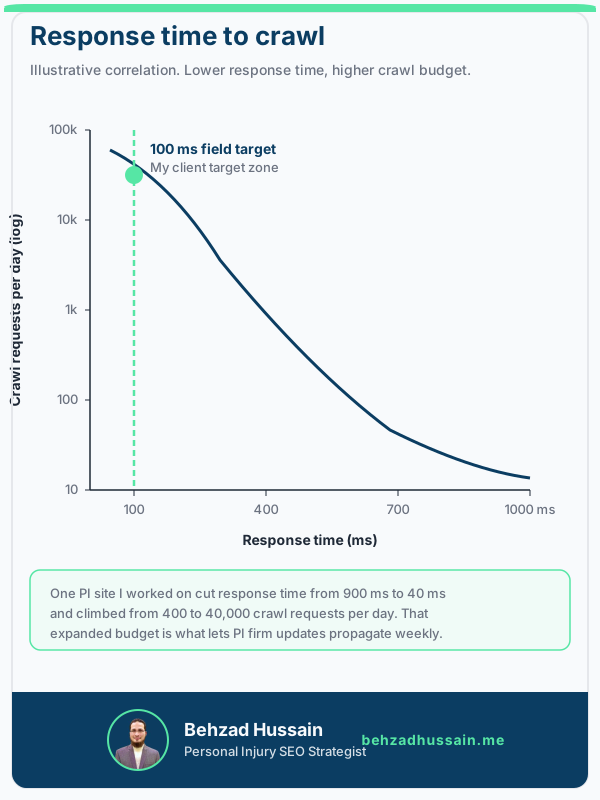
You get response time under 100 ms with edge caching, a CDN with a POP inside your primary metro, image compression at the pipeline layer, JavaScript lazy loading below the fold, and a lean HTML template. A PI firm serving Texas from a New York origin server is paying a latency tax that a Dallas or Houston POP resolves.
Semantic HTML and the Center Piece Annotation
Semantic HTML hands Google’s parser an unambiguous map of the page. The <main> tag marks the primary information zone, the <header> inside <main> marks the introduction, the <aside> marks supplementary material, and the <footer> marks citation and navigation. Google publishes no per tag ranking rule, but a parser that never has to guess which block answers the query resolves your page faster and cheaper. Every practice area page needs an H1 inside the <header> inside <main>, followed by the Center Piece Annotation, the largest and most prominent HTML component above the fold.
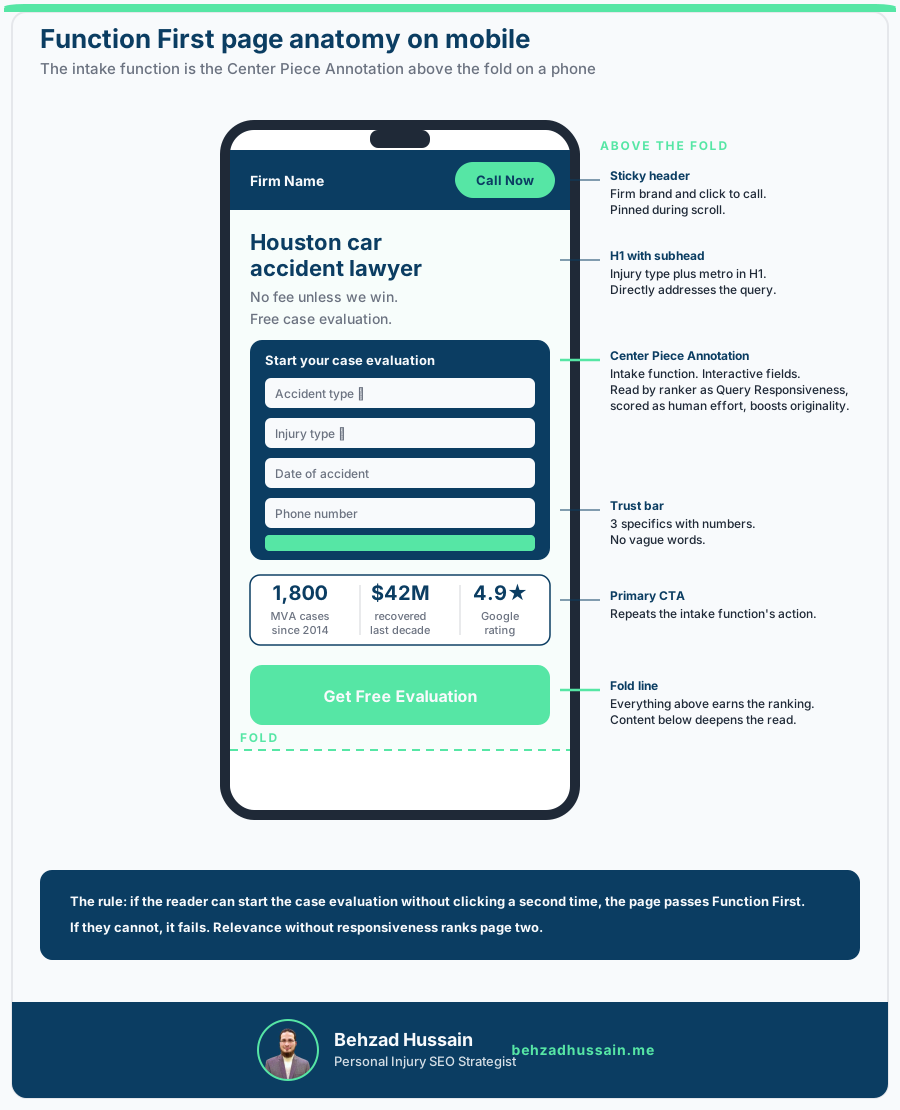
On a PI landing page, the Center Piece Annotation is the intake function. A free case evaluation form. A settlement calculator with a slider for accident type. A click to call button with a live intake specialist on the other end. That component tells Google the page is Query Responsive, not just topically relevant. I return to this in Phase 4 because it is the ranking and the conversion story at once.
Schema markup for legal entities
Schema markup for personal injury law firms helps Google resolve your firm and its attorneys as entities. Personal injury sites need at minimum LegalService for the firm, Person for each attorney, LocalBusiness for each office, FAQPage for practice area pages, and BreadcrumbList for the site structure. The Person schema for attorneys carries alumniOf, award, hasCredential, worksFor, and sameAs linking to the state bar profile. A named byline in the article author field bound to that Person schema is how AI Overviews and Google both verify who is speaking on a YMYL topic.
I run into firms with LegalService schema and no Person schema. That configuration puts the firm inside the Knowledge Graph but leaves the attorneys unbound. AI Overviews tend to cite named attorneys rather than firm brands, and in my client tracking, firms without Person schema get cited less often.
The gap is measurable, and I have published the measurements. In my audit of 1,005 Google page one personal injury law firm websites across all 50 US states, published on ResearchGate as Schema Markup Adoption in Top Ranking Personal Injury Law Firm Websites, 63.7 percent of ranking firms deploy some schema, yet only 35.3 percent use the LegalService type built for their industry, only 20.6 percent emit Person or Attorney schema for their lawyers, 57.2 percent omit areaServed entirely, and just 1.3 percent reach what the study scores as Level 4, Semantic Authority, where credentials, service areas, and entity identifiers connect into one graph. My earlier 500 firm study, published on SSRN as Schema Markup Adoption in Personal Injury Law Firm Websites, found that 77.8 percent of the firms that had schema at all shipped at least one validation error. Page one is not schema saturated. It is schema starved, and for a firm willing to do the entity work properly, that is an open lane.
The page below is the 1,005 site study itself, with the headline finding highlighted the way I would mark it on a printout. The frame carries the paper title, my name, and the numbers exactly as published, so you can check the claim against the source without leaving this page.

Phase 2: Intent capture across the query network
The best keyword strategy for personal injury SEO covers the full Query Path from informational to commercial for each injury type and jurisdiction the firm serves. Phase 2 of the PI Organic Authority Engine is how you map that path. Ranking for the commercial query is the last step. The firms that dominate the vertical are the ones whose site covers every stop the claimant walks before they type “car accident lawyer near me.”
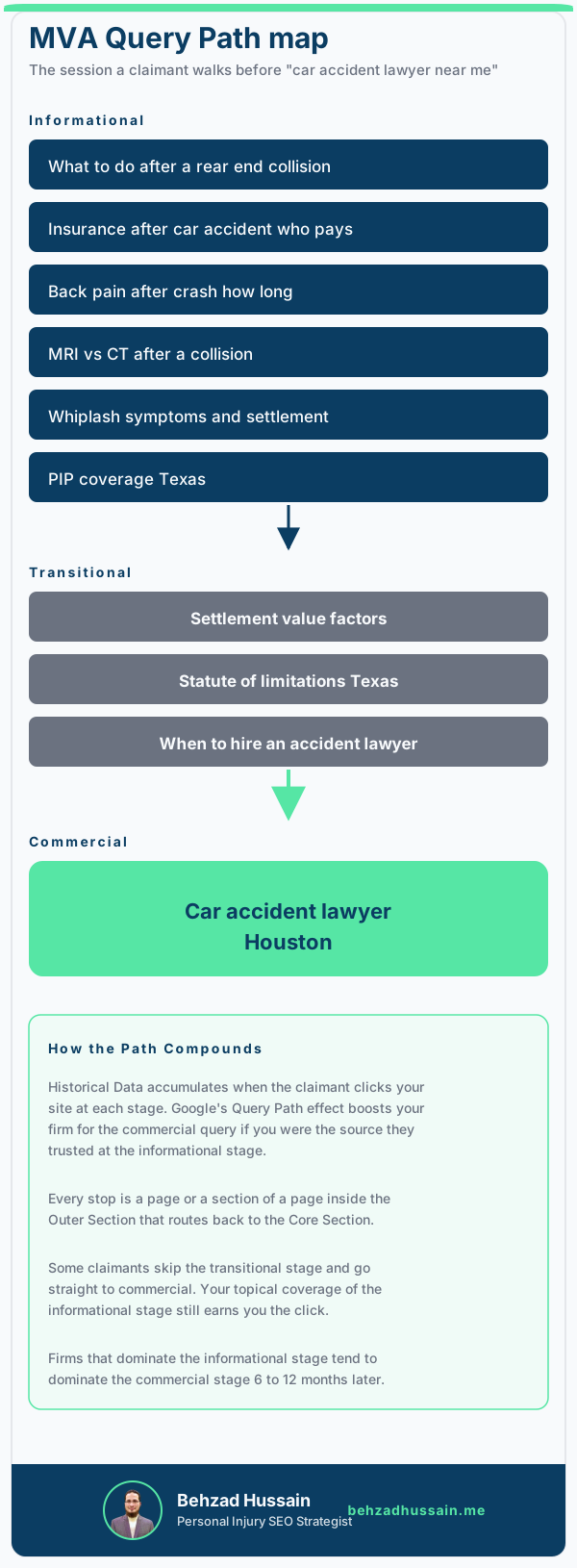
A claimant does not type “car accident lawyer Houston” as a first search. The session pattern I see across client Search Console and intake data starts with “what to do after a rear end collision,” moves to “insurance after car accident who pays,” passes through “back pain after crash how long,” and arrives at the commercial query at hour three or hour six. If your firm is not the source the claimant clicked at hour one, the odds of ranking for the hour six query drop.
“Every article in the topical map should serve a bridge back to the Core Section. If the informational content does not eventually route to a practice area or an attorney, it should not be published,”
I said on our last strategy call with a Florida MVA firm.
Core Section and Outer Section on a PI site
The Core Section of a PI site holds the pages that convert. Practice area pages, location pages, attorney bios, case results, contact forms. The Outer Section holds the informational articles that build the topical map. Recovery guides, insurance explainers, statute of limitations references, case value expectations.
| Attribute | Core Section | Outer Section |
|---|---|---|
| Purpose | Signed cases | Topical authority and Query Path capture |
| Intent class | Commercial and transactional | Informational and comparative |
| Page type | Practice area, location, bio, case result | Blog article, guide, resource |
| URL pattern | /car accident lawyer, /houston car accident lawyer | /learn/back pain after accident |
| Above the fold requirement | Intake function | Direct answer to the query |
| Internal linking | Receives from Outer Section | Links to Core Section |
The Outer Section is not a blog. It is a routing layer. Every article carries a link back to the practice area that satisfies the commercial intent behind the informational read.
Query Path modeling for one injury type
Query Path modeling for one injury type means writing out the full session a claimant walks before they type the commercial query. Start with the incident. Move to the injury. Add the insurance question. Add the settlement question. Add the lawyer selection question. Each step is a page or a section of a page. Each step earns Historical Data if it is the source the claimant clicked.
I built one for a Texas MVA firm last quarter across 34 nodes. The informational stops covered rear end collision, T bone, side swipe, hit and run, uninsured motorist, PIP coverage, PPO vs HMO after a crash, back pain, neck pain, whiplash symptoms, MRI vs CT after a collision, settlement value factors, medical lien resolution, and the local jurisdiction’s small claims and district court thresholds. All of it fed into three practice area hubs and 11 city pages. Two quarters later the firm was on page one for 26 of the 34 informational nodes and had lifted MVA case count from 22 per month to 61.
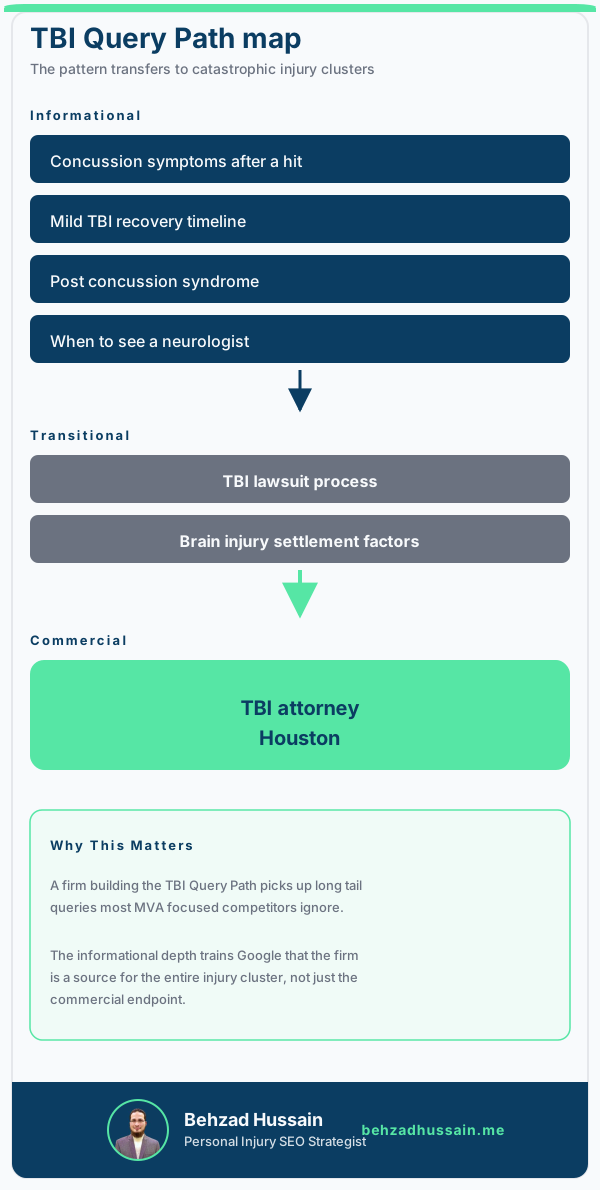
The pattern transfers to catastrophic injury clusters. A traumatic brain injury Query Path starts with the incident (fall from height, motor vehicle collision, sports concussion), moves to symptom searches (concussion symptoms after a hit, headache after a car accident, cognitive symptoms after a fall), passes through diagnosis and recovery searches (mild TBI recovery timeline, post concussion syndrome, when to see a neurologist), moves to litigation searches (TBI lawsuit process, brain injury settlement factors, expert witness for TBI cases), and lands on the commercial query (TBI attorney in [metro]). A firm building the TBI Query Path picks up long tail queries most MVA focused competitors ignore, and the informational depth trains Google that the firm is a source for the entire injury cluster.
Specialized clusters PI firms build around
Specialized clusters are the topical territories PI firms carve out when they want to dominate a subset of the market rather than spread thin across every accident type. Each cluster corresponds to a distinct Query Path branch. Firms that pick a cluster and go deep tend to outrank general PI competitors inside that cluster within 9 to 15 months.
| Specialized Cluster | Example Firm Entity | Primary Query Path Branch |
|---|---|---|
| Catastrophic injury | Statewide Catastrophic Injury Platform | TBI, spinal cord, amputation, burn, wrongful death queries |
| Commercial trucking | Trucking Authority Hub | FMCSA rules, hours of service, black box data, carrier liability queries |
| Mass tort and MDL | Mass Tort Lead Portal | Defective drug, defective device, class action, MDL bellwether queries |
| Medical malpractice with lien resolution | Medical Malpractice Firm with Lien Practice | Hospital lien, ERISA subrogation, Medicaid Medicare offset queries |
| Multilingual PI service | Bilingual Injury Platform | Spanish, Vietnamese, Portuguese, Mandarin, Creole PI queries |
| Community safety and digital PR | PI Safety Data and Research Center | Local crash data, dangerous intersection reports, pedestrian safety citations |
| Attorney to attorney referral | Referral Focused Trial Firm | Co counsel, national verdict archive, complex injury referral queries |
| Litigation stage content | Trial focused PI firm | Deposition prep, mediation guide, trial calendar, MSJ queries |
| Multi office regional dominance | Regional Multi Office PI Program | Coordinated Houston, Dallas, San Antonio, Austin queries |
| Verdict and settlement authority | PI firm with 20 plus reported results | Named case results, verdict archive, settlement range queries |
The best PI marketing directors I work with pick two clusters at most, not five. A firm that tries to own catastrophic injury and trucking and mass tort and multilingual all at once produces four thin coverage areas rather than two dominant ones. I had a firm come to me last year insisting on covering six clusters at retainer entry. We cut it to two, built dominance in catastrophic injury and trucking over 14 months, and revisited the other four in year two once the first two were compounding.
Choose your cluster based on three inputs: the case value your firm can service (catastrophic and mass tort carry higher case values), the language demographics your metro serves (multilingual carries lower CPCs and higher intent conversion), and the referral network your firm already has (attorney to attorney referral clusters require existing relationships, not new content alone).
How to prevent cannibalization on a PI site
Cannibalization on a PI site is the ranking signal dilution that happens when two pages compete for the same canonical intent. A firm with /houston-car-accident-lawyer and /car-accident-attorney-houston-tx is asking Google to split ranking signal across two documents that satisfy the same intent. Google’s segmentation model shares the rank power rather than picking one, and both pages sit at position 8 forever.
This is not an SEO superstition. The duplicate detection patent cited in Phase 1, US Patent 6,615,209, is shown below from the public USPTO record on Google Patents, with the operating sentence highlighted: Google compares the query relevant portions of documents, not whole pages, which is exactly why two location pages with the city name swapped collapse into one ranking slot. The frame shows the filing by Google and the patent number so the attribution is checkable at a glance.

Diagnose it in six steps.
- Export the top 50 queries from Google Search Console for the target cluster.
- Sort by query, then by landing page. Any query with more than one landing page is a candidate.
- Check the URL patterns for city, injury type, and page type overlap.
- Pick the stronger of the two pages using traffic, backlinks, and internal link count as the tiebreaker.
- Merge the weaker into the stronger with a 301 redirect. Do not delete the weaker page; the redirect preserves link equity.
- Re export in 60 days and confirm the merged URL absorbed the ranking of both original pages.
Most PI firms I audit have between 8 and 18 cannibalization incidents active at any moment. Cleaning them is often the single fastest source of ranking movement in the first 90 days.
Phase 3: Authority and entity reinforcement
Phase 3 reinforces the attorneys and the firm as named entities inside the Knowledge Graph. Structured data is what makes that entity work readable to the ranker, which is the mechanism behind how schema markup builds topical authority. Google does not rank strings. That has been Google’s stated direction since Amit Singhal introduced the Knowledge Graph in May 2012 under the banner “things, not strings.” Google ranks entities and the relationships between them, expressed as triples in the form Subject Predicate Object. “Firm X handles wrongful death cases in Harris County” is a triple. “Attorney Y is board certified in personal injury trial law by the Texas Board of Legal Specialization” is a triple. Every triple on your site either reinforces or contradicts the record Google is building on the entity.
Google’s 2019 Identifying Entity Attribute Relations patent, US Patent 11,263,400, describes how Google decides whether an entity and an attribute mentioned in ordinary sentences stand in a true relationship. The clearer your attorney bios, case results, and practice area pages state the underlying facts (who each attorney is, what they practice, where they practice, what results they have won), the more accurately the ranker binds your firm to the right queries.
Attorney bios that pass the E E A T filter
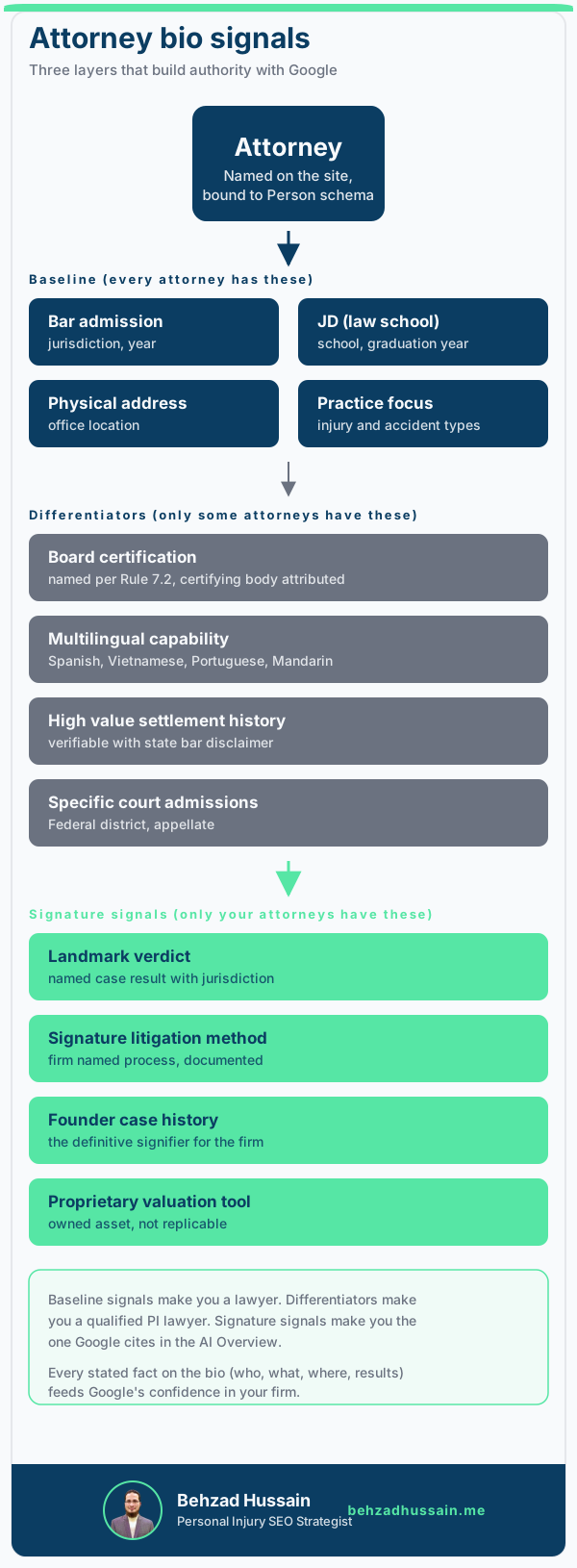
Attorney bios that pass the E E A T filter carry six components at minimum. Bar admission with jurisdiction and admission year. Law school with graduation year. Undergraduate with graduation year. Practice focus with named injury and accident types. Case results with disclaimers required by the applicable state bar. Bar association memberships and any board certifications.
The bio should read as declarative fact statements, not as a resume. “Attorney Y practices personal injury and wrongful death law in Texas. Attorney Y is admitted to the State Bar of Texas (2007) and the US District Court for the Southern District of Texas (2010). Attorney Y is board certified in personal injury trial law by the Texas Board of Legal Specialization (2015).” Each sentence is one fact. Each fact is easy for Google’s fact extraction systems to read and store.
Named authorship on articles feeds the same signal. Every practice area page should carry an author byline bound to the attorney’s Person schema. AI Overviews and Google both weigh who authored the content as a credibility signal, and Google’s Search Quality Rater Guidelines have instructed raters for years to establish who created a YMYL page and whether that person is qualified to speak on it. Team bylines that read “written by the team at the firm” do not carry the same weight. The idea has a patent trail: Google’s Agent Rank patent, US Patent 7,565,358, granted in 2009, describes ranking content by the reputation of the agent who signs it. An attorney byline bound to a Person entity is the legal vertical’s version of that signature.
The Agent Rank record is below, from the public USPTO record on Google Patents, with the scoring clause highlighted. The frame shows the inventors, the current assignee Google LLC, and the grant date, so the attribution is verifiable before you restructure a single bio page.

The scorecard I use with clients scores each attorney bio against the six E E A T components. A bio that scores below 4 out of 6 is a bio the firm should rewrite before it publishes another practice area page carrying that byline.
| E E A T Component | Pass Criteria | Fail Criteria | Signal Impact |
|---|---|---|---|
| Bar admission | Named jurisdiction and admission year present | Missing jurisdiction or year | Verifiable qualification, feeds Person schema |
| Education | JD school and year; undergraduate school and year | Missing years or schools | Establishes formal expertise |
| Practice focus | Named injury and accident types with jurisdiction limits | Vague “personal injury” descriptor only | Feeds practice area entity binding |
| Case results | Named verdicts or settlements with state bar required disclaimer | Case results without disclaimer, or numbers without context | Signals experience; violates rules if disclaimer missing |
| Board certifications | Certifying organization named per ABA Model Rule 7.2 | Certification claim without certifying body name | Meets specialty claim rules |
| Bar and professional memberships | State bar, county bar, specialty association named | Empty or generic | Feeds Surround Sound and entity trust |
Editorial backlinks and the Surround Sound loop
Editorial backlinks and the Surround Sound loop reinforce the firm’s entity by pairing your brand name with the topics you handle across independent sources. Local news coverage of a verdict your firm won. A podcast appearance where the host mentions your firm by name alongside the injury type. A bar association profile citing your firm as pro bono coordinator. Each mention trains Google’s entity phrase association model to favor your firm when a claimant searches the topic in your metro.
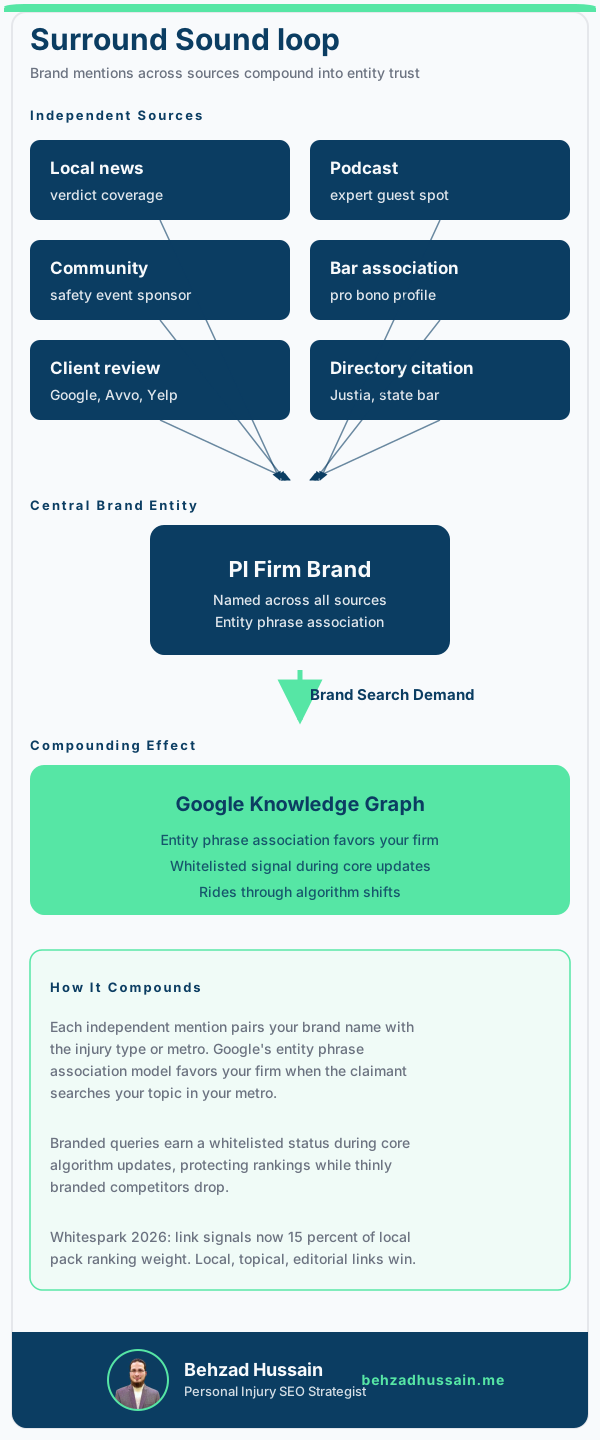
The compounding lever is Brand Search Demand. When a claimant reads about your firm in a local news story and later types your firm name plus “car accident lawyer” into Google, that branded query is demand Google can measure directly. I cannot point you to a documented mechanism, but the pattern across every core update I have tracked is consistent: firms with high Brand Search Demand ride out core updates that punish thinly branded competitors.
Whitespark’s 2026 Local Search Ranking Factors Report, its annual poll of 47 local SEO experts, puts link signals at 24 percent of local organic ranking weight, second only to on page signals at 33 percent. Inside the map pack itself the link share is smaller at 8 percent, but the organic blue link results below the map are where editorial links do their compounding work. The link mix that matters is local, topical, and editorial. A PI firm sponsoring the local high school football team gets a link with geographic and community relevance. A firm quoted by the local NBC affiliate on distracted driving statistics gets a link with subject matter authority. Both compound.
Running this Surround Sound program month after month is what the PI Authority Growth System delivers on a monthly retainer. You bring the case load; my team runs the entity work, the digital PR cadence, and the byline hygiene that compound your Brand Search Demand.
Phase 4: Case acquisition and Function First design
Phase 4 makes every ranked page a Function First page. A page is Function First when the largest and most prominent HTML component above the fold is the intake function, not decorative content. The ranker reads that component as evidence of Query Responsiveness, which is a distinct signal from Query Relevance.
Relevance is telling the reader how to file a claim. Responsiveness is providing the function to file it. In high intent PI markets, relevance without responsiveness ranks page two. Responsiveness is the on-page half of how a firm gets personal injury leads and signed cases; intake capacity is the other half.
“Every practice area page competes on responsiveness now,”
I tell every firm when we design their intake flow.
The page anatomy is simple. Hero with H1 and one sentence subhead. Intake function immediately below. Trust bar with three to five specifics (year founded, verdict amount, cases handled, jurisdictions). Click to call button pinned. Then the informational depth. On mobile, all of that lives above the fold on a 6.1 inch screen. That constraint is not a limitation; it is the whole design.
A client of mine, a mid size Ontario PI firm, had a beautiful 1,800 word practice area page with the intake form buried at 60 percent scroll depth. We moved the intake to the top and shortened the page to 900 words. Signed cases from the page rose from three per month to nine per month within the quarter. Same content, different Center Piece.
The Center Piece Annotation as an intake function
The Center Piece Annotation as an intake function is the concrete way Phase 4 reads to Google. The intake function has to be interactive, not a link that navigates to another page. A form with named fields (accident type, injury type, jurisdiction, date). A slider (severity 1 to 10). A dropdown (defendant type). Each interactive input is concrete evidence of effort, and Google’s Search Quality Rater Guidelines treat effort and originality as core Page Quality considerations.
The rule is a short one. If the reader can start the case evaluation without clicking a second time, the page passes Function First. If they cannot, it fails.
Trust bar, calculators, click to call
Trust bar, calculators, and click to call are the three levers that separate Function First pages from ordinary practice area pages. Each carries a specific job.
- Trust bar sits under the intake function. Three to five specifics with numbers. Not vague words. “Handled 1,800 MVA cases since 2014. Recovered $42 million in the last decade. Serving Harris County, Fort Bend County, and Brazoria County.”
- Settlement calculator or case value estimator. Slider inputs. Non binding disclaimer language reviewed by the state bar. The interactive element itself is the value; the number displayed is a courtesy.
- Click to call pinned to the header and repeated inside the intake function. Numbers routed to a live intake specialist, not a voicemail. Mobile response time under one ring is the standard I hold clients to.
The local pack layer: Google Business Profile mechanics
The local pack layer, driven by the Google Business Profile, controls which three firms appear on the map for a metro level PI query. The 2026 Whitespark Local Search Ranking Factors Report attributes 32 percent of local pack ranking weight to GBP signals, 20 percent to reviews, 15 percent to on page signals, 9 percent to behavioral signals, 8 percent to links, 6 percent to citations, 6 percent to personalization, and 4 percent to social signals. Whitespark also scored AI search visibility as a formal category in 2026 for the first time in the survey’s history, and the weights shift there: on page signals lead at 24 percent, reviews hold 16 percent, and GBP signals drop to 12 percent. The local pack game and the AI citation game are related but not identical for personal injury queries. GBP is the largest single lever a PI firm has for the local pack, and the same profile work feeds AI visibility as a secondary return.
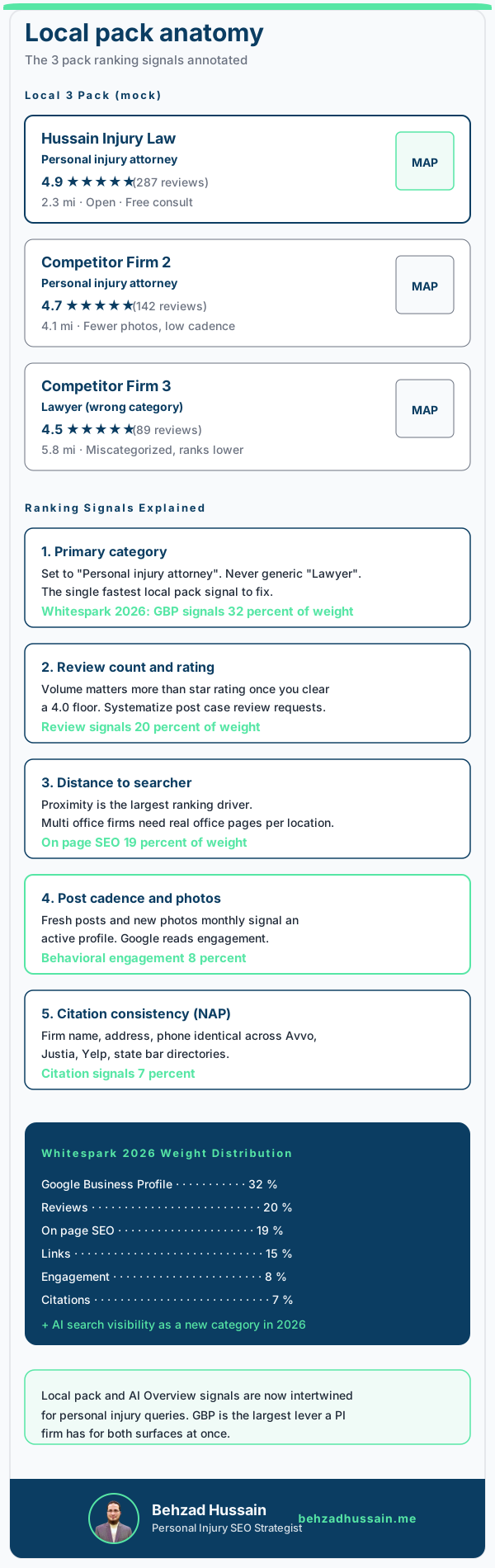
One firm I audited had “Lawyer” as their primary GBP category and “Personal injury attorney” as a secondary category. That single misordering was worth roughly six positions in the local pack for MVA queries in their metro. The fix took 90 seconds. Case count from GBP calls doubled inside four weeks.
GBP category, review acquisition, and post cadence
GBP category, review acquisition, and post cadence are the three levers that most reliably move a PI firm inside the local pack. Category selection is the ceiling. Review acquisition is the momentum. Post cadence is the freshness signal. Reviews carry a patent trail of their own: Google’s Methods and Systems for Endorsing Local Search Results patent, US Patent 7,827,176, filed in 2004 and granted in 2010, describes ranking local results using user endorsements, which is the mechanical reason review velocity moves the map.
| Lever | Signal Weight | Action to Take |
|---|---|---|
| Primary category | Highest controllable weight | Set to “Personal injury attorney.” Never “Lawyer” or “Law firm” for a PI focused practice |
| Secondary categories | Medium weight | Add the specific practice categories that apply: “Trial attorney,” “Legal services.” Cap at 4 to 5 |
| Review count | High weight | Systematize post case review requests. Aim for 8 to 15 new reviews per month depending on case volume |
| Review response rate | Medium weight | Reply to 100 percent of reviews. Public reply is a signal |
| Photos | Medium weight | Refresh at least 6 photos per quarter. Team, office, courthouse, community |
| Posts | Medium weight | Post 4 to 8 times per month. News, community, verdicts within bar compliance |
| Service list | Medium weight | Populate with specific practice areas. Each service tags a semantic signal |
| Q and A | Low weight but under used | Seed with 5 to 8 real questions and answer them in the firm voice |
Personal injury SEO by state and metro
The ranking mechanics in this guide hold everywhere. What changes by market is the depth of the competitor bench, the CPC floor that sets the cost of every alternative channel, and the state bar advertising rules your pages have to satisfy. These guides carry the market level detail this article treats generically.
By state
AI Overview and GEO for personal injury queries
AI Overview and GEO reshape where visibility on a personal injury query actually lives. When Google surfaces an AI generated answer above the blue links, a firm’s classical rank position stops predicting traffic. What predicts traffic is whether the firm is cited inside the AI Overview panel. The machinery is filed at the patent office: Google’s Generative Summaries for Search Results patent, US Patent 11,900,068, granted February 13, 2024, describes generating the answer with a language model and attaching links to the sources it drew from. Generative Engine Optimization is the discipline of shaping content to be cited inside those panels, and by adjacent AI search products like Perplexity, ChatGPT, and Claude.
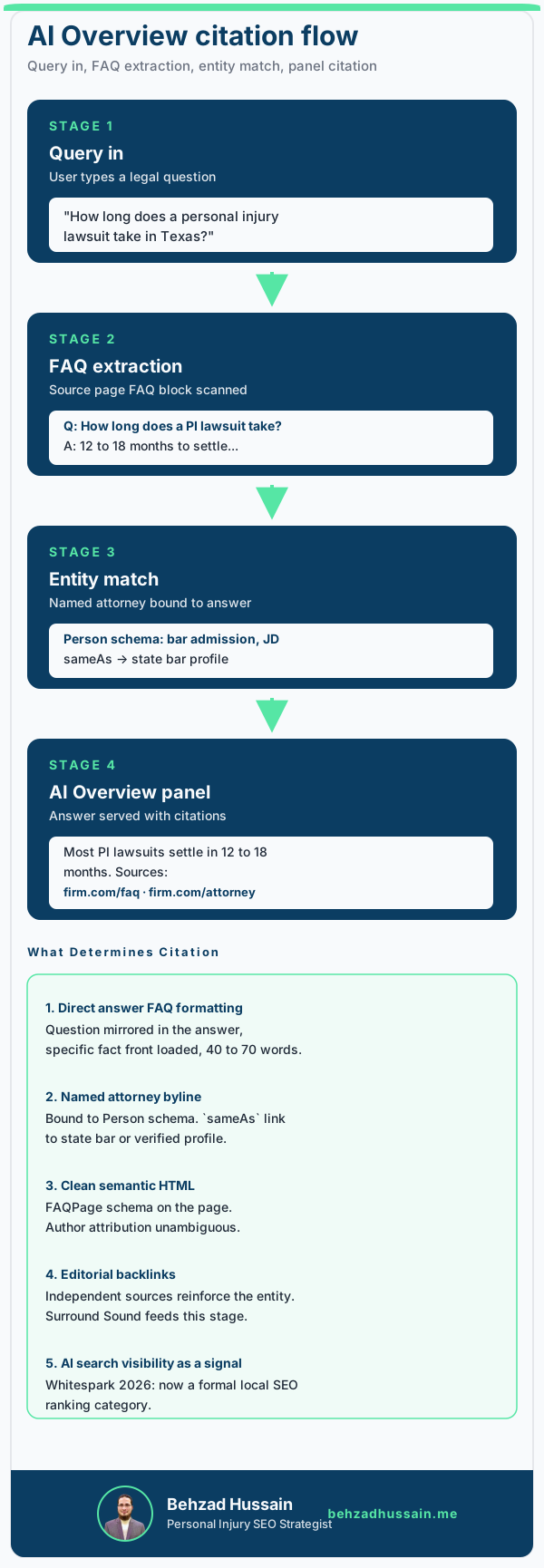
The generative summary patent named above is below, from the public USPTO record on Google Patents, with the operative sentence highlighted. The frame shows the assignment to Google LLC and the February 13, 2024 grant, so the claim that AI Overviews run on filed, inspectable machinery is one you can check yourself.

Semrush’s 2026 study “AI Overviews are expanding across commercial intent search” tracked more than 600,000 keywords from November 2025 to April 2026 and found the share of commercial SERPs with an AI Overview grew 71 percent during that period, while the share of transactional SERPs with one fell 5 percent. Google is absorbing the research phase of the journey and leaving the action phase to the blue links. Personal injury queries live overwhelmingly in that research phase: the symptom searches, the insurance questions, the settlement expectations a claimant walks through before choosing a lawyer.
“AI Overview citation is the new page one,”
I tell clients now. Position 3 with no citation loses to position 12 with one.
Why legal questions feed AI Overviews so readily
Legal queries feed AI Overviews so readily because the reader question format matches what the model is built to answer. “How long does a personal injury case take” is a natural FAQ question with a direct answer. “What is the statute of limitations for a car accident in Texas” is a fact retrieval question that maps to a knowledge citation. The ranker prefers to hand these to an AI Overview rather than force the reader through a long blue link result.
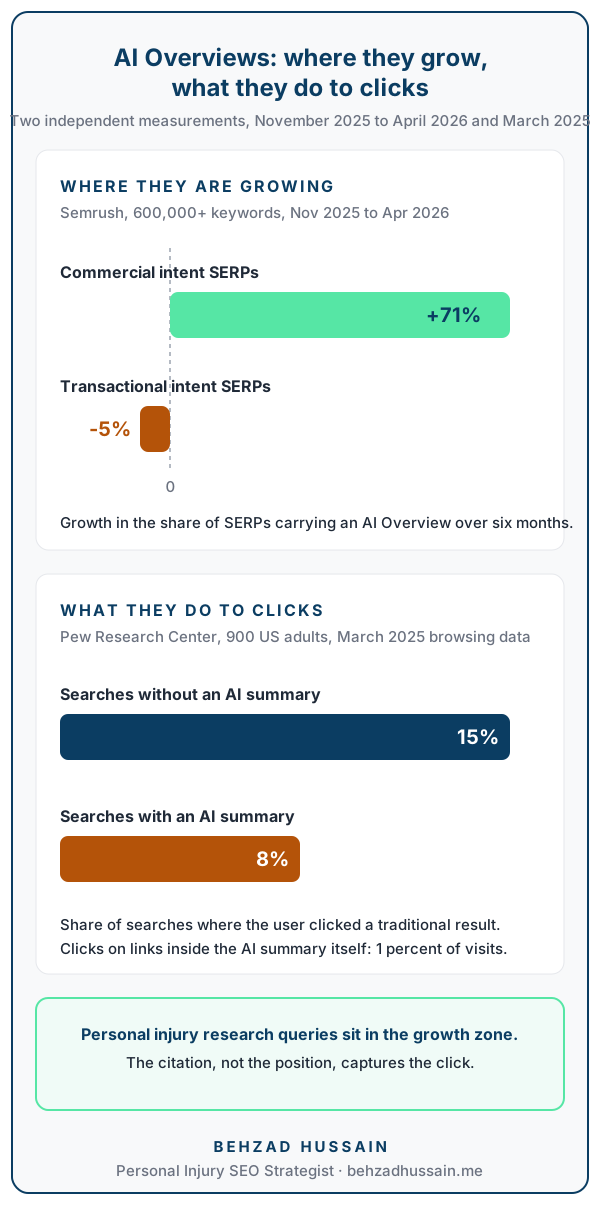
Pew Research Center measured the click behavior directly from the March 2025 browsing data of 900 US adults: users clicked a traditional result on 8 percent of searches that carried an AI summary, against 15 percent of searches without one. That means the traffic you used to earn at position 1 for a “how long does a personal injury case take” query now flows to whichever firm the AI Overview quotes. If the AI Overview quotes three firms in the answer and links two of them, those two firms capture the click. Everyone else disappears.
The Pew finding is below as published, with the 8 percent sentence highlighted and Pew’s own chart of the full click data in the same frame, including the 1 percent rate for links inside the summary itself. This is the study the whole AI Overview strategy conversation should start from.

Formatting FAQ blocks for citation
Formatting FAQ blocks for citation is a specific skill. The direct answer should come in the first sentence, matching the question language, front loading the concrete number or fact. The follow up sentence adds the qualifier. A named author byline sits at the top of the article and is bound to the FAQPage schema author field.
- Match the question language in the first sentence of the answer.
- Front load the specific number or fact.
- Keep the answer between 40 and 70 words. Long answers get truncated.
- Bind the FAQPage schema to a named attorney via the author field.
- Add a
sameAslink on the attorney Person schema pointing to their state bar profile. - Publish a canonical URL for the FAQ. Do not duplicate it across a practice area page and a blog article.
The firms that fail this test are the firms whose FAQ answers open with “Personal injury cases vary widely.” The answer runs 300 words without a single concrete number. AI Overview extracts nothing.
For firms already publishing at cadence, the PI Authority Growth System bakes AI Overview readiness into every article, FAQ block, and attorney byline as they publish, so citation eligibility is a design constraint, not a rewrite project.
What personal injury SEO costs in 2026
Personal injury SEO in 2026 costs between $3,500 per month for a single office solo practice and $25,000 per month for a metro competitive multi office firm. Most firms with a viable growth path fall between $6,000 and $15,000 per month. The number is not arbitrary; it is a function of how much technical work the site needs, how much content the topical map calls for, and how competitive the metros are.
Monthly retainer ranges by firm size and metro
Monthly retainer ranges by firm size and metro cluster in three tiers.
| Firm Profile | Metro Tier | Monthly Retainer Range |
|---|---|---|
| Solo, 1 office, single practice area focus | Tier 3 (secondary city, low PI density) | $3,500 to $5,500 |
| Small firm, 2 to 5 attorneys, 1 to 2 offices | Tier 2 (mid market metro) | $5,500 to $9,000 |
| Mid size firm, 6 to 15 attorneys, 2 to 4 offices | Tier 1 (Houston, Dallas, Atlanta, Miami, Chicago) | $8,000 to $15,000 |
| Large firm, 15+ attorneys, statewide or regional | Tier 1 or Tier 0 (NYC, LA) | $12,000 to $25,000 |
Tier 0 markets carry both the highest CPCs in the country and the deepest competitor benches. A New York City PI firm is competing with entrenched firms that have been running SEO for 10 to 15 years and hold hundreds of referring domains each. The retainer at the top of the range reflects the real cost of moving the needle.
Cost per signed case, worked example
Cost per signed case in a Houston MVA cluster illustrates why the retainer alone is the wrong number to evaluate.
| Channel | Cost per Lead (Houston MVA) | Signed Case Ratio | Cost per Signed Case | Ramp Time |
|---|---|---|---|---|
| SEO (steady state, year 2 onward) | $220 to $380 | 18 to 25 percent | $900 to $2,100 | 8 to 14 months to steady state |
| PPC (Google Ads) | $180 to $310 | 8 to 14 percent | $1,300 to $3,900 | Immediate |
| LSA (Google Local Services Ads) | $85 to $180 | 12 to 20 percent | $500 to $1,500 | 2 to 6 weeks |
The numbers are directional and depend on the firm’s intake conversion rate, but the shape holds across most Tier 1 metros I have worked in. SEO is the highest lifetime value channel because the retainer stops moving once the site is established, and every signed case after that runs at a marginal cost close to zero. LSA sits between SEO and PPC on both cost and control. PPC is a rent, not an asset, and what personal injury attorney advertising actually costs is worked through channel by channel alongside this comparison.
A Texas MVA firm I audited was spending $9,200 per month on SEO with no cost per signed case attribution loop. The firm believed SEO was breaking even. When we pulled the CRM data, organic sourced retainers had generated $780,000 in fee revenue over the prior 12 months. That was a 7 to 1 return on the annual retainer. The firm was winning and did not know it because nobody was doing the math.
How long personal injury SEO takes
Personal injury SEO takes 60 to 90 days for local pack movement, 6 to 12 months for organic signed cases, and 12 to 24 months for compounding growth. The timeline is not universal; it depends on the domain age, the referring domain count, the metro competitiveness, and the publication cadence.
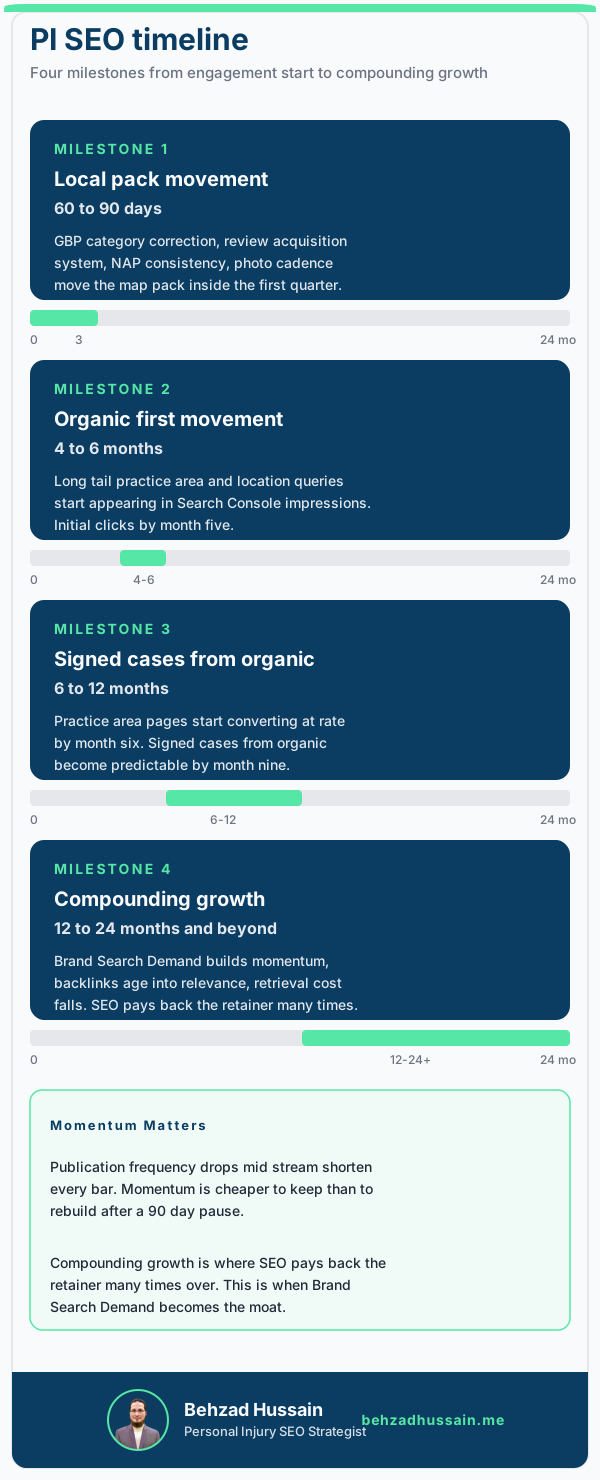
Local pack 60 to 90 days. Organic 6 to 12 months. Compounding beyond 12.
The milestone bars break as follows.
- Local pack, 60 to 90 days. GBP category correction, review acquisition system, NAP consistency, and photo cadence typically move the map pack inside the first quarter.
- Organic first movement, 4 to 6 months. Long tail practice area and location queries start appearing in Google Search Console impressions in month four, with initial clicks by month five.
- Organic signed cases, 6 to 12 months. Practice area pages start converting at rate by month six for a firm publishing 2 to 4 pieces of quality content per month. Signed cases from organic become predictable by month nine.
- Compounding growth, beyond 12 months. Brand Search Demand builds momentum, backlinks age into relevance, and the site’s Cost of Retrieval falls as Google refreshes it more often. The 12 to 24 month window is where SEO pays back the retainer many times over.
What happens if publication frequency drops mid stream
Publication frequency drops mid stream cause momentum decay, not a plateau. Google’s ranker treats publication frequency as a signal of how much crawl budget to allocate to the site. When the firm stops publishing at month 8 to catch up on billable hours, the site’s crawl frequency falls within four to six weeks. Rankings decay in the following quarter.
I have watched three PI firms in the last two years lose 40 to 55 percent of their organic case flow because publication paused for a single quarter. Each of them recovered inside 90 days once the cadence returned, but the recovery cost more than the pause saved. Momentum is cheaper to keep than to rebuild.
Bar compliance guardrails for personal injury SEO
Bar compliance guardrails for personal injury SEO exist because attorney advertising is regulated by state bars and by the ABA Model Rules, and the platforms Google indexes are considered advertising communications. The regulation sits on a constitutional floor: Bates v. State Bar of Arizona, 433 U.S. 350, decided in 1977, established truthful attorney advertising as protected commercial speech, which is why the rules constrain how you advertise rather than whether you may. Every state I work in treats a firm website as attorney advertising subject to the state’s Rules of Professional Conduct 7.1 through 7.6, which mirror the American Bar Association Model Rule 7.1 on Communications Concerning a Lawyer’s Services and Model Rule 7.2 on Communications: Specific Rules.
I had a firm come to me after a Texas Advertising Review Committee notice because a testimonial video on their homepage lacked the required disclaimer. The fix was straightforward, but the notice cost them two weeks of legal review before the site could resume normal publishing. Compliance is cheaper as a design constraint than as a remediation.
Advertising rule patterns across TX, CA, NY, FL
Advertising rule patterns across TX, CA, NY, and FL vary but share the same three concerns: false or misleading communications, testimonial handling, and disclosure of a responsible attorney.
| State | Primary Rule Reference | Testimonial Constraint | Disclaimer Requirement | Filing Requirement |
|---|---|---|---|---|
| Texas | Texas Disciplinary Rules 7.01 and 7.02 | Testimonials governed by Rule 7.01’s false and misleading standard | Rule 7.02 requires advertisements to publish the name of the responsible lawyer and the primary practice location | Rule 7.04: advertisements filed with the Advertising Review Committee within 10 days of dissemination |
| California | Rules of Professional Conduct Chapter 7, Rules 7.1 through 7.5 | Testimonials must not be false or misleading; comparison and endorsement restrictions | Communications must be truthful, not misleading | No prior filing; one year ad retention under Business and Professions Code 6159.1 |
| New York | Rules of Professional Conduct Rule 7.1 (22 NYCRR 1200.7.1) | Restrictions on comparison, endorsement, and past results | “Attorney Advertising” label on all covered communications; name, principal office address, phone required | Retention of copies for 3 years (1 year for computer accessed communications) |
| Florida | Florida Bar Rule 4-7.13 | Testimonials permitted only if they meet specific representativeness and consent criteria; no fabrication or compensation | Prohibits guarantees of results and misleading identity representations; requires clear and conspicuous display | Prior review available; some categories require filing |
The consistent threads are truthfulness, no result guarantees, testimonial specificity, and a named responsible attorney. Compliance is design, not damage control. If you build compliance into your intake page templates from day one, every downstream publishing decision inherits the guardrail.
How to evaluate a personal injury SEO partner
You should hire an SEO agency when your firm needs execution capacity and does not have internal marketing headcount. You should hire a fractional strategist when you already have execution and need senior direction over the top. How you evaluate either option comes down to whether the partner can articulate what they will do at each phase and how they will measure signed cases at the end. Ninety percent of the pitches I hear from firms shopping partners are indistinguishable. Same three pillars, same 60 keyword report, same $8,000 retainer number. The differentiators live in the questions the firm asks the partner, not the ones the partner asks the firm.
Questions I ask before I take a firm on
Questions I ask before I take a firm on are the same questions you should be asking any candidate partner.
- What is the current worth to index ratio, and how would you improve it in the first 90 days?
- What does the firm’s Query Path look like for its highest value injury type, and where are the gaps?
- How is signed case attribution wired between the CRM and organic sessions?
- What is the specific plan to preserve compliance while running an aggressive publication cadence?
- Which three cannibalization incidents show up in the current site, and how would you resolve them?
- What is the plan for AI Overview citation, specifically, for the top 20 PAA questions in the practice area?
- What is the expected timeline for organic signed cases, and what happens to the plan if publication frequency drops?
A partner who cannot answer these in a first strategy call is not the right partner. If you already have execution capacity and need senior direction over the top, the Fractional Personal Injury Search Strategist model is the one I offer for firms operating at scale.
Frequently asked questions
These questions carry answers that are not covered elsewhere in the article. Questions on cost, timeline, the types of SEO, agency vs fractional, keyword strategy, and AI Overview mechanics are answered in their own H2 sections earlier in the guide.
Is SEO worth it for personal injury attorneys?
Yes, SEO is worth it for personal injury attorneys with viable intake capacity and a metro where organic case value clears the retainer inside 12 to 18 months. A Houston MVA case at average settlement clears a $9,000 monthly retainer in a single signed case. Firms without intake conversion capacity should fix intake first, then invest in SEO. The retainer only compounds if the signed case system on the other end can convert what SEO delivers.
Why do I get traffic but no signed cases?
You get traffic but no signed cases when your pages rank on Query Relevance without meeting Query Responsiveness. The reader arrives, reads the content, and cannot start the case evaluation without a second click. Fix the Center Piece Annotation: put the intake function above the fold, add a click to call pinned to the header, and route the intake number to a live specialist. Also check whether the traffic is qualified: informational queries without a bridge to the practice area convert at a fraction of the rate commercial queries do.
Which practice area pages should a PI firm build first?
You should build practice area pages in the order of case value multiplied by case volume for your firm and metro. For most US PI firms, MVA and car accident pages come first because that is the highest volume cluster. Trucking, catastrophic injury, and wrongful death come next because case values are highest even at lower volumes. Medical malpractice, construction accident, and workers’ compensation follow wherever the firm has the medical records depth or the trial history to service them. Slip and fall and dog bite usually come later. If your firm has a referral edge in a specific injury type, that one goes first regardless of volume.
What should be included in a personal injury SEO audit?
A personal injury SEO audit should include a technical stability review (crawl profile, response time, DOM size, schema), an intent capture review (practice area architecture, location pages, cannibalization diagnosis, Query Path coverage), an authority and entity review (attorney bios against E E A T, backlink profile quality, Brand Search Demand), and a case acquisition review (Function First page anatomy, intake attribution loop, mobile conversion path). The audit closes with a prioritized 6 month roadmap.
Can I share client results in personal injury SEO content?
Yes, you can share client results in personal injury SEO content, but only with the disclaimer language your state bar requires and only if the results are verifiable and representative. Florida Bar Rule 4-7.13 restricts testimonials to actual client experiences with no compensation. Texas Rule 7.02 requires the name of a responsible lawyer on any advertising claim. New York requires the “Attorney Advertising” label and record retention. Always check your state rule before publishing case results.
Why is my personal injury site not ranking?
Your personal injury site is not ranking usually because of one of three causes: the site’s Cost of Retrieval is too high (slow response, bloated DOM, thin worth to index ratio), the site is cannibalizing itself across overlapping practice area or location pages, or the attorney entity signals are weak (team bylines, missing Person schema, no bar admission attribution). Diagnose in that order. Fix technical first, then structural, then entity.
What is YMYL and how does it apply to personal injury sites?
YMYL is Your Money or Your Life, Google’s classification for topics that could significantly impact a reader’s health, financial stability, or safety. Personal injury sites fall inside YMYL because inaccurate legal information could harm a claimant’s case. Google’s raters apply the highest Page Quality standard, and E E A T signals (Experience, Expertise, Authoritativeness, Trustworthiness) carry heavier weight on YMYL pages.
How do I recover from a Google core update as a personal injury firm?
You recover from a Google core update as a personal injury firm by consolidating quality nodes, adding attorney byline signals, cleaning technical debt, and building Brand Search Demand. Core updates hit thinly branded and thinly cited YMYL pages hardest. Firms with attorney entity binding, editorial backlinks, and Brand Search Demand ride through most core updates without material loss.
If you want a diagnosis before another quarter of guesswork
If the four phases above map to gaps you already suspect, the next step is a specific one. I run the Personal Injury SEO Diagnostic for firms that want a clear read on what is actually blocking signed cases from organic search. You get a scored review across technical stability, intent capture, entity authority, and case acquisition, delivered inside 7 to 10 days, followed by a 60 to 90 minute strategy call. One PI firm I audited last quarter walked out of that call with a prioritized 6 month roadmap and cut the guesswork out of the year.
Request the Personal Injury SEO Diagnostic