
Brand Context Optimization for Personal Injury Law Firms: The AIO and LLM Recommendation Playbook
Brand Context Optimization is the practice of shaping how AI retrieval systems perceive, cite, and recommend your personal injury firm when a consumer asks an AI for legal help. It sits inside AI Search Optimization, which sits inside SEO, which sits inside Search Marketing. It is not four disciplines. It is one discipline expressed on four surfaces: Google AI Overviews, ChatGPT, Perplexity, and the raw output layer of large language models. This playbook walks you through the mechanism, the execution surface, the compliance frame, and the budget conversation for a PI firm serious about getting cited by AI.
Table of Contents
- What Brand Context Optimization Actually Means for a Personal Injury Firm
- Why AIO, AEO, GEO, and LLM SEO Are Not Four Different Things
- How AI Systems Choose Which Personal Injury Law Firms to Recommend
- The Retrieval Layer: What Happens Between a Consumer Prompt and the AI Answer
- Entity SEO for Personal Injury Firms: The Prerequisite Nobody Wants to Do
- Semantic Triples and Passage Design: The Writing Craft Change
- Brand Mention Hierarchy for Personal Injury Firms
- Schema Markup That Actually Gets Read: Copy Paste JSON-LD
- Query Fan-Out Design for a Personal Injury Practice Area Page
- The Weekly AI Visibility Dashboard for a Personal Injury Firm
- Bar Advertising Compliance for AI Cited Content
- The 90 Day Brand Context Optimization Roadmap
- Budget Tiers by Personal Injury Firm Size
- What Most Personal Injury Firms Get Wrong (Field Notes)
- Ready to Diagnose Your Personal Injury Firm’s Current AI Citation Posture?
- Closely Related Topics
- FAQ
- References
What Brand Context Optimization Actually Means for a Personal Injury Firm
Brand Context Optimization is a discipline inside AI Search Optimization that engineers the corpus, entity, and content signals a search engine or a large language model consumes when it decides which personal injury law firm to name in an AI generated answer. It sits under the parent chain Marketing → Digital Marketing → Search Marketing → SEO → AI Search Optimization → Brand Context Optimization.
The diagram below shows the hypernymic chain from the broadest marketing category down to the specialized AI discipline this article covers.
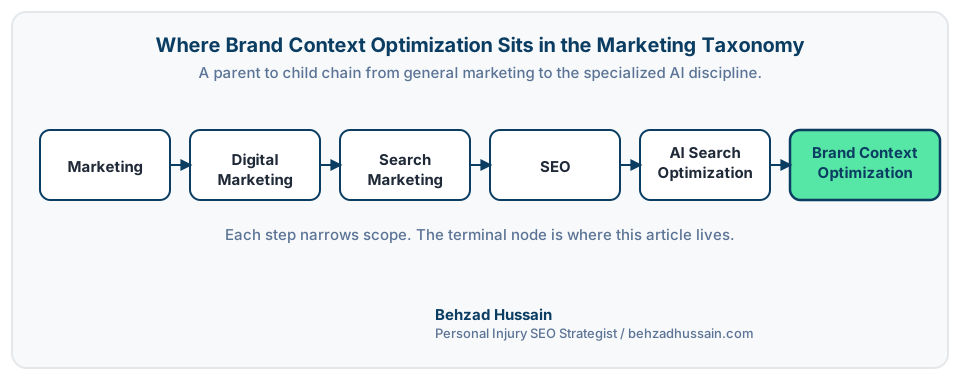
Every level narrows scope. By the time you are inside Brand Context Optimization you are asking one specific question: what does a retrieval system see when it looks for a personal injury firm that fits a particular query, and how do I become that firm.
Most PI marketing agencies treat this as an SEO refresh. It is not. Traditional SEO optimizes for scalar rank position inside a Google organic list. Brand Context Optimization optimizes for candidacy inside an answer set. Metzler, Tay, Bahri, and Najork of Google Research, in their 2021 SIGIR Forum paper Rethinking Search: Making Domain Experts out of Dilettantes, argued for consolidating the index, retriever, and ranker into a single trained corpus model that can produce expert-quality answers. That shift is what turns rank position into candidacy. The two disciplines share techniques (schema, content depth, off site mentions) but the outcomes are structurally different. A firm that ranks number one for “car accident lawyer Miami” on Google can still be invisible when a Miami consumer asks ChatGPT “who should I call after a rear end on I-95.” The retrieval system that produces the ChatGPT answer is not the same retrieval system that produces the Google organic list. Optimizing for one does not guarantee the other.
If you cannot state, in one sentence, why an AI system would pick your firm over the firm one block over, you do not have a brand context problem. You have a brand definition problem.
Behzad Hussain, on first strategy calls with new PI firm clients
This article treats the canonical hyponyms of AIO, AEO, GEO, and LLM SEO as retrieval surfaces, not competing disciplines. You optimize the same underlying brand context. You just check the results on different surfaces.
How this article is organized. The next section shows why AIO, AEO, GEO, and LLM SEO belong under one parent. Sections three and four explain how AI systems actually pick firms. Sections five through nine give you the execution surface: entity SEO, semantic triples, mention hierarchy, JSON-LD, and query fan-out. Section ten is measurement. Section eleven is state bar compliance. Sections twelve and thirteen give you a 90 day roadmap and a budget conversation. Section fourteen is where my client observations concentrate. The commercial tie in follows.
Why AIO, AEO, GEO, and LLM SEO Are Not Four Different Things
The four terms describe the same discipline applied to four different retrieval surfaces. AIO is Google AI Overviews, launched to Search in 2024 and operationalized by Google’s granted patent US 11,900,068 B1, Generative Summaries for Search Results, which describes selectively utilizing a large language model to generate a natural language summary rendered in response to a query, with additional retrieved content processed alongside the query to mitigate inaccuracies. AEO is Answer Engine Optimization for ChatGPT, Perplexity, Copilot, and Claude. GEO is Generative Engine Optimization, an umbrella term most agencies use to sell the same practice under one banner. LLM SEO is the deepest layer: influencing what large language models say about your firm even when no external retrieval fires.
I pulled the patent record myself. The capture below shows the granted patent on Google Patents, assignee Google LLC, with the operative abstract sentence highlighted. This is the machinery your practice area pages are being fed into.

Every top ranking article I audited for this piece treats these as competing disciplines. They are not. They are surfaces. The underlying work (entity resolution, semantic triple emission, structured data, mention density, freshness cadence, author entity binding) is identical across the four. What changes is the KPI you monitor and the retrieval architecture you tune for. The peer disciplines that also sit under Brand Context Optimization (Entity SEO, Knowledge Graph Optimization, Semantic SEO, RAG Optimization, and Corpus Placement Optimization) are technique layers you deploy across every surface, not separate surfaces themselves.
The comparison table below shows the four canonical surfaces side by side across retrieval layer, primary KPI, and index location.
| Surface | Retrieval Layer | Primary KPI | Where the retrieval index lives |
|---|---|---|---|
| AIO (Google AI Overviews) | Google index plus Knowledge Graph plus Gemini generation | AI Overview inclusion rate on target queries | |
| AEO (ChatGPT, Perplexity, Copilot, Claude) | Bing (ChatGPT, Copilot), proprietary plus Bing (Perplexity), connectors (Claude) | Citation rate per prompt set | Bing plus proprietary crawls |
| GEO (all generative engines) | Multi index plus RAG driven | Share of AI answer voice | Multi engine |
| LLM SEO (training corpus influenced) | Training corpus plus RAG | Named brand recall rate in unprompted queries | Training corpora (Common Crawl, curated datasets) |
My own 1,005 firm audit of Google page 1 PI websites, published on ResearchGate as publication 410589352, found that only 22 percent of top ranking firms carried FAQPage schema at a level Google could parse cleanly. If you assume top ranking firms are the sample most likely to have modern schema, that number is a floor, not a ceiling. AI Overviews consume FAQPage schema for extractable answers. Firms without it are competing with one arm behind their back on the AIO surface even when they rank organically.
AIO for personal injury law firms
AIO is the practice of optimizing your firm’s content, structured data, and entity graph so Google’s AI Overview generation layer selects your passages when it summarizes an answer at the top of the SERP. AIO reads the same signals traditional SEO reads plus additional signals for extractable passages, semantic clarity, and entity resolution. The AI Overview does not typically retrieve from a separate index; it retrieves from Google’s live index and then feeds candidate passages to Gemini for synthesis. That means if you are not eligible to rank organically on the query, you are not eligible for the AIO. The reverse is not true. Firms that rank organically on the query but write in dense, unextractable prose get skipped by the AI Overview.
Practical implication for a PI firm: a Miami car accident practice area page that ranks organically for “car accident lawyer Miami” but reads as a wall of adjectives will lose the AI Overview slot to a firm one page below that ships definitional first sentences and chunked passages.
AEO for personal injury law firms
AEO is the practice of shaping your firm’s presence across the corpora that Answer Engines retrieve from, so ChatGPT, Perplexity, Copilot, and Claude cite your firm inside their generated answers. ChatGPT and Copilot pull retrieval from Bing. Perplexity uses a proprietary index plus Bing. Claude, when browsing is enabled, uses direct fetch through connectors. Each engine has its own bot user agent (GPTBot, PerplexityBot, ClaudeBot, OAI-SearchBot, plus Google Extended for AI Overview specific opt out). If your robots.txt blocks any of these, you are erased from that surface. I audited a firm last year whose SEO agency had blocked GPTBot “for privacy” and left the firm invisible to every ChatGPT search for six months.
The measurable KPI for AEO is citation rate per prompt set. You establish a baseline prompt set of 30 to 60 queries that represent your practice area and jurisdiction, run them across the engines, and count how often your firm is named. Then you monitor weekly.
GEO for personal injury law firms
GEO is the vendor umbrella term for optimizing across every generative surface. Most agencies market their AI SEO service as GEO because it lets them combine AIO and AEO work under one banner. The practice inside GEO is identical to the practice inside AIO plus AEO. There is no separate GEO technique. If your agency is selling you GEO as a distinct discipline from AIO and AEO, ask them to show you what changes.
LLM SEO for personal injury law firms
LLM SEO is the practice of influencing what a large language model recalls about your firm even when no external retrieval fires. This is the hardest layer because it depends on your firm’s presence inside the training corpora of the models themselves. Training corpora refresh on cycles of months to years. A firm mentioned across Common Crawl, GitHub, academic papers, and news wires enters the training data for the next model version. A firm that only publishes on its own website does not.
The measurable KPI for LLM SEO is named brand recall in unprompted queries. You ask a model, without pointing it at any URL, to name the top personal injury firms in a jurisdiction. Do you appear. How often. In what position. LLM SEO is where corpus placement dominates. A PI firm whose founder writes a book cited in law schools enters the training corpus in a way a firm without published work cannot.
How AI Systems Choose Which Personal Injury Law Firms to Recommend
AI systems select firms through a sequence of filters that runs from the raw query to the final citation. Each filter culls the candidate pool. Firms that fail any single filter drop out. The foundational architecture for this pattern is retrieval augmented pre-training, introduced by Guu, Lee, Tung, Pasupat, and Chang of Google Research in their 2020 ICML paper REALM: Retrieval-Augmented Language Model Pre-Training, where the model retrieves documents from a corpus and uses them to predict masked tokens end to end. Modern AIO and LLM answer systems are variants of this pattern. Understanding the sequence is what separates a strategic conversation from a checklist conversation.
The capture below is the REALM paper’s abstract on arXiv with the sentence that defines the retrieve and attend mechanism highlighted. Every answer engine you are optimizing for descends from this architecture.

Selection funnel: prompt to citation
1. User queryConsumer asks a natural language legal question 2. Named entity recognitionModel tags ORG and LOCATION entities in the query 3. Entity resolutionQuery entities map to firm records in the knowledge graph 4. Embedding proximityRetriever scores content vectors against query vector 5. Passage retrieval and citationTop passages selected and cited in the AI answerThe sequence is: named entity recognition on the user query, entity resolution against the knowledge graph, embedding proximity between the query vector and candidate passages, passage retrieval and ranking, and finally citation formatting. Each step has its own optimization surface. Each step has its own failure modes. I have seen firms with excellent content lose citations at the entity resolution step because their firm name resolves to a different entity in the knowledge graph than they intended. I have seen firms with strong entity graphs lose citations at the passage retrieval step because their content is written in prose the retriever cannot extract.
Entity resolution and named entity recognition for law firms
Entity resolution is the process by which an AI system decides that the string “Miller Law Firm” in a user query refers to your firm specifically and not to one of the fifty other firms with a similar name. Named entity recognition is the first step: the model tags the string as an ORG entity (organization) rather than a common noun. Resolution then maps that ORG entity to a specific record in the model’s knowledge graph or entity table.
For personal injury firms, resolution has three common failure modes. First, name collision: multiple firms share the same or similar name and the model picks the wrong record. Second, entity fragmentation: the same firm appears under variant names (Miller Law, Miller Law Firm, Miller and Associates) and the model treats them as separate entities. Third, entity absence: the firm has no stable record in the model’s entity table because it has too few third party mentions to trigger record creation.
The triple that a resolver looks for is simple: subject (firm name), predicate (is-a), object (law firm) plus (practices in) plus (city/state) plus (handles) plus (practice areas). If your website emits this triple pattern clearly and third party sources corroborate it, resolution succeeds cleanly.
Embedding proximity between brand and query
Embedding proximity is the vector distance between the model’s numerical representation of the user’s query and the model’s numerical representation of your firm’s content. Smaller distance means better match. Embeddings are produced by the same encoder architecture that BERT introduced in 2019, refined by every model release since. A query like “who should I call after a rear end on I-95 Miami” produces a query vector. Your firm’s content produces content vectors. The retriever picks the top K content vectors closest to the query vector.
Why does ChatGPT recommend competitors even though I have more reviews? Because the review count feeds a different signal than embedding proximity. Reviews influence local pack ranking and consumer trust perception. They do not shrink the vector distance between your content and the query. Content that is topically dense, entity anchored, and semantically aligned with the query language wins the retrieval slot even against a firm with more reviews.
Passage retrieval and chunk ranking for legal content
Passage retrieval is the step where the retriever returns specific text passages (not whole pages) as candidates for the AI to cite. Rankers like the ones described in the 2020 Dense Passage Retrieval paper by Karpukhin and colleagues at Facebook AI Research operate at the passage level, typically 80 to 300 tokens per chunk. The retrieval augmented generation approach that most engines rely on was formalized by Lewis and colleagues in the same year. Google’s own passage-level infrastructure is described in US Patent Application 2016/078102 A1, Text Indexing and Passage Retrieval, which indexes and retrieves passages within documents independently of the document’s overall relevance. Cross-encoder passage re-ranking with BERT, established by Nogueira and Cho in their 2019 paper Passage Re-ranking with BERT, delivers the specific passage that appears in an AIO answer with a 27 percent relative improvement over the prior state of the art on the MS MARCO benchmark. A page that packs one idea per chunk with a clean definitional lead ships more retrieval candidates than a page that runs 800 word sections without internal breaks.
For legal content the practical guidance is that every H2 and H3 should stand alone as an extractable passage. Definitional first sentence. Named entities in the same sentence. Numeric specificity where possible. Chunks that fit inside a 300 token window are what retrievers pull.
The Retrieval Layer: What Happens Between a Consumer Prompt and the AI Answer
The retrieval layer is the intermediate step between the user’s prompt and the AI’s generated answer. It fetches candidate content the generator will synthesize. Every generative surface uses a retrieval layer, but the architectures differ enough that you have to optimize for each one distinctly.
The five surfaces this article treats are ChatGPT, Perplexity, Google AI Overviews, Claude, and Gemini. Each has its own index source, its own browsing capability, its own memory model, and its own citation format. The matrix below compresses the operator level distinctions I use when I audit a firm’s AI visibility.
| Surface | Primary Index | Live Browsing | Memory | Citation Format |
|---|---|---|---|---|
| ChatGPT | Bing plus proprietary crawls plus OpenAI training corpus | Yes when the model uses search | Yes across conversations for logged in users | Numbered footnote citations in the answer |
| Perplexity | Proprietary index plus Bing supplementary | Always live | Yes across conversations | Inline citation chips at end of sentences |
| Google AI Overviews | Google Search index plus Knowledge Graph | Always live | Session only | Inline linked source cards below the summary |
| Claude | Live fetch via connectors plus Anthropic training corpus | Yes when the user enables browsing or a connector | Project memory when configured | Inline URL citations |
| Gemini | Google Search index plus Gemini native corpus | Always live | Session plus optional cross session memory | Inline linked source cards |
ChatGPT retrieval architecture (Bing plus browsing plus memory)
ChatGPT retrieves through Bing when the model decides a query needs live information, and the retrieval-plus-generation orchestration is described in Microsoft’s Bing Blog post Building the New Bing (February 2023), which named the pairing Prometheus and its orchestrator. The Bing side of the graph, which Copilot references when it names a firm as a recommendation, is queryable through the Bing Entity Search API documented on Microsoft Learn. Microsoft’s Concept Graph, published as Probase in the 2012 SIGMOD paper Probase: A Probabilistic Taxonomy for Text Understanding by Wu, Li, Wang, and Zhu, is one input to Bing’s entity understanding. OpenAI publishes GPTBot as its crawler user agent. Sites that want ChatGPT search to index them keep GPTBot allowed in robots.txt. Sites that block GPTBot are absent from ChatGPT search results. Memory personalization means ChatGPT can recall prior firm mentions in the same user’s conversation history. That memory does not make your firm easier to find for new users. It only makes it easier to find for a user who has already discussed your firm.
Perplexity retrieval architecture (proprietary plus Bing)
Perplexity operates its own proprietary crawler (PerplexityBot) and supplements with Bing. Perplexity queries always fire live, meaning the retrieval index refresh cadence directly affects your citation rate. Perplexity is the surface most sensitive to content freshness for PI firms. A practice area page updated in the last 30 days ranks higher in Perplexity candidacy than an equivalent page updated 18 months ago.
Google AI Overviews retrieval (Google index plus Knowledge Graph plus Gemini)
Google AI Overviews retrieve from the standard Google index and layer Knowledge Graph facts on top before Gemini generates the summary. Every organic ranking factor still applies. AIO adds three requirements: extractable passages, entity resolution to a Knowledge Graph node, and content that satisfies Google’s YMYL (Your Money or Your Life) evaluation guidelines. Personal injury is YMYL. Google’s own Search Quality Evaluator Guidelines specify heightened E-E-A-T requirements for YMYL categories, and AIO applies those requirements before citing. Google’s public guidance on AI generated content also applies to any content produced by or attributed to your firm. Google’s AI Mode, the multi-turn chat surface, is described in US Patent Application 2024/289407 A1, Search with Stateful Chat, which retains state across turns through an aggregate embedding so content the claimant opens on one turn steers generation on the next.
Claude retrieval architecture (connectors and browsing)
Claude retrieves through Anthropic’s browsing capability when the user enables it or through configured connectors. ClaudeBot is Anthropic’s crawler user agent. Anthropic’s documentation states that ClaudeBot respects robots.txt directives. Claude does not maintain a persistent search index the way Google or Bing does; it relies more heavily on training corpus recall plus per session live fetch. This makes Claude a strong LLM SEO surface. Firms represented in training corpora appear even when browsing is disabled.
Gemini retrieval architecture (Google index plus Gemini native)
Gemini pulls from the same Google index that Google Search uses and layers Gemini’s native corpus for factual grounding. Gemini generation is the same layer that powers Google AI Overviews, so optimizing for AIO also optimizes for Gemini in most cases. Where the two diverge: Gemini in the standalone Gemini app can synthesize from a broader native corpus and is more likely to name firms it recognizes from training data even if they do not currently rank in Google Search.
Entity SEO for Personal Injury Firms: The Prerequisite Nobody Wants to Do
Entity SEO is the practice of representing your firm as a stable, machine readable entity across Google’s Knowledge Graph, Wikidata, and the entity tables inside AI systems. Amit Singhal introduced Google’s Knowledge Graph on the Official Google Blog in May 2012 with the phrase “things, not strings,” and every generative surface since draws on the same entity substrate. Schema.org sits alongside it as the publisher-controlled interface, formalized in the 2016 Communications of the ACM paper Schema.org: Evolution of Structured Data on the Web by Guha, Brickley, and Macbeth. Entity SEO is the prerequisite for every other Brand Context Optimization surface. Firms that skip entity work never accumulate mention density because the mentions attach to fragments of the firm’s identity instead of a single canonical record.
I get resistance on entity work more often than any other recommendation. The reason is that entity work is tedious. It requires an About page rewrite, a schema build, sameAs pointer discipline, and often a Wikidata submission. None of it produces immediate SERP movement. It produces AI recommendation eligibility.
Skip entity work and the rest of this playbook loses 40 percent of its return. The techniques still work. Your firm just does not accumulate the results.
Behzad Hussain, on quarterly reviews with managing partners
The diagram below shows what a resolved entity graph looks like for a mid market PI firm. Center node is the firm’s LegalService entity, which carries the Organization and LocalBusiness properties itself. Person nodes are named attorneys. Additional offices get their own per office LegalService nodes. sameAs anchors point to external identity sources.
PI firm entity graph
The four sub topics below are the order I execute in.
The entity home page for a personal injury firm
The entity home page is the single canonical URL that declares your firm’s identity to search engines and AI systems. It is typically the About page or Firm Overview page. Not the homepage. Google’s mechanism for surfacing this identity is described in US Patent 9,268,820 B2, Providing Knowledge Panels with Search Results, which pulls entity attributes from a canonical source and renders them at the SERP level. The pipeline that ingests third party structured entity data into the knowledge graph is codified in the US Patent 11,361,227 B2 family, Onboarding of Entity Data, with continuations extending the mechanism. The About page anchors the firm’s identity because it carries structured biographical content the homepage does not. The homepage carries conversion elements. The About page carries identity.
The entity home page must include:
- Firm legal name (as registered with the state bar)
- Founding date
- Physical address (matching Google Business Profile exactly)
- Service area (city, county, state)
- Attorney roster with names linking to Person schema bio pages
- Awards, associations, credentials (with year and issuing body)
- A single LegalService JSON-LD block (carrying the firm’s Organization and LocalBusiness properties, since LegalService inherits both in the Schema.org hierarchy) with a
sameAsarray pointing to LinkedIn, Justia, Avvo, Martindale, state bar profile, and Wikidata Q number if you have one
The LegalService JSON-LD is the machine readable form of the same content. Google’s structured data guidelines specify that the sameAs property is the primary way to declare entity identity across the open web. The corroboration mechanism that fuses these signals is described in US Patent 8,682,913 B1, Corroborating Facts Extracted from Multiple Sources, and refined in the fact fusion architecture published by Dong and colleagues in their 2014 KDD paper Knowledge Vault: A Web-Scale Approach to Probabilistic Knowledge Fusion. Every URL in the sameAs array should carry the same firm name, same address, and same phone number as the entity home page. NAP inconsistency across sameAs targets splits the entity in AI retrieval. Google also runs a defensive layer described in US Patent 10,223,637 B1, Predicting Accuracy of Submitted Data, that rejects inaccurate submissions before they degrade the entity graph.
Person schema for named attorneys with sameAs pointers
Every named attorney at the firm gets a bio page with a Person JSON-LD block. The Person block carries the attorney’s full name, credentials (JD, LLM, board certifications), bar admissions with years, jurisdiction, and a sameAs array pointing to LinkedIn, Justia profile, Avvo profile, speaking engagement pages, and Wikipedia if the attorney is notable enough for a page.
The Person schema on an attorney bio, linked back to the firm’s Organization via worksFor, tells the AI system that the attorney is an entity in her own right with her own authority signals, and that her authority reinforces the firm’s. Author bylines on blog posts and articles should link to the same attorney Person entity. Do not create a new author entity per platform. Reuse the same Person entity everywhere.
Office location properties and multi office LegalService nodes
A single office firm ships one LegalService node that carries the location properties (address, telephone, openingHours) directly on it. LegalService is a subtype of LocalBusiness in the Schema.org hierarchy, so the LegalService node is the place node. AI systems that answer “who is a personal injury lawyer near me” queries read the location signals straight off it. Do not split the firm into a separate Organization node plus a separate LocalBusiness node; that fragments the identity the entity resolver has to re-merge.
Firms with multiple offices ship one LegalService node per office, each with its own address, phone number, hours, and service area, linked to the primary firm entity via parentOrganization. The linkage tells AI systems these offices belong to one firm without conflating their local ranking signals.
Wikidata Q number path for a mid market PI firm
Wikidata is the machine readable spine of Google’s Knowledge Graph and sits inside every major LLM training corpus. A Wikidata Q number for your firm is one of the strongest possible AI recommendation anchors because it is structured, curated, and referenced across the open web.
You do not create a Wikidata item for a firm that does not meet notability. Wikidata notability is looser than Wikipedia notability but still requires third party references. Most mid market PI firms qualify if they have news coverage, bar association leadership records, or notable case results reported in legal press.
The path I use with clients:
- Confirm the firm has at least three reliable third party sources (news articles, bar directory, court records).
- Register a Wikidata editor account.
- Create a Q number for the firm with properties: instance of (law firm), country (United States), state (jurisdiction), founded (year), headquarters (city).
- Link the founder or managing partner’s Wikidata item (create one if needed).
- Add
sameAsfrom the firm’s on site Organization JSON-LD pointing to the new Q number.
The whole path takes a week if the sources exist. If sources do not exist, the answer is not to create fake ones. The answer is to build authority sources first (bar committee work, legal press pitches, guest appearances on legal podcasts with transcripts) and revisit Wikidata after 6 months.
Not sure where your entity build actually stands? Book a PI SEO Diagnostic to get a clear map of your current entity graph state and the shortest path to a Wikidata anchored identity.
Request a PI SEO DiagnosticSemantic Triples and Passage Design: The Writing Craft Change
Semantic triples are the writing craft change that separates AI cited firms from AI invisible ones. A semantic triple is a sentence structured as subject, predicate, object. The retriever inside every generative surface extracts triples from your content and matches them against triples the query decomposes into. The mechanism by which an LLM produces both an answer and a specific attribution to the passage that supports it is formalized in the 2022 Google Research paper Attributed Question Answering: Evaluation and Modeling for Attributed Large Language Models by Bohnet, Tran, Verga, and colleagues, which released a benchmark and human-rated evaluations for attribution quality. Content that emits many clean triples surfaces at retrieval. Content that hides its triples inside adjective heavy prose resists attribution.
Here is that paper on arXiv, with the sentence stating why attribution matters highlighted. Note the author list: this is a 22 author Google Research team formalizing the exact mechanism that decides whether your firm gets named as a source.

Most personal injury content is written in the opposite pattern. Long adjective clusters. Passive voice. Legal jargon without named entities. The result reads professionally to a human but the retriever cannot extract the underlying facts. Rewriting for triples is not a stylistic preference. It is a retrieval requirement.
Adjectives are what a firm reaches for when they cannot commit to a number. AI systems cite numbers. They ignore adjectives.
Behzad Hussain, on a strategy call last quarter
How to write a semantic triple for a personal injury practice area page
To write a semantic triple, start every claim sentence with the subject, follow with a factual predicate verb, end with the object. Named entities in every triple. Numbers instead of adjectives. Below is the pattern I hand every content lead I work with.
The strong version emits five extractable triples: firm handles catastrophic injury cases, firm operates in Texas, firm has been active since 2011, firm has represented 340 plaintiffs in this category, firm has recovered $180 million in aggregate. Each triple is a candidate for retrieval. The weak version emits zero.
For a Miami car accident practice area page, the triples I would build in the first 300 words are:
- Miami car accident law is governed by Florida no fault statutes.
- Florida no fault requires the injured driver to first exhaust $10,000 in PIP coverage.
- The statute of limitations for a Florida car accident personal injury claim is 2 years from the date of the accident.
- Comparative negligence in Florida reduces recovery by the plaintiff’s percentage of fault.
- This firm represents Miami car accident plaintiffs on contingency, meaning no fee unless the case recovers.
Every triple names the jurisdiction, the specific rule, and the firm. Every triple is a candidate passage.
The 300 token chunk architecture for AI retrieval
Passage retrieval operates at the chunk level, and chunks are typically 80 to 300 tokens. A token is roughly three quarters of a word. So a 300 token chunk is around 220 to 250 words. Every H2 and every H3 on your page should stand alone as a chunk. That means:
- One idea per section
- Definitional first sentence
- Named entities in the same sentence
- Numeric specificity where possible
- No cross section pronoun references (do not say “this issue” referring to something in the prior section)
The chunk architecture is what makes a page extractable across engines. AIO extracts chunks for its summary. Perplexity extracts chunks for its citation cards. ChatGPT extracts chunks for footnote references. Claude extracts chunks for URL citations. Every engine benefits from a page that is composed of self contained chunks.
Rewriting a stock practice area paragraph as chunked triples
The two panel callout below shows the same content in two forms. The Before panel is adjective heavy and emits zero extractable triples. The After panel is fact dense and emits nine.
Before (stock)
Our attorneys have extensive experience handling motor vehicle accident cases in the greater Miami area. We understand the challenges that victims face after a serious accident and are committed to fighting for the compensation you deserve. Our team takes a personalized approach to every case, working closely with clients to understand their unique circumstances and develop a customized legal strategy.
After (chunked triples)
This firm represents motor vehicle accident plaintiffs in Miami, Dade County, and Broward County. The firm handles single vehicle collisions, rear end collisions, T-bone collisions, hit and run collisions, and commercial vehicle collisions. The Florida statute of limitations for a car accident personal injury claim is 2 years from the date of the accident. Florida is a no fault state, which requires the injured driver to first exhaust $10,000 in PIP coverage before pursuing an at fault driver. This firm accepts car accident cases on contingency, meaning no attorney fee unless the case recovers.
The before version emits zero extractable triples. The after version emits nine. The word count is nearly identical. What changed is the density of factual claims per sentence.
Brand Mention Hierarchy for Personal Injury Firms: Which Mentions Move the Needle
The brand mention hierarchy ranks the types of third party mentions by their expected AI citation lift for a personal injury firm. What those mentions ultimately buy is branded search volume, and my 1,000-firm study of how brand search demand and Knowledge Panels move organic traffic measures the size of that effect. Not every mention carries equal weight. A single mention in an ABA Journal feature outperforms fifty syndicated press wire posts because the domain authority the retriever weights is orders of magnitude different. The academic foundation for this asymmetry comes from Aggarwal, Murahari, Rajpurohit, Kalyan, Narasimhan, and Deshpande in their 2024 KDD paper GEO: Generative Engine Optimization, where 10,000 queries across AI search systems showed content with epistemic authority markers (statistics, source citations, quotations from credible authorities) improved visibility in AI generated answers by up to 40 percent. Google’s Panda ranking patent, US Patent 8,682,892 B1, Ranking Search Results, further identifies branded and navigational query volume as a primary demand signal the AIO grounding layer can observe.
The 40 percent figure is not a marketing round number. It comes from the paper’s own abstract. Below is the capture from arXiv with the finding highlighted, one sentence before the number itself.

The pyramid below shows the tier structure I use when I run a mention build program with clients.
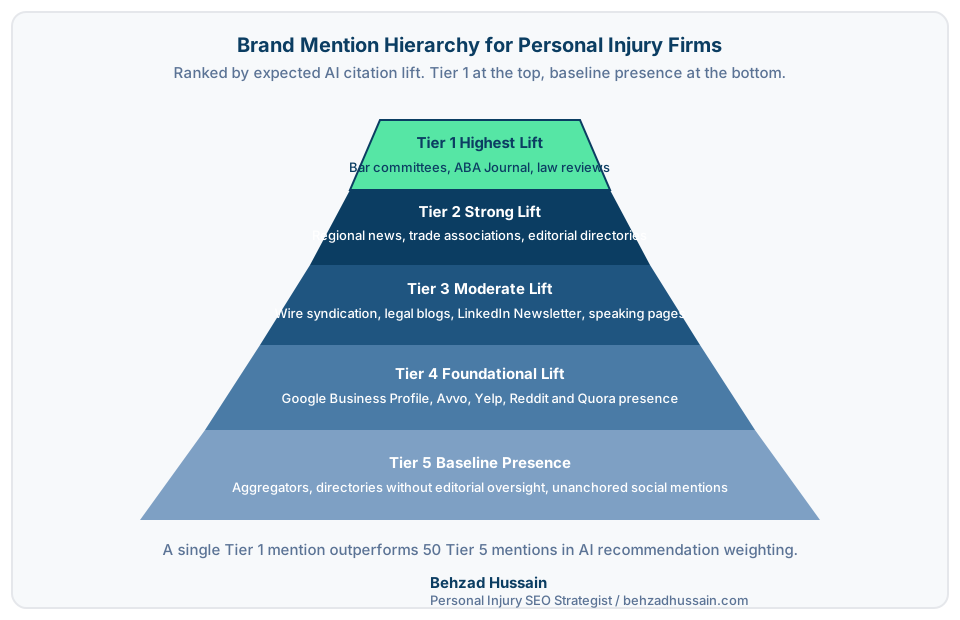
I built this hierarchy from client data across US, UK, and Canadian firms. The order below is the sequence I execute in when I run a mention build program.
Tier 1 (highest expected lift):
- State bar association publications and committee mentions
- ABA Journal or ABA Committee publications
- Law reviews and academic legal journals
- Major legal press (Law.com, Above the Law, National Law Journal)
Tier 2 (strong lift):
- Regional daily newspapers (Miami Herald, Houston Chronicle, Los Angeles Times) on legal topics
- Trade association mentions (AAJ, ATLA, state trial lawyer associations)
- Legal directories with editorial oversight (Justia, Martindale, Best Lawyers)
- Podcast guest appearances with hosted transcripts
Tier 3 (moderate lift):
- Regional news wire syndication (with consistent brand anchor)
- Legal blogs on high authority domains
- Speaking engagement pages
- LinkedIn Newsletter presence
Tier 4 (foundational lift):
- Google Business Profile with regular posting
- Yelp, Avvo, Facebook business listings with active reviews
- Reddit and Quora participation by verified attorneys
Tier 5 (baseline presence):
- Aggregator citations
- Directory listings without editorial oversight
- Social media mentions without anchoring
How many brand mentions do I need before I appear in AI answers? The honest answer is between 20 and 60 mentions from Tier 1 through Tier 3, distributed across at least 15 distinct domains, before you see consistent AI citation across Perplexity, ChatGPT, and Google AI Overviews. Solo firms in Tier 3 metros can hit the threshold in 6 to 9 months of steady effort. Firms already publishing in bar committees or teaching CLEs hit it faster because the Tier 1 slots stack.
Client observation. I audited a Dallas PI firm last year that had 80 press release wire syndications and zero bar association mentions. Their AI citation rate was near zero. We killed the wire program, redirected the same budget to bar committee work and a speaker series pitch, and citation rate on their target prompt set moved from 3 percent to 34 percent in eight months. Mention type matters more than mention volume.
Mention hierarchy sits inside the 90 day roadmap in the same order I present here.
Schema Markup That Actually Gets Read: Copy Paste JSON-LD for a Personal Injury Firm
Schema markup for a personal injury firm should ship one LegalService node as the firm’s single representative entity, one Service node per practice area, one Person node per named attorney, and FAQPage on any page with genuine question and answer content. LegalService sits below LocalBusiness and Organization in the Schema.org type hierarchy, so the one LegalService node legitimately carries every Organization property (name, url, logo, image, foundingDate, founder, sameAs) and every LocalBusiness property (address, telephone, openingHours) alongside its own service properties (areaServed, priceRange, knowsAbout). The practice areas hang off the firm through hasOfferCatalog: each Offer in the catalog points to a dedicated Service node with its own @id anchored to the practice area page URL, and each Service node points back to the firm via provider. The nodes combine into a single JSON-LD @graph at the top of your homepage or About page, linked by @id anchors so the entities relate to each other explicitly.
The most common failure mode I see is fragmented identity: the same firm split across separate Organization, LegalService, and LocalBusiness nodes that the entity resolver then has to re-merge, or a firm node with no Person blocks for the attorneys. Fragmented schema tells the AI system that the firm exists but makes it guess which record is canonical. One LegalService node carrying the full property set, linked to Person nodes via @id, is the fix.
Below is the copy paste @graph a Miami single office PI firm would ship. Substitute your firm’s data where the placeholders sit. Validate the result with Google’s Rich Results Test before publishing.
{
  "@context": "https://schema.org",
  "@graph": [
    {
      "@type": "LegalService",
      "@id": "https://www.examplepi.com/#legalservice",
      "name": "Example Personal Injury Law Firm",
      "url": "https://www.examplepi.com/",
      "logo": "https://www.examplepi.com/images/logo.png",
      "image": "https://www.examplepi.com/images/logo.png",
      "foundingDate": "2011-06-01",
      "founder": {"@id": "https://www.examplepi.com/attorneys/jane-doe/#person"},
      "address": {
        "@type": "PostalAddress",
        "streetAddress": "123 Brickell Ave, Suite 500",
        "addressLocality": "Miami",
        "addressRegion": "FL",
        "postalCode": "33131",
        "addressCountry": "US"
      },
      "telephone": "+1-305-555-0100",
      "openingHours": "Mo-Fr 08:00-18:00",
      "areaServed": [
        {"@type": "City", "name": "Miami"},
        {"@type": "AdministrativeArea", "name": "Miami-Dade County"},
        {"@type": "State", "name": "Florida"}
      ],
      "knowsAbout": [
        "Florida no fault statutes",
        "Florida statute of limitations for personal injury",
        "PIP coverage requirements",
        "Comparative negligence in Florida"
      ],
      "priceRange": "Contingency fee",
      "hasOfferCatalog": {
        "@type": "OfferCatalog",
        "name": "Personal Injury Legal Services",
        "itemListElement": [
          {
            "@type": "Offer",
            "itemOffered": {"@id": "https://www.examplepi.com/practice-areas/car-accidents/#service"}
          },
          {
            "@type": "Offer",
            "itemOffered": {"@id": "https://www.examplepi.com/practice-areas/truck-accidents/#service"}
          },
          {
            "@type": "Offer",
            "itemOffered": {"@id": "https://www.examplepi.com/practice-areas/motorcycle-accidents/#service"}
          },
          {
            "@type": "Offer",
            "itemOffered": {"@id": "https://www.examplepi.com/practice-areas/slip-and-fall/#service"}
          },
          {
            "@type": "Offer",
            "itemOffered": {"@id": "https://www.examplepi.com/practice-areas/wrongful-death/#service"}
          }
        ]
      },
      "sameAs": [
        "https://www.linkedin.com/company/example-personal-injury",
        "https://www.wikidata.org/wiki/QXXXXXXX",
        "https://www.justia.com/lawyers/example-personal-injury/",
        "https://www.avvo.com/lawyers/example-personal-injury"
      ]
    },
    {
      "@type": "Service",
      "@id": "https://www.examplepi.com/practice-areas/car-accidents/#service",
      "name": "Car Accident Representation",
      "serviceType": "Personal injury law",
      "url": "https://www.examplepi.com/practice-areas/car-accidents/",
      "provider": {"@id": "https://www.examplepi.com/#legalservice"}
    },
    {
      "@type": "Service",
      "@id": "https://www.examplepi.com/practice-areas/truck-accidents/#service",
      "name": "Truck Accident Representation",
      "serviceType": "Personal injury law",
      "url": "https://www.examplepi.com/practice-areas/truck-accidents/",
      "provider": {"@id": "https://www.examplepi.com/#legalservice"}
    },
    {
      "@type": "Service",
      "@id": "https://www.examplepi.com/practice-areas/motorcycle-accidents/#service",
      "name": "Motorcycle Accident Representation",
      "serviceType": "Personal injury law",
      "url": "https://www.examplepi.com/practice-areas/motorcycle-accidents/",
      "provider": {"@id": "https://www.examplepi.com/#legalservice"}
    },
    {
      "@type": "Service",
      "@id": "https://www.examplepi.com/practice-areas/slip-and-fall/#service",
      "name": "Slip and Fall Premises Liability",
      "serviceType": "Personal injury law",
      "url": "https://www.examplepi.com/practice-areas/slip-and-fall/",
      "provider": {"@id": "https://www.examplepi.com/#legalservice"}
    },
    {
      "@type": "Service",
      "@id": "https://www.examplepi.com/practice-areas/wrongful-death/#service",
      "name": "Wrongful Death Claims",
      "serviceType": "Personal injury law",
      "url": "https://www.examplepi.com/practice-areas/wrongful-death/",
      "provider": {"@id": "https://www.examplepi.com/#legalservice"}
    },
    {
      "@type": "Person",
      "@id": "https://www.examplepi.com/attorneys/jane-doe/#person",
      "name": "Jane Doe",
      "jobTitle": "Managing Partner",
      "worksFor": {"@id": "https://www.examplepi.com/#legalservice"},
      "hasCredential": [
        {"@type": "EducationalOccupationalCredential", "credentialCategory": "Juris Doctor", "recognizedBy": {"@type": "CollegeOrUniversity", "name": "University of Miami School of Law"}, "dateCreated": "2005"},
        {"@type": "EducationalOccupationalCredential", "credentialCategory": "Bar Admission", "recognizedBy": {"@type": "Organization", "name": "The Florida Bar"}, "dateCreated": "2005"}
      ],
      "knowsAbout": ["Florida personal injury law", "Car accident litigation", "Wrongful death claims"],
      "sameAs": [
        "https://www.linkedin.com/in/jane-doe-attorney",
        "https://www.avvo.com/attorneys/jane-doe.html"
      ]
    }
  ]
}
Validate the block by pasting your page URL into Google’s Rich Results Test. The tool surfaces which schema types Google detected and flags errors. The capture below is the actual test result for the @graph above. Note what Google detects: the single LegalService node registers as both a Local businesses item and an Organization item, which is the inheritance argument from the top of this section proven by Google’s own validator.

Google’s own August 2023 guidance restricted FAQPage rich result eligibility to authoritative government and health sites, so most PI firm FAQPage schema no longer triggers the collapsible FAQ display in the SERP. FAQPage schema still matters for AI Overview extraction and for RAG retrieval. Ship it anyway. The rich result was a bonus. The retrieval benefit is the reason to keep the block.
Need a compliance safe schema audit for your firm? Book a PI SEO Diagnostic and get a validated schema deliverable your web team can ship the same week.
Request a PI SEO DiagnosticQuery Fan-Out Design for a Personal Injury Practice Area Page
Query fan-out is the process by which Google’s AI Overview and Perplexity’s retriever break a single user query into multiple sub queries, run each sub query, and synthesize the results. The Google mechanism is described in US Patent 11,663,201 B2, Generating Query Variants Using a Trained Generative Model, which takes a single search query and actively generates multiple related query variants. A user who asks “best car accident lawyer in Miami” triggers a fan-out that typically includes: statute of limitations for Miami car accident claims, Florida no fault law and PIP coverage, comparative negligence in Florida, average car accident settlement in Miami, contingency fee explained, medical bill lien handling in Florida, insurance carrier tactics after a Miami crash, and the specific firm named entity resolution.
Here is the granted patent on Google Patents, filed by Google in 2018 and granted in 2023, with the abstract’s operative phrase highlighted. Fan-out is not speculation; it is filed, granted, and active until 2040.

The radial diagram below shows the fan-out for a typical Miami car accident query.
Query fan-out: Miami car accident lawyer
Your practice area page ranks in the AI answer when it covers enough of the fan-out with extractable passages. A page that answers only the primary query (who is the best car accident lawyer in Miami) but misses the fan-out sub queries competes against pages that ship the whole thing. In my experience the top ranking AI Overview candidate pages cover 6 to 10 sub queries per fan-out on a single URL, chunked into their own H2 or H3 sections.
The design pattern I use with clients:
- Take the primary practice area query.
- Run the query manually through ChatGPT, Perplexity, Google AI Overviews, and Claude.
- List every sub topic the AI responses raise or that the AI Overview cites.
- De duplicate and rank by frequency.
- Build a section on the practice area page for each surviving sub topic.
- Each section leads with the sub topic query as a natural sentence and answers in 40 to 70 words with named entities and numbers.
The worksheet below shows the filled sub query list for the Miami car accident example. Copy the pattern for your own market and practice area.
| Sub query | Target passage (leads the H2 or H3) | Word budget | Named entities to include |
|---|---|---|---|
| What is the statute of limitations for a Florida car accident claim? | “The Florida statute of limitations for a car accident personal injury claim is 2 years from the date of the accident.” | 40 to 60 | Florida, statute of limitations, 2 years |
| How does Florida no fault law affect a car accident claim? | “Florida is a no fault state, which requires the injured driver to first exhaust $10,000 in PIP coverage before pursuing the at fault driver.” | 50 to 80 | Florida, no fault, $10,000, PIP coverage |
| What is comparative negligence in Florida? | “Florida applies modified comparative negligence, which reduces a plaintiff’s recovery by their percentage of fault and bars recovery when the plaintiff is more than 50 percent at fault.” | 60 to 90 | Florida, modified comparative negligence, 50 percent threshold |
| What is the average car accident settlement in Miami? | “Average Miami car accident settlements vary by injury severity and liability clarity, ranging from $15,000 for minor soft tissue cases to over $500,000 for cases involving surgical intervention.” | 60 to 90 | Miami, $15,000 range, $500,000 range, injury severity |
| What is a contingency fee for a Florida car accident case? | “A contingency fee for a Florida car accident case is a percentage of the recovery, typically 33.3 percent pre litigation and 40 percent after suit is filed, with the client owing no attorney fee unless the case recovers.” | 60 to 90 | Florida, contingency fee, 33.3 percent, 40 percent |
| How are medical bill liens handled in Florida personal injury settlements? | “Medical bill liens in Florida personal injury settlements are negotiated at settlement to reduce the amount owed to hospitals and PIP carriers, preserving more of the recovery for the injured client.” | 50 to 80 | Florida, medical bill liens, PIP carriers, settlement negotiation |
| How do Florida insurance carriers respond to a car accident claim? | “Florida insurance carriers typically request a recorded statement, contest liability where comparative negligence applies, and offer initial settlements below the injured claimant’s medical damages.” | 50 to 80 | Florida insurance carriers, recorded statement, comparative negligence, medical damages |
You will apply this discipline again when we walk through the 90 day roadmap.
The Weekly AI Visibility Dashboard for a Personal Injury Firm
The weekly AI visibility dashboard tracks six metrics that together measure whether your Brand Context Optimization is working. Firms without a dashboard fly blind and default to vanity metrics. Firms with a dashboard notice regression the same week it happens and can restore before it compounds. Freshness is a load bearing input on this measurement, as documented by Vu, Iyyer, Wang, Constant, Wei, and colleagues in their 2023 FreshLLMs paper, which introduced the FreshQA benchmark and the FreshPrompt technique and showed that both the number of retrieved evidences and their order in the prompt materially affect answer correctness.
The six metrics are: prompt set citation rate, share of AI answer voice, sentiment of AI generated mentions, referral traffic from AI sources, assisted conversion attribution across AI referrers, and mention count delta from the prior week. The table below defines each metric with baseline benchmarks for a small PI firm.
| Metric | Definition | Baseline benchmark for a small PI firm | Cadence | Tool source |
|---|---|---|---|---|
| Prompt set citation rate | Percent of 30 to 60 baseline prompts where the firm appears in the AI answer | 10 to 20 percent at month 3, 25 to 45 percent at month 12 | Weekly | Manual prompt log or Profound, Peec, Otterly.ai |
| Share of AI answer voice | Firm’s mention count divided by total firm mentions across all AI answers on the prompt set | 5 to 15 percent at month 3, 20 to 35 percent at month 12 | Weekly | Same as above |
| Sentiment | Percent of firm mentions that are neutral or positive | 90 to 95 percent baseline | Weekly | Manual review |
| Referral traffic from AI sources | Sessions in Google Analytics 4 tagged with ChatGPT, Perplexity, or AI referral source | Baseline zero, grow from month 2 | Weekly | Google Analytics 4 with UTM parameters |
| Assisted conversion attribution | Percent of new client intake forms that first touched an AI referred session | Baseline zero, grow from month 3 | Monthly | GA4 assisted conversion report |
| Mention count delta | Count of net new brand mentions across the corpus this week | 3 to 7 net new mentions per week for a small firm | Weekly | Brand monitoring tools (Brand24, Meltwater) plus manual bar and directory checks |
The visual reference below shows the dashboard skeleton I ship with clients so a marketing lead can maintain it in 30 minutes per week.
| A | B | C | D | E | F | G |
|---|---|---|---|---|---|---|
| Week | Prompt set citation rate | Share of AI answer voice | Neutral or positive sentiment | AI referral sessions | Assisted conversions | Mention count delta |
| W1 | 3% | 4% | 92% | 0 | 0 | +2 |
| W2 | 3% | 4% | 93% | 0 | 0 | +3 |
| W3 | 4% | 5% | 93% | 1 | 0 | +4 |
| W4 | 5% | 6% | 94% | 2 | 0 | +3 |
| W5 | 6% | 7% | 93% | 4 | 0 | +5 |
| W6 | 7% | 8% | 94% | 6 | 0 | +4 |
| W7 | 9% | 10% | 95% | 9 | 1 | +6 |
| W8 | 10% | 11% | 94% | 12 | 1 | +5 |
| W9 | 12% | 13% | 95% | 17 | 1 | +7 |
| W10 | 13% | 15% | 95% | 21 | 2 | +6 |
| W11 | 15% | 16% | 96% | 26 | 2 | +5 |
| W12 | 17% | 18% | 96% | 33 | 3 | +7 |
The measurement discipline is where most firms fail. The dashboard is 30 minutes per week for a marketing lead. Skipping it turns Brand Context Optimization into a faith based investment, which is not a conversation any managing partner wants to have at budget season.
Measurement discipline scales with budget; the budget tier table shows what a solo firm ships versus a multi state one.
Data note: My 500 firm Schema Completeness Index study, published on SSRN under DOI 10.2139/ssrn.6551638, found that firms in the top schema completeness tier were 3.2 times more likely to appear in Perplexity’s cited sources than firms in the bottom tier. The dashboard baseline benchmarks above are informed by that data, though your individual results vary by market competitiveness.
The 90 Day Brand Context Optimization Roadmap for a Personal Injury Firm
The 90 day BCO roadmap for a personal injury firm sequences the work across 12 weeks and maps each week to a PI Organic Authority Engine phase. The 12 weeks are grouped into four phases of 3 weeks each. You end month 3 with a working entity graph, schema deployed, mention program active, dashboard live, and a compliance file open.
The timeline below shows the 12 week track color coded to PIOAE phases.
90 day BCO roadmap
The full week by week detail is in the table below.
| Week | Focus | PIOAE Phase | Concrete deliverables |
|---|---|---|---|
| 1 | Entity home page rewrite | Authority Reinforcement | About page rewrite with full biographical structure, service area, attorney roster |
| 2 | LegalService JSON-LD (carrying Organization and LocalBusiness properties) | Technical Stability + Authority Reinforcement | JSON-LD deployed, Rich Results Test validated |
| 3 | Person schema for every named attorney | Authority Reinforcement | Attorney bio pages updated with Person schema, sameAs to LinkedIn, Justia, Avvo |
| 4 | Baseline prompt set for AI visibility measurement | Case Acquisition Optimization | 30 to 60 prompt list defined; baseline run across ChatGPT, Perplexity, Google AIO, Claude, Gemini |
| 5 | Weekly dashboard setup | Case Acquisition Optimization | Dashboard live with 6 metrics; weekly cadence assigned to marketing lead |
| 6 | Practice area page audit for chunk architecture | Intent Capture | Top 5 practice area pages evaluated for chunk boundaries, definitional leads, named entities |
| 7 | Practice area page rewrite (page 1 of 5) | Intent Capture | Page 1 rewritten for semantic triples plus query fan-out coverage |
| 8 | Practice area page rewrite (page 2 of 5) | Intent Capture | Page 2 rewritten |
| 9 | Practice area page rewrite (page 3 of 5) | Intent Capture | Page 3 rewritten |
| 10 | Mention program: bar committee and legal press pitching | Authority Reinforcement | Committee memberships filed, press pitches drafted for 2 legal news outlets |
| 11 | Mention program: podcast guest booking and LinkedIn Newsletter launch | Authority Reinforcement | 2 podcast bookings confirmed; LinkedIn Newsletter issue 1 published |
| 12 | Compliance and audit close | Case Acquisition Optimization | Compliance log opened, dashboard week 8 review, roadmap for months 4 to 6 drafted |
Firms that follow this cadence typically see their prompt set citation rate move from a baseline of 3 to 8 percent to a month 3 result of 12 to 25 percent. Firms that skip the entity work (weeks 1 to 3) rarely see any movement.
The roadmap is not a plan document. It is a signed contract with yourself about what shipping every Friday looks like.
Behzad Hussain, on a strategy call with a UK PI firm
Budget Tiers by Personal Injury Firm Size (Solo to Multi State)
The budget tier table below reflects what I recommend for firms serious about Brand Context Optimization as an operating discipline. The floor for a solo firm assumes an in house marketing lead and a technical resource on retainer. The ceiling for a multi state firm assumes a full agency partnership plus in house dashboard ownership.
What is the minimum monthly budget for a solo PI firm to run this in-house? For a solo firm in a Tier 3 metro with an existing in house marketing lead, the honest floor is $3,500 to $5,000 per month, covering tool subscriptions, freelance content writing, and part time technical support. Anything less and the entity work stalls and the mention program does not fire.
| Firm size | Monthly range | Staffing model | Tool stack | Expected month 12 citation rate lift |
|---|---|---|---|---|
| Solo (1 attorney) | $3,500 to $5,000 | In house marketing lead at 40 percent time plus freelance technical support | GA4, prompt monitoring (Otterly.ai or Profound entry tier), Brand24 or equivalent | 15 to 25 percentage points from baseline |
| Small (2 to 5 attorneys) | $6,000 to $10,000 | Marketing lead full time plus part time developer plus copywriter retainer | Above plus Ahrefs or Semrush, Meltwater, dashboard automation | 25 to 40 percentage points from baseline |
| Midsize (6 to 20 attorneys) | $12,000 to $22,000 | Marketing team (2 to 3 people) plus dev team plus agency partnership | Above plus Screaming Frog, Sitebulb, enterprise brand monitoring | 40 to 60 percentage points from baseline |
| Multi state (20+ attorneys) | $25,000 to $50,000+ | In house marketing team (5+) plus agency partnership plus fractional strategist | Enterprise tool stack across every category | 60 to 80 percentage points from baseline, with plateau near saturation |
The budget conversation is where I lose the most firms. Managing partners who spend $80,000 per month on LSA and PPC balk at $5,000 per month on Brand Context Optimization because BCO is unfamiliar. The math I offer: a single signed catastrophic injury case at typical PI settlement values covers 24 months of BCO investment for a solo firm. AI referred cases skew toward higher intent because the consumer has already been through a comparison process before contacting.
Client observation. One of my clients, a multi state PI firm with 30 attorneys, reallocated 15 percent of their PPC budget to Brand Context Optimization over 12 months. AI referred consultation form fills grew from zero to 8 percent of total intake. LSA and PPC dependency dropped from 62 percent to 51 percent of intake origin. The firm did not increase total marketing spend; they redistributed it.
Ready to skip guesswork on your firm’s budget tier? Request a PI SEO Diagnostic and get a defensible spending plan mapped to your firm’s size and competitive market.
Request a PI SEO DiagnosticWhat Most Personal Injury Firms Get Wrong About AI Recommendations (Field Notes)
This section is where my client observations concentrate. Nothing here comes from theory. Every observation is a pattern I have seen at least three times across the US, UK, and Canadian PI firms I have worked with.
Client observation 1 (mistake). Why is my law firm invisible in ChatGPT when I rank on Google? Because Google rank is an ordering; ChatGPT citation is a candidacy event. The two systems use different retrieval indices, and Google’s Bing index is not the retrieval source for ChatGPT. Firms treat the ranking on Google as a signal that they are winning AI recommendation too. They are not.
Client observation 2 (mistake). Firms hire an agency for “AI SEO” without asking the agency to distinguish AIO from AEO from GEO. The agency ships the same six signal checklist for every surface and moves on. Six months later the firm has schema improvements but no measurable citation rate change because nobody built the entity graph and nobody ran a baseline prompt set.
Client observation 3 (working example). I worked with a Toronto PI firm that spent the first two months of our engagement rewriting attorney bios with Person schema and sameAs pointers. They resisted because the work felt slow. Month 4 their firm entity appeared in Google’s Knowledge Panel. Month 5 they started appearing in Perplexity citations. Month 6 a consultation form submission arrived directly from a Perplexity referral. The sequencing worked; the resistance was the delay.
Client observation 4 (mistake). Firms publish press releases through a wire syndication service and count each syndicated copy as a brand mention. AI systems weight domain diversity, not copy count. Twenty identical wire posts on twenty regional news sites count as one editorial mention in retrieval weighting, not twenty. Redirect the same budget to genuinely distinct authorship (bar committee pieces, guest posts, podcast appearances with transcripts).
Client observation 5 (working example). A Houston PI firm added a monthly LinkedIn Newsletter authored by the founding partner. Six issues in, the partner’s LinkedIn profile started appearing in AI answers about complex trucking litigation. The Newsletter created a stable, dated, indexable body of first person authority content that retrievers pulled from. Cost: 3 hours per month of the partner’s time.
Client observation 6 (mistake). Firms build FAQ pages that duplicate answers already in their practice area guides. Duplicate content dilutes retrieval because the retriever cannot decide which chunk to cite. The fix is FAQ non duplication: FAQ carries only questions the body does not cover. Every duplicate FAQ moves to the body as a preceding question format inline answer or gets deleted.
Client observation 7 (working example). A midsize Chicago PI firm allocated 4 hours per week to Reddit and Avvo Q&A answers, posted by a named associate attorney with a linked bio. Over 8 months the associate accumulated 60 answers with the firm name in the linked bio. The associate started appearing in ChatGPT and Claude answers about Illinois personal injury procedure. The firm’s citation rate on procedure heavy prompts moved from 2 percent to 21 percent. Community platforms are inside training corpora. Named attorneys answering there build entity association that no other channel produces at the same cost.
Client observation 8 (mistake). Firms treat Brand Context Optimization as a one time project scoped in a proposal. Optimization is a discipline. The retrieval systems change. The training corpora refresh. The competitors update. A firm that runs BCO for six months and stops loses ground because everyone else keeps running. Budget it as an operating discipline, not a project.
This is why bar advertising compliance sits earlier in the article and not as an afterthought. Every one of the observations above has a compliance dimension. Named attorneys answering on Reddit trigger Rule 7.1 language considerations. Newsletter content triggers case result disclaimers. Every optimization action inside a regulated profession lives inside the compliance envelope. That is the frame every managing partner should insist their marketing team operate under.
Ready to Diagnose Your Personal Injury Firm’s Current AI Citation Posture?
Brand Context Optimization is not a checklist you finish. It is a diagnosis followed by an operating discipline. The diagnosis is where I start with every firm. Before you invest in schema builds, mention programs, or dashboard tools, you need a clear read on where you are and where the highest return concentrates.
The Personal Injury SEO Diagnostic is the entry point. In 7 to 10 days I deliver a written diagnostic covering your current entity graph state, your baseline prompt set citation rate, the four failure modes concentrated in your current setup (technical, entity, semantic, mention), and a prioritized roadmap for the next 90 days. The engagement includes a 60 to 90 minute strategy call to walk through the deliverable and answer questions.
If you want a compliance aligned diagnosis your counsel is comfortable with and a defensible plan you can hand to your marketing lead, this is the offer. Fixed scope, fixed price, no ongoing commitment.
Request a PI SEO Diagnostic See What Is IncludedFAQ
How do I fix a fragmented entity where AI thinks two names refer to two firms?
Consolidate every reference to the firm under one canonical name matching your state bar registration. Update your Organization JSON-LD name field and every sameAs target to match. Redirect variant domain names to the canonical URL with 301 redirects. Correct legal directory listings, LinkedIn, Justia, Avvo, and Wikidata to the canonical name. Give AI systems 8 to 12 weeks to reconsolidate the entity after correction.
How many prompts should I baseline before I start optimizing?
Baseline 30 to 60 prompts representing your practice areas, jurisdictions, and target case types. Run each prompt across ChatGPT, Perplexity, Google AI Overviews, Claude, and Gemini. Log firm citation, competitor citation, and generic answer. Baseline weekly for 2 weeks before starting optimization work so you have a stable pre optimization comparison.
Do I need a Wikipedia page to be cited by AI?
No. A Wikipedia page accelerates AI recommendation dramatically but is not a prerequisite. Firms without Wikipedia can still accumulate AI citations through Wikidata (looser notability), consistent Organization JSON-LD, and third party authority mentions. Wikipedia is a compounding advantage for firms whose founders meet notability, not a gating requirement.
Should I block GPTBot with robots.txt?
Only if you want to be invisible to ChatGPT search recommendations. Blocking GPTBot removes your site from ChatGPT’s retrieval index for live queries. Some firms block GPTBot over training data concerns; the tradeoff is AI recommendation absence. For personal injury firms competing for AI cited case acquisition, blocking GPTBot is a strategic self erasure. Firms that want finer control can publish a /llms.txt file declaring which pages the firm considers authoritative for LLM crawlers.
Can PPC and LSA replace Brand Context Optimization?
No. PPC and LSA feed paid slots inside Google’s ad inventory and Local Services Ads inventory respectively. AI Overviews, ChatGPT, Perplexity, and Claude do not pull from Google Ads. Firms that fund only paid channels have zero AI recommendation footprint. PPC and LSA remain valuable for high intent capture, and BCO complements them by capturing consumers who arrive at your firm through a different channel entirely.