
Personal Injury Lawyer Marketing Compliance: State Bar Rules That Bound Your SEO, Ads, and Reviews
Personal injury lawyer marketing compliance is the operating practice of keeping every ad, page, profile, testimonial, and outreach act inside the rules the state bar adopted from ABA Model Rules 7.1 through 7.5, plus any state statute that layers on top. Two 2026 changes make this a right now question. California SB 37, effective January 1, 2026, exposes law firms to consumer lawsuits with statutory damages of 5,000 to 100,000 dollars per violation, and it holds the firm liable for the acts of its marketing vendors. Alabama’s revised Rules of Professional Conduct took effect the same day and reset the direct mail waiting period for known accident victims to 21 days.
I am Behzad Hussain, a personal injury SEO strategist and organic case acquisition consultant for PI law firms in the US. Compliance is not a substitute for SEO for personal injury attorneys; it bounds the same surfaces that SEO is trying to win, which is why the two disciplines belong side by side in every PI marketing program. In this guide, I’m going to share the universal baseline, a 20 state comparison matrix, deep dives on the six states where the matrix is not enough, and the operational translation of every rule onto the marketing surfaces you already run.
If you already know your marketing surfaces need a compliance review, you can request a Diagnostic and skip the rest of this article. Nothing here is legal advice; it is marketing compliance guidance from an operator’s perspective, and every state’s rules should be confirmed with counsel before you rely on them.
Table of contents
- Universal ABA Baseline: Rules 7.1 to 7.5 That Apply Everywhere
- The 20 State Compliance Matrix
- State Deep Dives Where Matrix Compression Fails
- What the Rules Mean on Each Marketing Surface You Optimize
- The 2026 Legal Shifts You Cannot Ignore
- AI Generated Content Compliance Under Rule 7.1
- Enforcement Mechanics: What Actually Happens After a Complaint
- Marketing Vendor Onboarding After SB 37
- Forum Questions PI Firm Marketing Leads Are Asking
- Build a PI Marketing Program That Passes Compliance Review
- Frequently Asked Questions
- Closely Related Topics
- References
Universal ABA Baseline: Rules 7.1 to 7.5 That Apply Everywhere
The American Bar Association Model Rules of Professional Conduct 7.1 through 7.5 set the baseline that every state adopts with edits. Roughly 80 percent of state rules track the ABA text closely enough that mastering the baseline covers most day to day decisions. The remaining 20 percent is state specific variation covered in later sections. Attorney marketing compliance sits inside a broader category of regulated marketing that also covers medical marketing compliance (bound by FDA and FTC rules), financial services marketing compliance (bound by SEC and FINRA rules), and insurance marketing compliance (bound by state insurance departments). The regulatory logic is similar across all four; the specific rules and enforcement bodies differ.
ABA Model Rules 7.1 to 7.5 Wheel
Four rules bound every marketing surface a personal injury firm touches. Hover any slice to jump to that rule.
- Rule 7.1 TruthfulnessWebsite copy, title tags, meta descriptions, hero claims.
- Rule 7.2 AdvertisingPaid search, display, LSA, social ads, referral payments.
- Rule 7.3 SolicitationDirect mail, email, chat pop-ups, DM outreach, waiting periods.
- Rule 7.5 Firm NamesFirm name, letterhead, domain, DBA, trade name.
Rules 7.1 through 7.5 map to specific marketing surfaces. Every ad, page, and profile sits inside at least one rule’s perimeter.
Rule 7.1: The False or Misleading Standard
Rule 7.1 prohibits false or misleading communications about a lawyer or the lawyer’s services. A statement is misleading when it contains a material misrepresentation of fact or law, or when it omits a fact necessary to make the statement, considered as a whole, not materially misleading. Two implications flow from this. First, every objective claim on a website, ad, or profile must be substantiated. Second, subjective claims that imply a guarantee, a specific outcome, or an unjustified expectation of results violate the rule even when they contain no false factual statement.
What counts as materially misleading in a PI attorney ad? A statement is materially misleading when a reasonable prospective client would draw an incorrect impression from the statement’s totality, even if each individual word is technically accurate. A verdict claim without a disclaimer that prior results do not guarantee similar outcomes is a textbook example. A hero stat block that reads “over 500 million recovered” without context on case types, geographic distribution, or a prior results disclaimer produces the same problem.
The rule applies to every surface. Every title tag, meta description, hero headline, testimonial widget, ad copy line, GBP business description, and LSA profile blurb is bounded by 7.1.
Rule 7.2: Advertising Through Any Media
Rule 7.2 permits lawyers to advertise services through written, recorded, and electronic media, including print, television, radio, social media, and law firm websites. The 2018 revisions to the ABA Model Rules also folded former Rule 7.4 (communication of fields of practice and specialization) into Rule 7.2 so that specialization statements now live inside the same rule that governs advertising channels.
Rule 7.2 also carries a payment for recommendations bar with narrow exceptions. Lawyers cannot pay a person for recommending the lawyer’s services, except in the enumerated cases: reasonable costs of advertising or communications, usual charges of a legal service plan or a not for profit lawyer referral service, reciprocal referral agreements meeting specific conditions, and nominal gifts of appreciation.
Every ad must include the contact information for the responsible lawyer or firm. That requirement is why every landing page needs a visible attorney name, firm name, and office location, not merely a phone form.
Rule 7.3: Solicitation and the PI Accident Blackout Period
Rule 7.3 prohibits real time solicitation of prospective clients. In person contact, live telephone contact, and real time electronic contact (including direct messages that behave conversationally) are prohibited when the prospect is known or reasonably should be known to need legal services in a specific matter. The rule carries narrow exceptions for pre existing family, personal, professional, or business relationships.
Personal injury is the highest scrutiny category under 7.3 because the accident aftermath is the exact moment when a victim is most vulnerable and least able to evaluate legal representation. That is why nearly every state layers a waiting period on top of the universal solicitation rule for direct mail and email contact with known accident victims. Waiting periods commonly run 30 days after the incident. Alabama’s 2026 revised rule sets the direct mail window at 21 days. New York carves out a 15 day window when a filing deadline requires earlier action.
Live phone and in person contact never becomes permissible even after the waiting period expires, unless the pre existing relationship exception applies. The constitutional footing for both halves of that rule is settled Supreme Court law. In Ohralik v. Ohio State Bar Association, 436 U.S. 447 (1978), the Court upheld discipline for in person solicitation of accident victims. In Florida Bar v. Went For It, Inc., 515 U.S. 618 (1995), the Court upheld Florida’s 30 day direct mail waiting period, which is why the blackout periods in every state’s rule survive First Amendment challenge. The official syllabus page below shows the Went For It holding with the two load bearing passages highlighted.

Rule 7.4 Status: Deleted in 2018 and Merged Into Rule 7.2
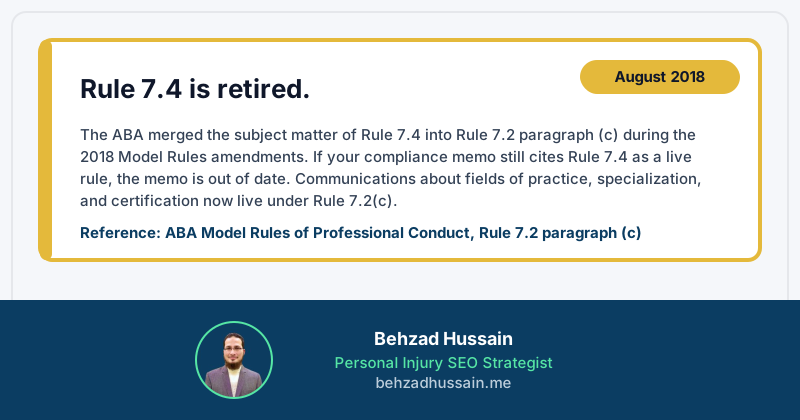
The former Rule 7.4 governed the way attorneys communicate specialization and certification. In August 2018 the American Bar Association retired the standalone rule and folded its subject matter into Rule 7.2 paragraph (c). The callout below summarizes what the retirement changed and what carried forward without change.
Rule 7.4 is retired
Rule 7.4 no longer exists in the ABA Model Rules. The August 2018 revisions (Resolution 101) retired 7.4 and merged its subject matter into Rule 7.2 paragraph (c). State adoption of the merger varies. Some states still cite a standalone 7.4; others updated to the merged 7.2 text. The subject matter of the retired rule (how attorneys communicate specialization and certification) is still enforceable in every state, but the rule citation depends on that state’s adoption timing. Firms writing internal compliance memos should cite by subject matter rather than by legacy rule number when the state has updated.
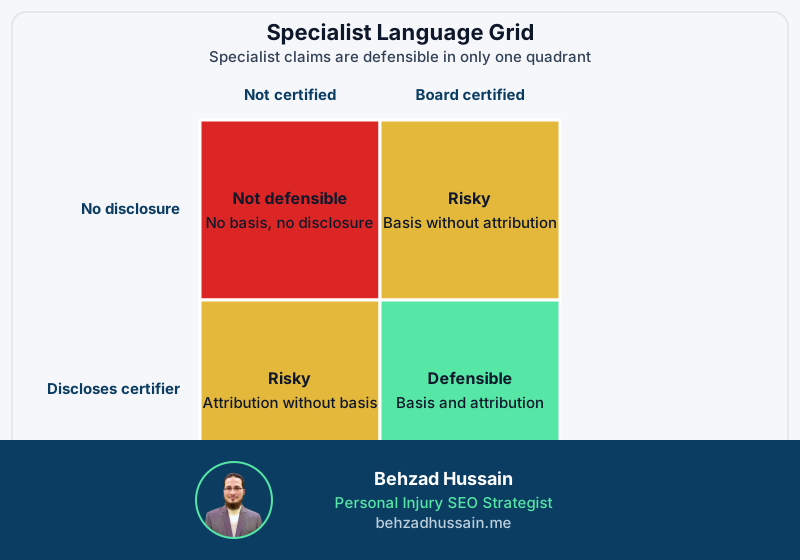
The substantive rule that matters for PI attorneys is unchanged. A lawyer may not state or imply that the lawyer is a specialist or expert in a particular field unless the lawyer is certified by an accredited organization and the certifying organization is named in the communication. This bar applies to title tags, meta descriptions, H1 copy, PPC ads, LSA profile blurbs, and every profile bio.
Rule 7.5: Firm Names and Letterheads
Rule 7.5 governs firm name and letterhead accuracy. A firm name may not imply a partnership that does not exist, a public purpose that does not exist, a specialization the firm cannot claim, or any misleading identity. Trade names are permitted where not misleading and where they do not imply a connection with a government agency or a legal services organization.
For SEO decisions, 7.5 matters most in domain selection and DBA choices. A domain that reads as “PersonalInjurySpecialists dot com” carries the Rule 7.4 (now 7.2 paragraph c) certification problem into the URL structure. A domain that reads as “JusticeForThePeopleLaw dot com” invites review under Rule 7.5’s misleading identity concern. Every firm name and domain decision should be tested against 7.5 before an SEO investment is made behind it.
“Firm name and domain choices are one of the few compliance decisions that compound into SEO for a decade or more, so I treat them as strategy rather than branding.”
Behzad Hussain, Personal Injury SEO Strategist
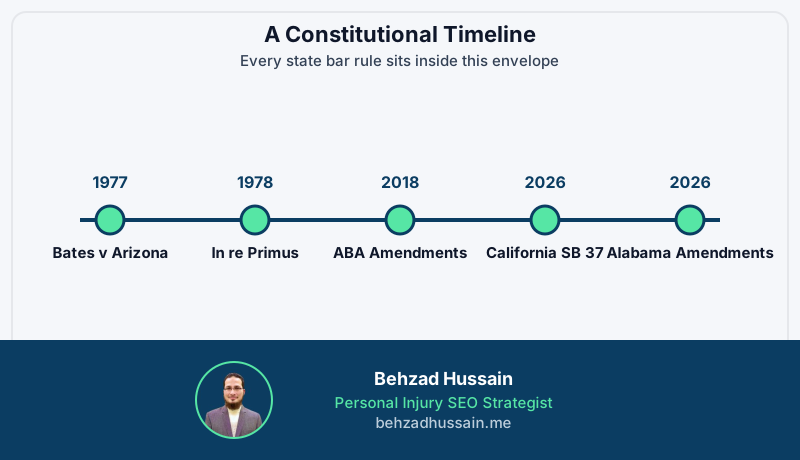
The commercial speech foundation for attorney advertising traces to Bates v. State Bar of Arizona, 433 U.S. 350 (1977), which held that truthful attorney advertising is protected commercial speech under the First Amendment. In re Primus, 436 U.S. 412 (1978), refined the boundary between constitutionally protected speech and prohibited solicitation. Zauderer v. Office of Disciplinary Counsel, 471 U.S. 626 (1985), protected truthful illustrated advertising while upholding mandatory disclosure of contingent fee terms, the doctrinal basis for every disclaimer requirement in this article. Shapero v. Kentucky Bar Association, 486 U.S. 466 (1988), extended protection to truthful targeted direct mail. Every state bar rule since then operates inside that constitutional envelope. The official United States Reports syllabus page below shows the Bates holding that started the modern era, with the commercial speech holding highlighted.

The 20 State Compliance Matrix
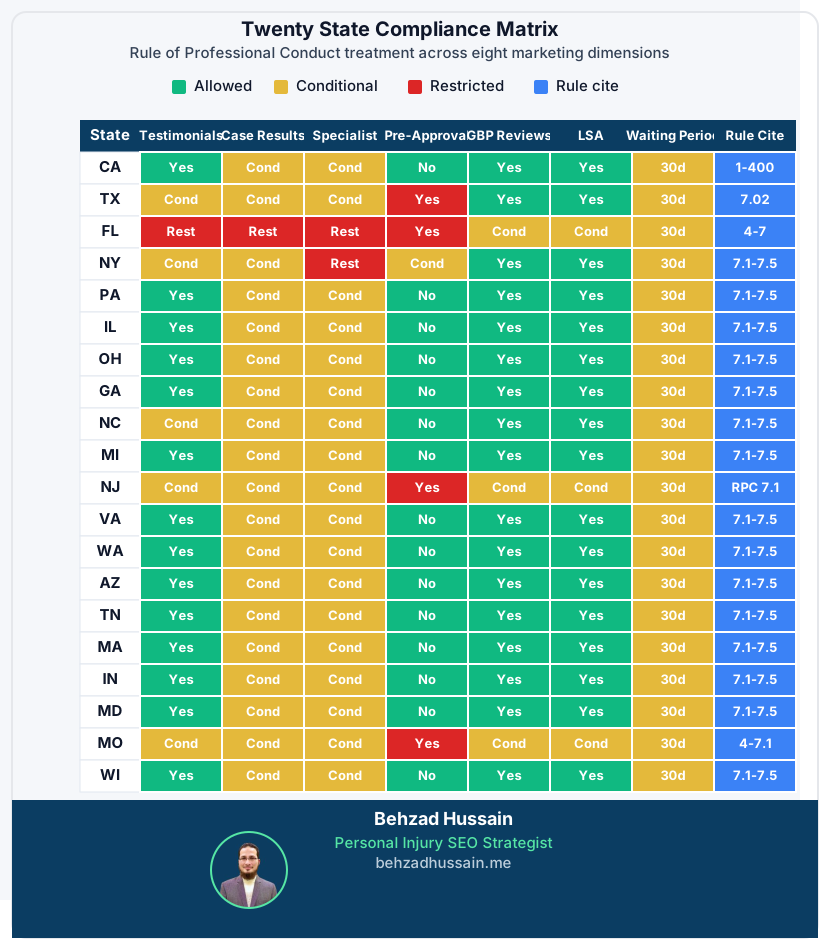
The 20 highest population states cover roughly 75 percent of the United States by population and a larger share of PI legal spend. The matrix below stacks the eight most operationally relevant compliance dimensions per state.
Which state’s rules apply when my ad reaches multiple states? The strictest applicable rule applies, so a multi state PI firm harmonizes across every state the ad reaches, not just the licensing state.
The table below lists the 20 highest population states down the left column and the eight most operationally relevant compliance dimensions across the top. Each cell states whether the dimension is permitted, permitted with a state specific condition, or restricted, and the final column names the state’s Rule of Professional Conduct by number so a compliance owner can jump straight to the source. Last verified 2026-07-22; confirm with the state bar’s current published rules before publishing content that relies on the row, since state rules change 2 to 5 times a year across a 20 state set.
| State | Testimonials | Case Results Disclaimer | Specialist Language | Pre Approval | GBP Reviews | LSA Copy | Waiting Period | Rule Citation |
|---|---|---|---|---|---|---|---|---|
| California | Yes with disclaimer | Yes (SB 37 outcome ban) | Certified only + disclosure | No | Treated as testimonials | Follows 7.1 to 7.5 + SB 37 | 30 days (baseline) | CA RPC 7.1 to 7.5; SB 37 |
| Texas | Yes | Yes | Conditional (certified fields only) | No | Treated as testimonials | Follows TX 7.01 to 7.06 | 30 days | TX DR 7.01 to 7.06; Opinion 524 |
| Florida | Yes | Yes + objective verifiability | Certified fields only | Yes (Rule 4-7 series) | Treated as testimonials | Follows 4-7 series | 30 days (Rule 4-7.15) | FL RPC 4-7.11 to 4-7.23 |
| New York | Yes with disclaimer | Yes + factually supportable | Certified only + disclaimer | No | Treated as testimonials | Requires ATTORNEY ADVERTISING notice | 30 days; 15 days for filings | NY RPC 7.1 to 7.5 |
| Pennsylvania | Yes | Yes | Conditional | No | Treated as testimonials | Follows 7.1 to 7.5 | 30 days | PA RPC 7.1 to 7.5 |
| Illinois | Yes | Yes | Conditional with certifier disclosure | No | Treated as testimonials | Follows 7.1 to 7.5 | 30 days | IL RPC 7.1 to 7.5 |
| Ohio | Yes | Yes | Conditional | No | Treated as testimonials | Follows 7.1 to 7.5 | 30 days | OH RPC 7.1 to 7.5 |
| Georgia | Yes | Yes | Certified fields only | No | Treated as testimonials | Follows 7.1 to 7.5 | 30 days | GA RPC 7.1 to 7.5 |
| North Carolina | Yes | Yes | Certified only | No | Treated as testimonials | Follows 7.1 to 7.5 | 30 days | NC RPC 7.1 to 7.5 |
| Michigan | Yes | Yes | Conditional | No | Treated as testimonials | Follows 7.1 to 7.5 | 30 days | MI RPC 7.1 to 7.5 |
| New Jersey | Yes with disclaimer | Yes | Certified only + disclosure | Yes (advertising committee filing) | Treated as testimonials | Follows 7.1 to 7.5 | 30 days | NJ RPC 7.1 to 7.5 |
| Virginia | Yes | Yes | Conditional | No | Treated as testimonials | Follows 7.1 to 7.5 | 30 days | VA RPC 7.1 to 7.5 |
| Washington | Yes | Yes | Conditional with certifier disclosure | No | Treated as testimonials | Follows 7.1 to 7.5 | 30 days | WA RPC 7.1 to 7.5 |
| Arizona | Yes | Yes + expense/fee split disclosure | Certified fields only | No | Treated as testimonials | Follows 7.1 to 7.5 | 30 days | AZ RPC 7.1 to 7.5 |
| Tennessee | Yes | Yes | Conditional | No | Treated as testimonials | Follows 7.1 to 7.5 | 30 days | TN RPC 7.1 to 7.5 |
| Massachusetts | Yes | Yes | Conditional with certifier disclosure | No | Treated as testimonials | Follows 7.1 to 7.5 | 30 days | MA RPC 7.1 to 7.5 |
| Indiana | Yes | Yes | Conditional | No | Treated as testimonials | Follows 7.1 to 7.5 | 30 days | IN RPC 7.1 to 7.5 |
| Maryland | Yes | Yes | Conditional | No | Treated as testimonials | Follows 7.1 to 7.5 | 30 days | MD RPC 7.1 to 7.5 |
| Missouri | Yes with disclaimer | Yes | Certified only | Filing required for some | Treated as testimonials | Follows MO 4-7 series | 30 days | MO RPC 4-7.1 to 4-7.5 |
| Wisconsin | Yes with disclaimer and consent | Yes | Conditional with certifier disclosure | No | Treated as testimonials | Follows 7.1 to 7.5 | 30 days | WI SCR 20:7.1 to 20:7.5 |
Rows are read left to right per compliance dimension. Testimonials “Yes with disclaimer” means the state permits testimonials only with a specific disclaimer required by rule. “Certified only” for specialist language means only board certified attorneys may use “specialist” or “expert” phrasing and the certifying organization must be identified. “Pre approval” applies where the state bar reviews certain ad formats in advance of publication.
State Deep Dives Where Matrix Compression Fails
Six states diverge from the ABA baseline in ways that a matrix row cannot fully carry. Marketing decisions in those states need dedicated review. The ring diagram below identifies the nine strictest enforcement states, and the six deep dives that follow cover the states where compression fails most consistently.
Nine Strict Enforcement States for Personal Injury Firms
Each state layers its own rule on top of the ABA baseline. Hover the diagram to pause the rotation.
Nine states diverge from the ABA baseline enough to warrant dedicated review.
California: The Bar Rules Plus SB 37 Statutory Layer
California layers two regimes on PI marketing. The California Rules of Professional Conduct 7.1 through 7.5 supply the bar rule baseline. California Senate Bill 37, effective January 1, 2026, adds a statutory layer with a private right of action, vendor liability, and statutory damages of 5,000 to 100,000 dollars per violation. The State Bar of California’s official rule text below shows Rule 7.1 as approved by the California Supreme Court, with paragraph (a) and the no fee without recovery comment highlighted, because those two passages drive most California compliance rewrites.

SB 37 changes three operational decisions. Every digital touchpoint must explicitly name a responsible California licensed attorney and either a physical office location or the attorney’s State Bar address of record. Every guarantee, warranty, and prediction of outcome is now barred by statute in addition to bar rule. The law firm is directly liable for the acts of its marketing vendors and lead generation partners, so vendor selection is a compliance decision, not a procurement decision.
A firm that operated across California, Texas, and Florida rebuilt its intake funnel disclosure in Q4 2025 after mapping SB 37 obligations against its existing GBP profile, LSA copy, and landing pages. The firm dropped one lead generation vendor after the vendor refused to sign an SB 37 compliance rider. The rebuild cost 90 days of team time. The alternative was $100,000 per violation exposure across a multi state ad footprint.
“Vendor selection is now a compliance decision, not a procurement decision. A cheap vendor that publishes non compliant ad copy exposes the firm to a private lawsuit under SB 37, and the firm carries the liability, not the vendor.”
Behzad Hussain, Personal Injury SEO Strategist
Excerpt: California Senate Bill 37, 2025 (effective January 1, 2026)
California Legislature · Senate Bill 37 · 2025 to 2026 Regular Session
Statutory Damages and Cure Period for Attorney Advertising Violations
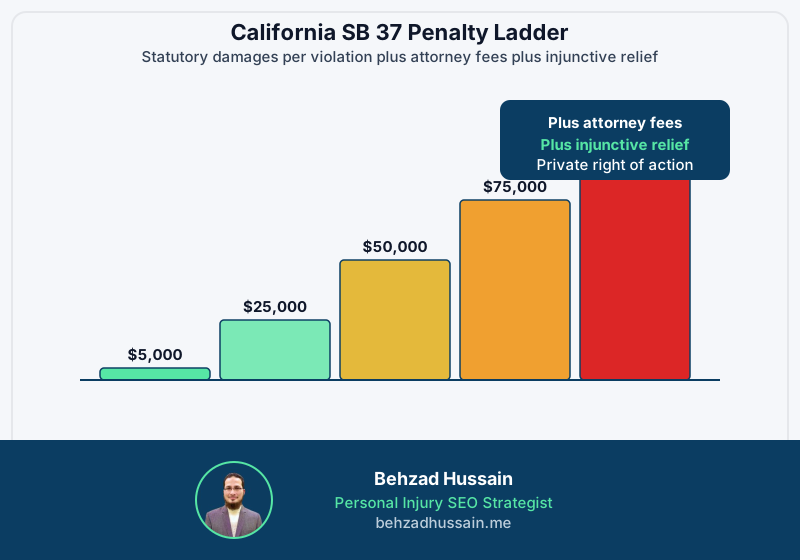
A person injured by a violation of this section may bring a civil action against the law firm, attorney, or advertiser responsible for the advertisement. In an action brought under this section, the court may award statutory damages of not less than five thousand dollars ($5,000) and not more than one hundred thousand dollars ($100,000) per violation, plus reasonable attorney’s fees, costs, and injunctive relief.
No action for statutory damages may be brought if the advertiser withdraws the advertisement within seventy-two (72) hours of receiving written notice of the alleged violation and provides written confirmation of the withdrawal to the person who provided the notice.
A law firm is liable for the acts of any marketing vendor, lead generation service, or third party engaged to place or produce advertisements on behalf of the firm.
Statutory damages up to $100,000 per violation, a 72 hour cure window, and firm liability for every vendor act.
Florida: Rule 4-7 Series and the Pre Approval Regime
Florida runs the most burdensome regime in the country. The Florida Rules of Professional Conduct 4-7.11 through 4-7.23 establish the framework, and the Florida Bar Handbook on Lawyer Advertising and Solicitation carries the operational detail. Florida requires objective verifiability of every claim under Rule 4-7.13, which is a stricter standard than the ABA baseline “not materially misleading” test.
Excerpt: Florida Rule of Professional Conduct 4-7.13
The Florida Bar · Rules of Professional Conduct · Subchapter 4-7
Rule 4-7.13 · Deceptive and Inherently Misleading Advertisements
A lawyer may not engage in deceptive or inherently misleading advertising. An advertisement is deceptive or inherently misleading if it: (1) contains a material statement that is factually or legally inaccurate; (2) omits information necessary to prevent the information supplied from being misleading; or (3) implies the existence of a material nonexistent fact.
Inherently misleading advertisements include, but are not limited to: statements that are not objectively verifiable; statements that promise results; statements that state or imply the lawyer can achieve results by improper means; and comparisons of lawyers based on subjective factors.
Florida’s objective verifiability standard is stricter than the ABA baseline “not materially misleading” test.
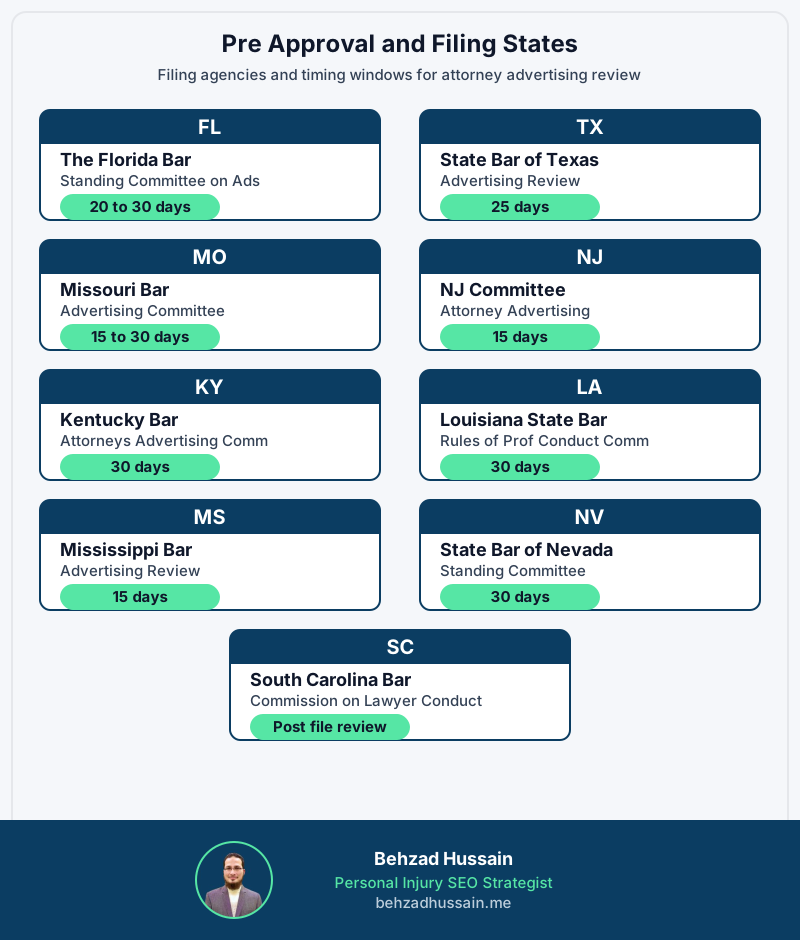
Florida’s pre approval regime differentiates it from every other state. Certain advertising formats must be submitted to the Florida Bar Standing Committee on Advertising in advance of publication. Direct mail pieces are subject to review timelines that can add 15 days to a campaign launch schedule.
Florida Rule 4-7.15 prohibits direct mail solicitation of a person known to have suffered a personal injury within 30 days of the accident. Out of state attorneys may not advertise Florida legal services for state matters, so a Georgia PI firm cannot run Facebook ads targeting Florida audiences with Florida practice claims.
Certification and specialty rules are also stricter. A Florida lawyer who is board certified in civil trial law may state that certification, but may not state certification in personal injury unless the lawyer holds the specific personal injury certification through the Florida Board of Legal Specialization or an ABA accredited certifier. The distinction is enforced.
New York: Rule 7.1 to 7.5 and the ATTORNEY ADVERTISING Label
New York layers a labeling regime on top of Rules 7.1 through 7.5. New York Rule 7.1(f) requires that any advertisement in electronic or written form include the phrase “ATTORNEY ADVERTISING” on the first page or first screen viewed. The homepage label is not optional. Placement must be clearly visible to a reasonable reader; a footer only label at 8 pixels is not defensible when litigated.
New York Rule 7.1(d) governs prior settlements and verdicts. A firm may reference prior results provided the statement is factually supportable and accompanied by the required disclaimer language “Prior results do not guarantee a similar outcome.” The disclaimer must be paired with the statement, not buried in a footer.
New York Rule 7.3 sets the direct mail waiting period at 30 days after a personal injury or wrongful death incident, with a carve out to 15 days when a filing deadline within 30 days would otherwise be missed. Solicitations must be labeled as attorney advertising when sent to prospects the lawyer knows or reasonably should know need legal services.
Multi state firms with New York exposure often carry a New York specific email footer with the label and disclaimer language to satisfy the labeling requirement without maintaining separate creative variants per state.
Texas: Rule 7.03 and the Interpretive Opinion Layer
Texas Disciplinary Rule 7.03 governs solicitation. The rule bars in person, live phone, and real time electronic solicitation of prospective clients unless the pre existing relationship exception applies. Personal injury and wrongful death solicitations of prospective plaintiffs are permitted through non real time methods only 30 days after the incident.
Texas is distinctive because a layer of Legal Ethics Committee opinions materially shapes rule application. Texas Legal Ethics Committee Opinion 524 addresses referral service participation. Newer opinions address chat pop ups, LSA participation, and lead generation vendor relationships. Firms operating in Texas need to track opinions in addition to rule text, because the operational rule is what the opinions say the rule text means.
A solo PI attorney in Houston overhauled his direct mail cadence after reviewing Opinion 524 and adjacent guidance. He dropped a third party lead reseller that could not demonstrate compliance with Rule 7.03’s real time contact ban, and rebuilt his mail template with a 30 day delay from a verified accident date field in his intake CRM. Mail response rates dropped 12 percent in the first quarter. Signed case volume rose 8 percent, because the delayed mail reached prospects at a moment when they were ready to hire rather than triaging emergency care.
“Texas without the opinion layer is a rule you have half read. Every campaign in Texas needs a lawyer with recent opinion review inside the decision loop.”
Behzad Hussain, Personal Injury SEO Strategist
Missouri: Solicitation History and the Current Enforcement Posture
Missouri has a long history of strict solicitation enforcement dating to In re Primus territory in the late 1970s. Missouri Rules of Professional Conduct 4-7.1 through 4-7.5 track the ABA baseline, but the state’s enforcement posture on testimonials, endorsements, and direct mail remains stricter than the median state.
Missouri requires testimonial disclaimers similar to New York’s language, informed client consent, and clarity that the testimonial is not a guarantee of similar outcomes. Direct mail and email to known accident victims within 30 days of the incident is barred.
A St. Louis PI firm rewrote its testimonial page after the Missouri Office of Chief Disciplinary Counsel opened an informal inquiry about a homepage testimonial widget that displayed client outcomes with insufficient disclaimer prominence. The firm relocated the disclaimer language into each testimonial card rather than a footer, added the informed consent flag inside the CMS, and standardized the testimonial approval workflow with an attorney sign off before publication. The inquiry closed with no discipline.
New Jersey: The Committee on Attorney Advertising Pre Approval Path
New Jersey Rules of Professional Conduct 7.1 through 7.5 track the ABA baseline. The distinguishing feature is the New Jersey Supreme Court’s Committee on Attorney Advertising, which reviews advertising formats and issues advisory opinions.
Certain advertising formats are subject to filing with the committee. Advisory opinions are published and become operational rules for firms marketing to New Jersey audiences. Testimonial rules require specific disclaimer language and informed consent. Comparative advertising is more tightly bounded than in most states.
A New Jersey firm running a campaign that reaches Pennsylvania and New York needs to stack all three states’ rules onto the same creative, so the New Jersey Committee on Attorney Advertising’s most restrictive requirements set the operational rule for the whole campaign.
What the Rules Mean on Each Marketing Surface You Optimize
You do not comply with rules; you comply with rules on specific surfaces. The section below translates universal rules into operational bounds on the surfaces you already run. The matrix that follows shows how each ABA Model Rule intersects with the marketing surfaces a personal injury firm touches every day.
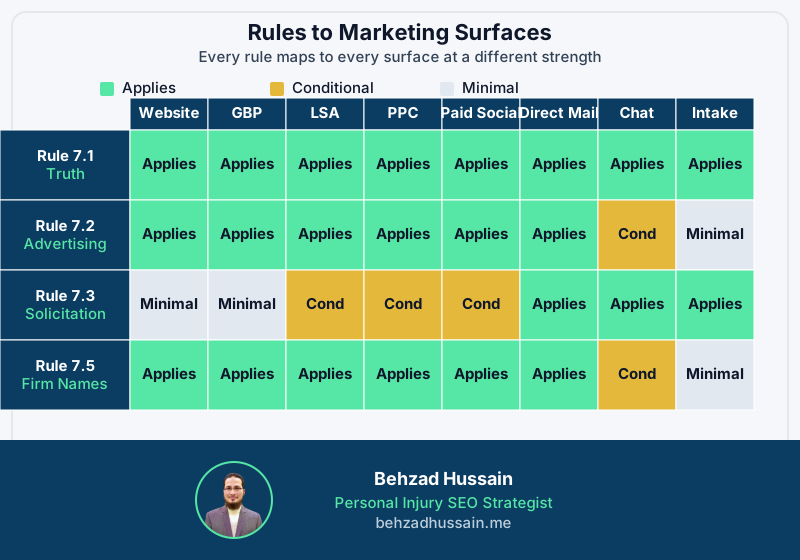
Title Tags, Meta Descriptions, and H1 Copy
Title tags and meta descriptions carry the highest per character compliance risk of any surface. Rule 7.1 misleading standards apply. Rule 7.2 paragraph (c) specialist language restraint applies. A title tag that reads “Best Personal Injury Specialist in Miami” combines a comparative claim under 7.1 with a specialist claim under 7.2. Both fail unless the attorney is board certified and can substantiate “best” through verifiable data, which is almost never possible.
A solo PI attorney in Ohio pulled his site’s title tags after receiving an informal warning from the Ohio Office of Disciplinary Counsel. He rewrote every practice area title with descriptive attribute framing (“Ohio Personal Injury Attorney serving Franklin County”) that carried keyword weight without triggering rules. Rankings held. Warning letter closed.
Practice Area Pages and Location Pages
Practice area pages carry claims about the lawyer’s services. Every objective claim must be substantiable. Fee statements (“no fee unless we win”) trigger contingency fee disclosure rules in states like Arizona and California, where the client’s responsibility for costs must be disclosed alongside the fee promise.
Location pages carry a jurisdictional layer. If the location page describes services in a state where no firm attorney is licensed, the page implies unauthorized practice unless the disclaimer is clear. Multi state firms need per state page disclaimers rather than a generic footer disclaimer.
Case Results, Verdict Pages, and Hero Stat Blocks
Verdict and settlement pages are the highest scrutiny content type on a PI website. Every prior result claim requires a disclaimer that prior results do not guarantee similar outcomes. Florida adds an objective verifiability requirement. New York requires the specific “Prior results do not guarantee a similar outcome” language paired with the claim. California under SB 37 bars outcome guarantees entirely.
“Every PI firm I audit has at least one hero stat block that overstates the firm’s verdict record by omitting case types, geographic distribution, or the ratio of settlements to verdicts. That omission alone is a Rule 7.1 misleading violation in most states.”
Behzad Hussain, Personal Injury SEO Strategist
Illustrative mockup: Verdict hero block, before and after
Car accidents. Truck accidents. Wrongful death.
Car accidents. Truck accidents. Wrongful death.
Illustrative mockup. The disclaimer belongs paired with the claim, not buried in a footer. Firm name and figures are for illustration only.
Testimonials, Endorsements, and Review Widgets
Testimonials are permitted in most states with three conditions. First, the testimonial must be truthful. Second, if the testimonial describes a specific outcome or comparative claim, the required state disclaimer must accompany the testimonial. Third, informed client consent for use of the testimonial must be documented, especially where the underlying matter is pending.
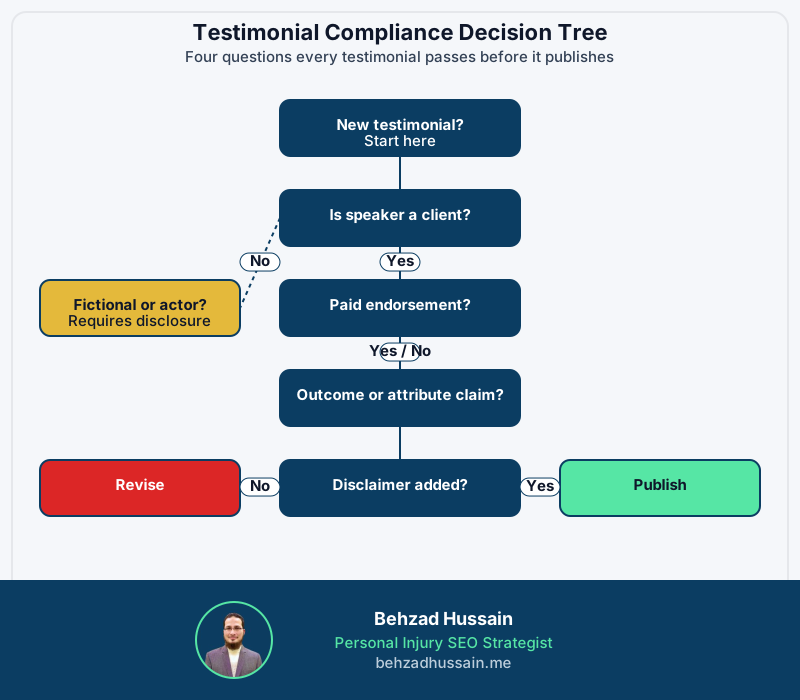
Some states distinguish between soft testimonials (which describe the lawyer’s professional attributes and service) and hard testimonials (which describe case outcomes or make comparisons). Soft testimonials face fewer disclaimer requirements. Hard testimonials require the outcome disclaimer at minimum.
Are Google reviews considered testimonials under bar rules? Yes, most state bars treat every review posted about a lawyer or firm as a testimonial subject to the same rules that govern testimonials published on the firm’s own site, which means outcome claims in reviews trigger disclaimer and truthfulness bounds even though the firm did not author the review.
Illustrative mockup: Testimonial card, before and after
★★★★★
M. R., Kansas City
“Got me a $2 million settlement after my truck accident. They fought harder than any other firm I met with. Would hire them again in a heartbeat.”
★★★★★
M. R., Kansas City
“They fought harder than any other firm I met with. Would hire them again in a heartbeat.”
Outcome quantity removed. Disclaimer paired with the card. Informed written consent on file.
Illustrative mockup. The disclaimer belongs on the testimonial card itself, not the page footer. Names and quotes are for illustration only.
Google Business Profile and Google Reviews
Google Business Profile is a marketing surface subject to bar rules on multiple fronts. Business categories, hours, address accuracy, and business description are all firm published content. The address must correspond to a real office where lawyers regularly conduct business. Business descriptions carry Rule 7.1 misleading bounds. Reviews the firm solicits are testimonials for compliance purposes.
Can I offer a discount for a Google review? No, incentivizing reviews with discounts or gifts crosses ABA Rule 7.2 paragraph (b) payment for recommendation restrictions and violates the FTC Endorsement Guides at 16 CFR Part 255 independent of bar rules, because a review incentivized by compensation is a paid endorsement that must be disclosed as such.
The technical mechanics of how Google treats reviews as endorsement signals are documented in Google’s 2004 patent, Methods and Systems for Endorsing Local Search Results, US Patent 7,827,176 B2, which describes how endorsements function as inputs into local search ranking. Business listing verification mechanics are described in Google’s 2011 patent, Using Images to Identify Incorrect or Invalid Business Listings, US Patent 8,462,991 B1. These patents matter operationally because a review acquired through non compliant means creates both a bar risk and a signal risk if Google’s verification systems flag the listing.


Google Local Services Ads
Google Local Services Ads collide with disclaimer requirements because the 30 character ad copy limit leaves no room for a full state required disclaimer. The workaround is to keep ad copy purely descriptive and place disclaimers on the landing page. LSA also requires attorney identity verification, insurance confirmation, and license validation through the state bar.
“LSA character limits are the compliance choke point of the platform. The only workable pattern is to move every disclaimer to the landing page and treat the ad copy as pure descriptive language, never as substantive claim.”
Behzad Hussain, Personal Injury SEO Strategist
Texas attorneys running LSA must comply with Texas Rules 7.01 through 7.06 in addition to Google’s policy. Firms in Florida must confirm no Rule 4-7 pre approval requirement applies to the LSA copy before running the ad.
Google Ads and PPC
Google Ads text carries similar character limit tension with disclaimer requirements. Headlines are limited to 30 characters, and disclosure requirements often exceed that limit. Landing page policy under Google Ads requires substantiation of claims, which aligns with Rule 7.1’s misleading standard.
Comparative claims in ad copy (“Best Injury Lawyer”) face both bar rule scrutiny and Google Ads policy scrutiny. Guaranteed outcomes (“We guarantee compensation”) are barred by both Google Ads policy for personal injury advertisers and by every state bar’s Rule 7.1.
Facebook, Instagram, and TikTok Paid and Organic
Meta and TikTok surfaces bring solicitation risk into play alongside advertising rules. Paid Facebook targeting that reaches a known accident victim inside the state waiting period triggers Rule 7.3 solicitation concerns. Instagram Reels and TikTok videos that show client outcomes without accompanying disclaimers replicate the verdict page problem inside a different container.
A California firm’s TikTok campaign triggered a bar inquiry after a video showing a client’s post settlement lifestyle went viral without the required outcome disclaimer. The firm removed the video, added a written internal review workflow requiring attorney sign off on every social video before publication, and cleared the inquiry with a compliance certification to the California Bar. The compliance cost was low relative to the branding value of the campaign, but only because the firm cured quickly.
LinkedIn and X Profile Activity
LinkedIn profiles are advertising for compliance purposes. A profile that describes the attorney as a “personal injury specialist” without certification and disclosure violates 7.2 paragraph (c). Direct messaging that offers legal services to a prospect the lawyer knows or reasonably should know needs legal services is prohibited under 7.3, and the interactive nature of DMs likely qualifies as real time electronic contact.
X profile bios face the same specialist restriction. Threads describing client outcomes require the same disclaimer language as any other testimonial or verdict claim.
Direct Mail, Email, and SMS Outreach
Direct mail carries the widest state variation. The universal starting point is a 30 day waiting period after a known personal injury. Alabama’s 2026 rule moves the direct mail window to 21 days. New York carves out 15 days when a filing deadline requires earlier contact. Florida requires ATTORNEY ADVERTISING labeling under Rule 4-7.15 and prohibits mail within 30 days of the accident. The timeline below places every state’s earliest permissible contact date against the accident date, so a multi state cadence can be built without violating the strictest applicable rule.
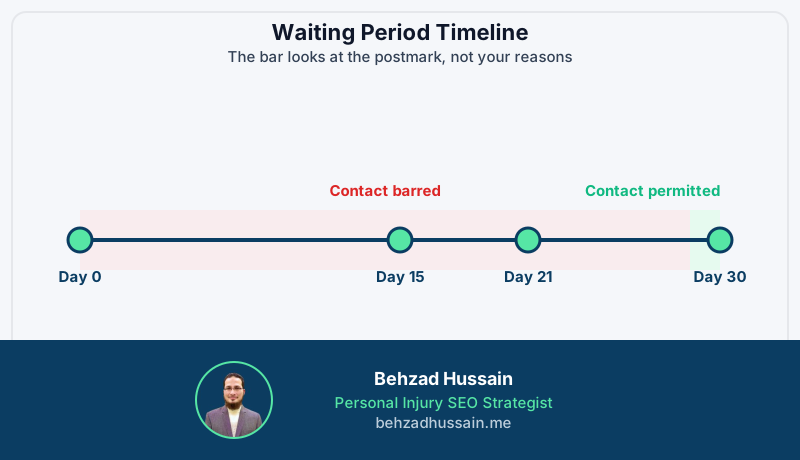
Email carries the same waiting period logic. SMS is a real time or near real time channel; if the SMS interaction is conversational, it falls within Rule 7.3’s real time electronic contact prohibition regardless of the mail waiting period. Most firms avoid unsolicited SMS to PI prospects entirely.
“Cadence discipline is the difference between a compliant campaign and a filed grievance. The bar does not look at your reasons for missing a 30 day window; the bar looks at the postmark.”
Behzad Hussain, Personal Injury SEO Strategist
Chat Widgets, Web Forms, and Intake Scripts
Is a chat pop up considered solicitation under Rule 7.3? Not when the prospect initiated the visit and the chat opens in response to the visitor’s action; a chat pop up that fires unprompted while the visitor is passively reading is closer to real time solicitation and requires jurisdiction specific review before deployment.
Intake scripts that promise outcomes (“we always win these cases”) violate Rule 7.1 the same way ad copy does. Every intake team member speaking to a prospect is speaking for the firm. Staff training on Rule 7.1 misleading standards is a compliance foundation.
Podcast, Video, and Broadcast
Podcast episodes and YouTube content that describe client outcomes without disclaimers replicate the verdict page problem. Broadcast television and radio ads in Florida, Texas, and other states with pre approval regimes require submission to the state bar advertising committee before airing.
Broadcast disclosures move at a different pace than digital disclosures. A 30 second radio ad cannot recite the full prior results disclaimer; the workaround is to move disclaimers to the landing page or website the ad drives to.
The 2026 Legal Shifts You Cannot Ignore
Two 2026 changes reset the operating environment for personal injury attorney marketing. California SB 37 layers statutory damages and vendor liability on top of the bar rules. Alabama’s revised Rules of Professional Conduct compress the direct mail waiting period. The ladder diagram below sizes the SB 37 exposure at a per violation level before the deep dive on each state.
California SB 37: Vendor Liability and Consumer Private Right of Action
California Senate Bill 37, effective January 1, 2026, adds a statutory layer to California’s attorney advertising rules. Three provisions matter operationally.
First, every digital touchpoint must explicitly name a responsible California licensed attorney and disclose a real office location or the attorney’s State Bar address of record. Websites, landing pages, social profiles, LSA profiles, and lead generation intake funnels all fall inside this requirement.
Second, guarantees, warranties, and predictions of outcome are barred by statute in addition to bar rule. Phrases like “we always win,” “guaranteed compensation,” and “fast cash promise” that once faced only bar review now face civil liability.
Third, law firms are directly liable for the acts of their marketing vendors and lead generation partners. A vendor that publishes non compliant ad copy exposes the firm to statutory damages of 5,000 to 100,000 dollars per violation, plus attorney fees and injunctive relief. Vendor selection is now a compliance decision.
Consumers hold the private right of action. The 72 hour cure period after notice is short. Firms that receive a compliance notice must withdraw the advertisement within 72 hours to avoid the statutory damages calculation.
Alabama 2026 Amendments: The 21 Day Direct Mail Window
The Supreme Court of Alabama issued amendments to the Alabama Rules of Professional Conduct on May 13, 2025, effective January 1, 2026. The amendments reshape multiple advertising provisions.
The change that matters most for PI marketing operations is the direct mail window. Alabama’s revised rule permits direct email or letter contact with a known personal injury victim only after 21 days from the incident date, not 30. The window is shorter than the universal baseline but the constraint remains real.
An Alabama PI firm that had been running a 30 day post accident mail cadence rebuilt its intake CRM to fire the mail on day 22 after a verified accident date. Response rates rose because the mail arrived earlier in the prospect’s decision timeline. The firm still cleared the waiting period requirement.
AI Generated Content Compliance Under Rule 7.1
Artificial intelligence is now part of every PI firm’s content pipeline, from AI headshots to AI generated ad copy. Rule 7.1’s misleading standard applies to AI outputs the same way it applies to human authored copy. The decision flow below tracks the three questions the compliance owner asks before publishing any AI generated marketing artifact.
AI Content Compliance Flow Under Rule 7.1
Every AI generated marketing artifact passes through the same three questions before it can be published.
AI content passes through Rule 7.1 the same way human written content does.
AI Headshots, Images, and Video
AI generated headshots on attorney bio pages fail Rule 7.1’s misleading standard when the image implies the lawyer’s appearance or credentials in a way that departs from reality. A synthesized image that presents an idealized version of the attorney is materially misleading even if the underlying claim about the attorney’s services is accurate.
AI generated images of “clients” that are not clients require actor disclosure at minimum. A photograph or video that appears to be a client but is a stock image or AI generated actor must be labeled so a reasonable viewer understands the depiction is not a real client.
The technical mechanics of AI content detection are documented in IBM’s 2020 patent application, Artificial Content Identification Using Subset Scanning Over Generative Model Activations, US Patent Application 2022/0138584 A1, which describes identification of artificial content through activation pattern scanning. State bar disciplinary counsel and consumer plaintiffs under SB 37 style regimes have access to these detection techniques.

“AI headshots on PI attorney bio pages are the fastest growing accidental Rule 7.1 violation I see. The firm did not intend to deceive; the firm bought a photo package that happened to be synthetic. The rule does not care about intent.”
Behzad Hussain, Personal Injury SEO Strategist
AI Generated Ad Copy and Landing Page Text
AI generated ad copy and landing page text carry the same Rule 7.1 misleading and Rule 7.2 specialist bounds as human written copy. The compliance risk is that AI systems tend to produce comparative language (“best,” “top rated,” “most experienced”) that fails the substantiation test. Firms using AI to draft copy need an attorney review layer between generation and publication.
Actor and Non Client Disclosure
Every visual depiction of a person implied to be a client must either use a real client with informed consent or disclose that the depiction is an actor or stock image. The disclosure must be clear enough that a reasonable viewer understands the depiction, not buried in a footer.
Enforcement Mechanics: What Actually Happens After a Complaint
The Bar Complaint Procedural Timeline
A bar advertising complaint typically follows a five stage timeline.
- Complaint intake. Receipt and initial screening by the state bar’s disciplinary counsel or advertising review committee.
- Investigation. The committee requests records and responses from the firm.
- Informal resolution. Many complaints close at this stage with a warning letter or minor remediation.
- Formal charges. If applicable, the matter moves to a disciplinary tribunal.
- Discipline. If applicable, discipline ranges from private reprimand through disbarment.
Most PI advertising complaints resolve at stage three when the firm remediates promptly and demonstrates a compliance program.
State Bar Advertising Review Committees
Florida’s Standing Committee on Advertising, New Jersey’s Committee on Attorney Advertising, Missouri’s Chief Disciplinary Counsel, and Texas’s Advertising Review process review ad copy on complaint or on submission. Committees issue advisory opinions that carry weight beyond the specific matter, because subsequent firms rely on the opinions to gauge what conduct is permissible.
Records Retention and Substantiation
Most state bars require advertising records to be retained. Retention periods vary from one year to three years across states. Records include screenshots, dated captures, PDF exports, mail piece samples, and video files. Records support substantiation of claims if a complaint arises and support the firm’s defense during any investigation.
Example: State bar informal inquiry closure letter anatomy
Office of Chief Disciplinary Counsel
State Bar of Missouri
Re: Inquiry No. XX-2026-1284 · File closed on March 14, 2026
Dear Counselor Name,
This letter confirms that the informal inquiry opened on January 21, 2026 regarding the testimonial widget published at firm-website.com/reviews has been closed at the informal resolution stage.
The Office received your response dated February 4, 2026, together with the revised testimonial page and the documented per card disclaimer language now in place. The revisions satisfy the disclaimer requirements of Missouri Rule of Professional Conduct 4-7.1 and 4-7.2.
No formal charges will be filed. This matter is closed. The Office reminds counsel that testimonials referencing case outcomes must carry the required disclaimer paired with the outcome statement, and that written client consent must be retained for each testimonial published.
Sincerely,
Assistant Chief Disciplinary Counsel
Illustrative anatomy of an informal closure letter. Redacted fields show where identifying details would be blacked out in a real capture. Most PI advertising inquiries close at this stage when the firm remediates promptly.
Self Diagnostic
Score your PI firm’s compliance posture
Check every statement that is true for your firm today. The score updates as you check. Nothing is submitted; the answers live on your screen only. Use the score to decide which sections of this article deserve a compliance owner’s attention this quarter.
Your compliance posture score
Below 5 of 10: meaningful compliance exposure across multiple surfaces; a Personal Injury SEO Diagnostic is the fastest way to prioritize the fixes. 5 to 7: foundational posture with specific gaps; the PI Authority Growth System closes the remaining surfaces on a monthly cadence. 8 to 10: mature program; a Fractional PI Search Strategist engagement adds senior oversight and cross state harmonization.
Request a Personal Injury SEO DiagnosticMarketing Vendor Onboarding After SB 37
California SB 37 makes the firm liable for the conduct of every marketing vendor and lead generation partner it engages. Vendor selection turned into a compliance decision on January 1, 2026. The hub and spoke diagram below shows how liability flows from every vendor category back to the firm at the center; the checklist that follows converts the diagram into an operational onboarding script.
Vendor Accountability Under California SB 37
Every marketing vendor category flows liability back to the firm at the center. Hover a spoke to highlight.
SB 37 puts the firm at the center of every vendor decision.
The Vendor Vetting Checklist
The vendor vetting checklist below covers the operational questions to ask before signing any marketing vendor after California SB 37 raised the vendor liability bar. The checklist runs 8 items.
- Does the vendor have documented experience with attorney advertising compliance in California and any other state you market in?
- Does the vendor produce ad copy that satisfies Rule 7.1 misleading and Rule 7.2 specialist bounds by default?
- Does the vendor handle prior results disclaimers correctly by state and by surface?
- Does the vendor understand and honor waiting period rules for direct mail and email?
- Does the vendor maintain advertising records at retention periods matching the strictest state you market in?
- Does the vendor carry professional liability insurance appropriate to attorney advertising exposure?
- Does the vendor agree to a compliance rider in the master services agreement?
- Does the vendor consent to periodic audits and provide access to campaign artifacts on request?
Contract Clauses to Require
The three contract clauses below are the minimum defensible package for a PI firm signing a marketing vendor in a post SB 37 regime. The clauses cover indemnification, compliance representations, and audit rights.
Indemnification. The vendor indemnifies the firm for statutory damages, attorney fees, and defense costs arising from vendor non compliance with applicable attorney advertising rules or state statutes.
Compliance representations. The vendor represents that it maintains policies, training, and workflows to ensure ad copy compliance with ABA Model Rules 7.1 through 7.5 as adopted by every state where campaigns run.
Audit rights. The firm may audit vendor artifacts, records, and workflows quarterly and on notice, and the vendor cooperates with document requests.
Ongoing Audit Cadence
The audit cadence below fits most multi state PI firms without adding unbounded overhead. The audit cadence runs on three tempos.
- Weekly artifact review by the firm’s designated compliance owner for any new landing page, ad, or profile change.
- Monthly random sampling of vendor produced content by the responsible California licensed attorney.
- Quarterly full audit of vendor artifacts, records, and workflows against the applicable state rules stack.
Firms that run all three tempos catch vendor drift inside one quarter, before a consumer notice or a bar inquiry forces the review on a deadline the firm does not control.
Run compliance and ranking together, every month
The PI Authority Growth System is the monthly retainer that pairs the four pillar PI Authority Engine with a compliance overlay on every ranking surface. Monthly roadmap. Compliance reviewed practice area rewrites. Vendor audits. State bar defensible by design, before publication.
Apply for the Growth SystemForum Questions PI Firm Marketing Leads Are Asking
Two questions recur across PI firm marketing lead conversations. I am posting them here without answers because the operational answer varies by firm and by state stack. If you have a working answer, leave it in the comments.
Build a PI Marketing Program That Passes Compliance Review
The PI Authority Growth System is the operating framework I run for firms that want their marketing to pass state bar review the first time. The system covers four pillars, each with a compliance overlay. The diagram below shows how the compliance perimeter maps onto the four operating pillars.
PI Authority Engine With Compliance Overlay
The four operating pillars of the PI Authority Engine each carry a compliance overlay that tests every artifact against state bar rules before publication.
Technical Stability
Crawlability, indexation, site architecture, Core Web Vitals, and schema.
Intent Capture
Practice area structure, location pages, keyword alignment, and search intent mapping.
Authority Reinforcement
Internal linking, entity signals, backlink direction, and topical authority.
Case Acquisition
Conversion paths, page structure, CTAs, intake flow, and lead quality.
Every pillar carries a compliance overlay. The engine and the compliance perimeter run together.
Technical Stability covers crawlability, indexation, site architecture, Core Web Vitals, and schema. The compliance overlay tests every schema property (Person, LegalService, Organization) against attorney identity disclosure requirements. Intent Capture covers practice area structure, location pages, and keyword alignment. The compliance overlay tests every title tag, meta description, and H1 against Rule 7.1 misleading and Rule 7.2 specialist bounds. Authority Reinforcement covers internal linking, entity signals, and topical authority. The compliance overlay tests external endorsements and citation strategies against Rule 7.2 payment for recommendation restrictions. Case Acquisition Optimization covers conversion paths, CTAs, and intake flow. The compliance overlay tests every intake script, chat script, and form disclosure against Rule 7.3 solicitation bounds and state specific disclosure requirements.
Frequently Asked Questions
Do out of state advertising rules apply to my in state PI firm when my ad reaches other states?
Yes, an ad that reaches an out of state audience is subject to the reach state’s advertising rules in addition to the licensing state’s rules, so a multi state firm harmonizes across every state the ad reaches. Two operational patterns work. Publish per state variants targeted by geography. Or publish a single asset that stacks the strictest applicable rules across all reach states.
How long do I need to keep copies of my ads?
Most states require retention of advertising records for 1 to 3 years. Florida requires retention of copies of all advertisements, including websites, for at least 3 years from the date of last publication or use. New York requires retention for 1 year for computer accessed communications and 3 years for other advertisements. Confirm your specific state’s rule number before setting a retention policy.
Can I compare my firm to another firm’s results in advertising?
Comparative claims that another firm’s results are inferior to yours require factual substantiation to satisfy Rule 7.1. Most PI firms cannot substantiate the comparison because outcomes vary by case, jurisdiction, and settlement dynamics. Some states impose additional restrictions on comparative advertising. New Jersey and South Dakota require the actual name of the compared firm to appear if a comparative claim is made.
What is the fine for an attorney advertising violation in California under SB 37?
California SB 37 exposes law firms to statutory damages of 5,000 to 100,000 dollars per violation, plus attorney fees and injunctive relief. The 72 hour cure period after notice applies only when the firm withdraws the advertisement within that window; failure to withdraw triggers the statutory damages calculation.
Do I have to include ATTORNEY ADVERTISING on every page of my website or just the homepage?
New York Rule 7.1(f) requires the ATTORNEY ADVERTISING label to appear on the first page or first screen viewed by the visitor of a computer accessed communication. Firms commonly place the label on the homepage and on any communication that qualifies as an advertisement, and many firms carry the label site wide to prevent an argument that a subpage entry point missed the label.