
The Schema Markup Adoption Study: What 1,005 Personal Injury Law Firms Actually Ship on Google Page 1
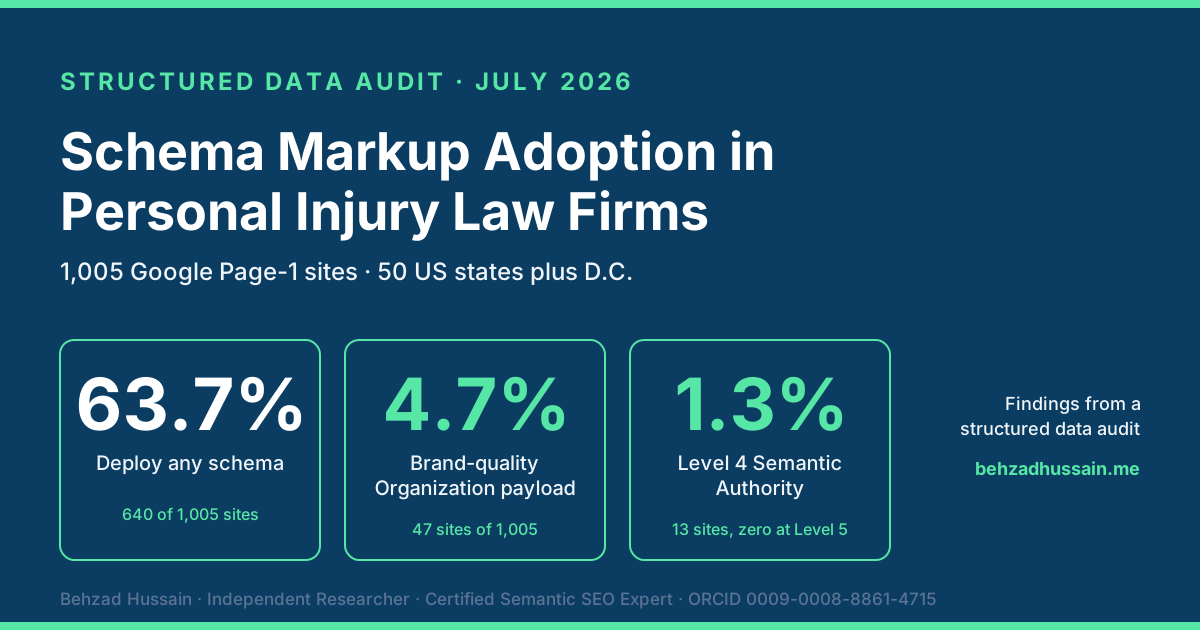
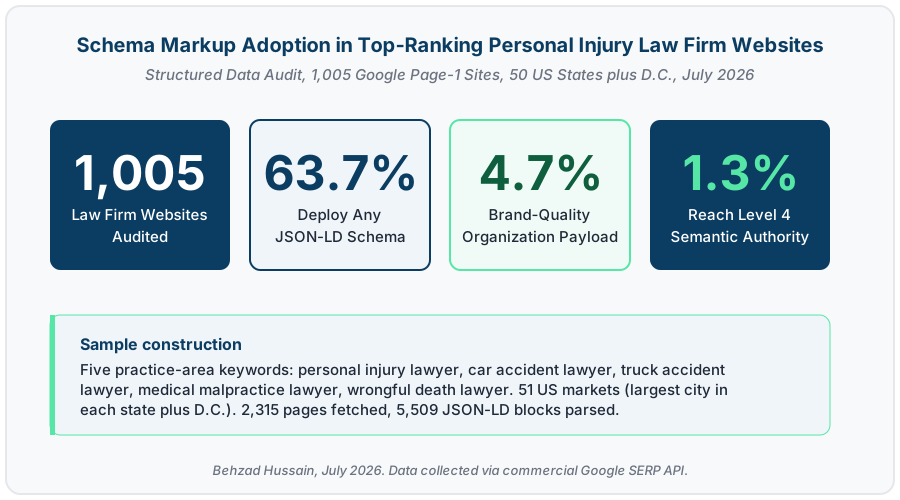
I audited 1,005 personal injury law firm websites currently ranking on the first page of Google Search, across all fifty US states plus Washington D.C., for five practice-area keywords: personal injury lawyer, car accident lawyer, truck accident lawyer, medical malpractice lawyer, and wrongful death lawyer. Only 63.7% of these Page-1 firms deploy any JSON-LD schema at all. Only 35.3% use the industry-specific LegalService type. Only 4.7% ship an Organization payload complete enough to declare the firm as a brand-quality entity. And only 1.3% reach Level 4 Semantic Authority on the six-level maturity model, with zero firms in the entire sample reaching Level 5.
The full working paper, Schema Markup Adoption in Top-Ranking Personal Injury Law Firm Websites: A Structured Data Audit of 1,005 Google Page-1 Sites Across 50 US States, is published on ResearchGate (Publication 410589352, July 2026). This article translates the numbers into practitioner language, walks through what each finding means for a personal injury firm reading it today, and closes with the specific fixes that separate the top 1.3% from the rest of the field.
Contents
- What This Study Measured
- Why This Matters: Structured Data as the Codified Interface into Google
- The Headline Finding: 63.7% Any Schema, 4.7% Brand-Quality
- Where the Gap Is Biggest: Type-by-Type Adoption
- The Rich Results Gap: Ten Features, Ten Different Adoption Curves
- Rank Correlation: Tiebreaker, Not Lever
- Entity Disambiguation: The @id, sameAs, and areaServed Story
- Structured Data Maturity: Where 99% of PI Firms Live
- The Leader Board: The Top-Ranked Firms
- Practical Fixes, Prioritized by the Data
- What This Means for AI Overviews and the Generative Answer Layer
- Study Limitations
- FAQ
- References
- About the Author
What This Study Measured
The audit summarized here is my July 2026 ResearchGate working paper, the second of seven papers in the personal injury search research programme and a direct extension of the earlier 500-firm Schema Completeness Index study. The abstract screenshot below shows the exact 63.7% figure this article opens with, highlighted in the source itself.

I built the sample by querying a commercial Google SERP API on five keyword templates combined with the largest city in each of the 50 US states plus Washington D.C. That is 255 SERP calls, each returning the top ten organic results. From the raw result list I removed legal directories and aggregators (Justia, FindLaw, Avvo, Martindale-Hubbell, SuperLawyers, Nolo, LawInfo, Best Lawyers, HG.org), business directories and review platforms (Yelp, YellowPages, BBB, Thumbtack), social networks (LinkedIn, Facebook, YouTube), forums (Reddit, Quora), encyclopedic sources (Wikipedia), major news outlets, and government or military domains. After filtering and root-domain deduplication, each domain was retained once at the best rank observed. The result: 1,005 unique law firm and attorney websites, of which 371 first appeared in Positions 1-3, 306 in Positions 4-6, and 328 in Positions 7-10.
For every retained domain I fetched the homepage plus up to four practice-area URLs that had actually ranked in the Page-1 SERPs. All URLs were fetched over HTTPS with a Chrome-class User-Agent string, 20 concurrent workers, a 20-second timeout, and follow-redirects enabled. Every <script type="application/ld+json"> block on each fetched page was parsed. The final crawl produced 2,315 successfully fetched pages and 5,509 JSON-LD blocks. Sites deploying schema exclusively via Microdata or RDFa were classified as having no schema for the completeness index; that population is a small minority.
Each site was scored against a five-dimension Schema Completeness Index that I introduced in my earlier 500-firm SSRN paper (Schema Completeness Index for personal injury law firm websites, DOI 10.2139/ssrn.6551638) and reused here to permit comparability across studies. The five dimensions are Type Coverage (breadth of @type values deployed), Property Completeness (average percentage of Google-recommended properties populated across schema types deployed), Entity Disambiguation (presence of @id, sameAs, and url for entity resolution), Hierarchical Nesting (proper nesting of Person to worksFor to Organization, structured PostalAddress, LegalService to hasOfferCatalog), and Validation Status (pass rate against Schema.org required-property requirements per type). Each dimension is scored 0 to 5, summed into a composite score in the range 0 to 25. Sites with no structured data receive 0 on every dimension.
The SCI scoring model was introduced in the earlier 500-firm SSRN paper. The abstract screenshot below shows the same five-dimension model this article scores the 1,005-firm sample against, highlighted in the source.


I also ran ten eligibility checks against Google’s published Rich Results feature specifications: FAQ, Breadcrumb, LocalBusiness, Review Snippet, Sitelinks Search Box, Article, Video, HowTo, Event, and Organization or Knowledge Panel. Each check verifies both schema type presence and specific required properties. A valid FAQ, for example, requires a FAQPage node with mainEntity containing at least one Question whose acceptedAnswer has non-empty text. A count of eligible features from 0 to 10 was recorded per site.
Finally, I computed Spearman rank correlations between each site’s best observed SERP position and its SCI score, and between its SERP position and its Rich Results feature count. The sample was also aggregated into three rank tiers, Positions 1-3, Positions 4-6, and Positions 7-10, so mean adoption rates within each tier could be compared.
What is the Schema Completeness Index and how is it scored? A five-dimension composite that reads Type Coverage, Property Completeness, Entity Disambiguation, Hierarchical Nesting, and Validation Status, each scored 0 to 5, summed to a 0 to 25 total. A firm scoring 25 would have every recommended type deployed with every recommended property populated, every entity wired into the graph via @id and sameAs, correct nesting, and clean validation. In this study, the highest observed score was 19, achieved by schreckpersonalinjurylawyer.com at SERP position 2.
Why This Matters: Structured Data as the Codified Interface into Google
Two shifts in Google’s search infrastructure have raised the stakes on how a law firm’s website is structured for machines to consume. First, since the launch of Google’s Knowledge Graph, described by Amit Singhal in his 2012 Google Official Blog post Introducing the Knowledge Graph: things, not strings, and the deployment of transformer language models such as BERT, published by Devlin and colleagues in 2019 in the Proceedings of NAACL-HLT, Google’s understanding of a page has moved past keyword matching toward entity resolution. The system tries to answer “who or what is this page about?” before it asks “what words does it use?” Second, the arrival of AI Overviews and generative answer engines has added a new consumer surface where an AI system, not a ten-blue-links SERP, is the immediate audience of the page. Both shifts privilege pages whose entities and attributes are declared explicitly.
Schema.org markup, embedded as JSON-LD, is the codified interface for that declaration. A body of Google patents establishes that structured data is not an incidental signal but the primary input surface for the systems that turn a web page into entities in Google’s knowledge stores. Google’s 2023 patent on a transferable neural architecture for structured data extraction from web documents describes an architecture designed to lift structured fields directly from the DOM; the absence of schema forces the extractor onto a noisier text-inference fallback patented separately.

Google’s 2020 patent on improved onboarding of entity data describes a computing system associated with an existing knowledge graph that receives a request from a third-party site to onboard entity data, and schema.org markup is the standard payload for that request. Google’s 2013 patent on providing knowledge panels with search results codifies the downstream use: panels populate from entity attributes the system has resolved reliably, and structured data is the primary reliable input.

Google’s 2014 patent on corroborating facts extracted from multiple sources states that facts extracted as attribute-value pairs from multiple sources are corroborated by cross-source agreement on the same subject. Google’s 2013 patent on search result ranking based on trust and its 2014 patent on ranking and importing business listings tie the machinery together: consistent schema across the firm site, the Google Business Profile, and legal directories feeds the cross-source agreement that corroboration and trust ranking depend on. Google’s 2022 patent on identifying entity attribute relations identifies properties such as areaServed, knowsAbout, hasCredential, and memberOf as the atomic unit of entity understanding, and those are properties on schema types.
The emergence of generative answer engines has extended the role of structured data from search-index construction into runtime context assembly. Google’s 2024 patent on search with stateful chat describes a system where contextual information available at each turn of a multi-turn session includes data extracted from prior search results pages and prior query-responsive documents. Structured data on a firm’s pages is the shape of that extractable signal. Personal-injury queries are characteristically multi-turn: a claimant may first ask about statute-of-limitations deadlines, then about typical settlements, then about firm-selection criteria. Well-marked-up content on each page carries the firm’s signal forward into the session state that steers every subsequent turn.
Microsoft has pursued a parallel research agenda anchored on structured data. Probase, presented by Wu and colleagues at ACM SIGMOD 2012, later became the Microsoft Concept Graph and converts prose into a typed concept taxonomy. Schema.org markup that labels an attorney explicitly as Attorney or a firm as LegalService hands the taxonomy a labeled concept rather than an inferred one. This is the machinery that consumes structured data on the retrieval side of both Bing and, through OpenAI’s grounding, ChatGPT search integrations.
The Headline Finding: 63.7% Any Schema, 4.7% Brand-Quality
Of the 1,005 Page-1 ranking domains I audited, 640 (63.7%) deploy at least one JSON-LD schema block. 365 sites (36.3%) publish no structured data at all. This is a striking gap given that every site in the sample is currently ranking on the first page of Google for at least one high-intent personal injury query. The mean Schema Completeness Index across schema-using sites is 11.5 out of a possible 25, essentially unchanged from the broader-sample benchmark of 11.8 I reported in the earlier 500-firm SSRN study. Even top-of-page rankers, in other words, are not close to a ceiling on structured-data quality.
How many personal injury law firms actually use schema markup on Google Page 1? 63.7% of the 1,005 firms I audited ship at least one JSON-LD block on the homepage or a ranking practice-area page. That number sounds like a majority until you look at what those blocks actually contain: only 35.3% include the industry-specific LegalService type, only 20.6% include Person or Attorney schema on the attorney bios, only 4.7% ship an Organization payload complete enough to constitute a brand-quality entity declaration, and only 1.3% reach Level 4 Semantic Authority on the six-level maturity model I use to score implementation depth.
The 36.3% of firms shipping zero structured data is the surface most obviously handing free ground to competitors. But the more consequential story is what happens inside the 63.7% that do ship something. Almost every one of them is stopping short of what Google’s machinery is designed to consume.
Where the Gap Is Biggest: Type-by-Type Adoption
The paper’s Figure 1 and Table 1 report adoption rates across ten schema types. In descending order of adoption:
LegalService: 35.3% (355 sites)Review/AggregateRating: 26.5% (266 sites)Person/Attorney: 25.8% (259 sites)Organization: 21.2% (213 sites)FAQPage: 18.5% (186 sites)LocalBusiness: 10.9% (110 sites)BreadcrumbList: 7.2% (72 sites)WebPage: 5.3% (53 sites)Article/BlogPosting: 2.2% (22 sites)HowTo: 0.5% (5 sites)

The two industry-defining types, LegalService and Person or Attorney, lead but neither exceeds 36% of the sample. LocalBusiness adoption is only 10.9%, despite every firm in the sample being definitionally a local business with a physical address. HowTo is effectively absent at 0.5%.
Underneath those top-line numbers, the property-coverage tables tell an even sharper story about how shallow most deployments are.
The Organization Schema is Not Brand-Quality
Of the 213 firms that deploy Organization schema, name is populated on 97.7% and url on 83.1%, essentially universal. But the properties that turn an Organization declaration into a brand entity resolvable to the knowledge graph, logo (77.9%), sameAs (68.1%), description (27.2%), founder (8.9%), contactPoint (20.7%), are populated on only a minority of sites. Applying a brand-quality gate that requires all of name, url, logo, sameAs, and description to be present, only 47 sites out of the full 1,005 sample (4.7%) ship a complete brand payload.
sameAs is the single most consequential property in the Organization payload. It is the input that links the firm’s declared identity to external identity anchors: the Google Business Profile URL, the LinkedIn company page, the Facebook page, the state bar association listing. This is the mechanism John Barnard describes in his 2022 book Fundamentals of Brand SERPs for Business as the machinery of brand SERP construction: unless a firm is declared as a resolvable entity with unambiguous external identity links, it will be inferred rather than recognized. Inference is fragile, and it collapses first under high-competition conditions such as multiple firms sharing a common surname in the same jurisdiction.
LegalService Skips the Geographic Properties That Trigger the LocalBusiness Rich Result
LegalService is a schema.org subclass of LocalBusiness and, transitively, of Organization. It exists specifically so a legal services provider can classify itself with the vocabulary Google’s semantic-class extraction, wrapper induction, and structured-data extraction systems were trained to consume. Beyond identity, LegalService carries the properties that trigger the LocalBusiness rich result and feed the attribute-inference machinery: address as PostalAddress, telephone, geo as GeoCoordinates, openingHoursSpecification, priceRange, areaServed (which encodes the counties or states the firm serves), knowsAbout (the specific practice areas the firm handles), hasOfferCatalog (an OfferCatalog of subservices such as car accident, truck accident, medical malpractice), and aggregateRating or review for review markup where reviews are legitimately hosted.
Of the 355 sites that deploy LegalService, address is present on 96.3%, telephone on 81.4%, and url on 97.2%. So far, so good. But geo is populated on only 61.7%, areaServed on 53.5%, openingHoursSpecification on 34.4%, and hasOfferCatalog, which would expose the firm’s sub-services as first-class offerings that Google can extract as offered practice areas, is populated on only 14.1% of LegalService adopters.
The under-population of areaServed shows up again in the entity disambiguation section: 57.2% of schema-using sites omit areaServed entirely. This is the single most consequential missed property in local search. Google’s 2014 patent on ranking and importing business listings ties the ranking of local business surfaces to the consistency of business-listing attributes across sources; areaServed is the property that hands Google the firm’s declared service footprint as a typed field rather than as prose that must be inferred.
Person/Attorney Schema Is Where PI Firms Leave the Most on the Table
Only 20.6% of sites in the sample (207 firms) deploy Person or Attorney schema at all. Within that subset, name is universal, but jobTitle appears on only 30.4%, worksFor on 15.5%, alumniOf on 8.2%, knowsAbout on 6.8%, award on 4.8%, and hasCredential is essentially absent.
worksFor is the property that links an attorney’s Person node to the firm’s Organization or LegalService node via @id. Without it, an attorney is an unlinked entity floating in the extractor’s output; with it, the attorney becomes a node in the firm’s entity graph and the firm’s entity graph becomes richer by every attorney it contains. hasCredential as EducationalOccupationalCredential is the mechanism by which bar admission becomes a typed fact rather than a text mention; alumniOf does the same for law school; memberOf for bar associations; sameAs for the state-bar registry listing and LinkedIn.
Person and Attorney together are the most under-invested schema surface in the sample and the surface with the highest marginal return for firms that want their individual attorneys to become resolvable knowledge-graph entities in their own right. These are the properties Google’s disambiguation patents key on when two attorneys share a common name, and they are the properties Google’s fact-corroboration machinery cross-checks against the state bar registry and law-school alumni directories.
Which schema type gives PI law firms the biggest visibility lift? LegalService populated with the full geographic property set (address, geo, areaServed, openingHoursSpecification, priceRange, and hasOfferCatalog), followed by a brand-quality Organization payload with sameAs linked to the firm’s Google Business Profile and LinkedIn, followed by Person or Attorney schema on every attorney bio with hasCredential, alumniOf, worksFor, and sameAs to the state-bar profile. Those three payloads together move a firm from Level 1 or Level 2 on the maturity model into Level 3 or Level 4.
The Rich Results Gap: Ten Features, Ten Different Adoption Curves
Rich Results eligibility measures whether a site’s schema payload meets Google’s published requirements for a specific visual SERP treatment. I ran ten eligibility checks. Across the full 1,005-site sample:
- Organization / Knowledge Panel: 63.9%
- Sitelinks Search Box: 56.8%
- LocalBusiness: 43.4%
- Review Snippet: 35.0%
- Breadcrumb: 25.2%
- FAQ: 22.6%
- Video: 7.3%
- Article: 6.1%
- HowTo: 0.8%
- Event: 0.1%

Organization/Knowledge Panel eligibility is the most common at 63.9%, driven by the relative ease of hitting name, url, and logo. Sitelinks Search Box eligibility at 56.8% is unexpectedly high for a specific reason: most WordPress-hosted firms emit WebSite.potentialAction automatically via SEO plugins even when the firm has not consciously deployed structured data. This is one of the few Rich Results treatments a PI firm gets essentially for free by choosing a modern content management system.
LocalBusiness eligibility at 43.4% is the more diagnostic number. LocalBusiness requires the property triad of name, address, and telephone. That triad is not exotic; it is what every firm prints on its contact page. But only 43.4% of the sample declares all three in a schema block. FAQ (22.6%) and Breadcrumb (25.2%), both of which are trivial to add to any modern content management system, remain in the low twenties. HowTo (0.8%) and Event (0.1%) are essentially unused across the entire vertical.
The Rich Results gap has one useful property for a firm reading this article: it identifies specific visual SERP treatments where a competitor has left ground for you to take. Every feature at 25% adoption or lower is a place where shipping the right schema payload moves you ahead of 75% of the market on that specific SERP surface.
Rank Correlation: Tiebreaker, Not Lever
I computed Spearman rank correlation between each site’s best observed SERP position and its Schema Completeness Index; the correlation is -0.0581. The correlation between SERP position and Rich Results feature count is -0.084. Both are weakly negative, meaning that in this sample sites ranking higher (lower position number) have marginally more complete schema and marginally more Rich Results eligibility. The magnitude is small and consistent with Google’s public position that structured data influences understanding and rich-result treatments, not ranking directly.

The rank-tier breakdown makes the same point in a way that is easier to act on:
| SERP Positions | Sites (n) | With Schema (%) | Mean SCI | Mean RR Features |
|---|---|---|---|---|
| Positions 1 to 3 | 371 | 66.3% | 9.57 | 2.73 |
| Positions 4 to 6 | 306 | 65.0% | 9.32 | 2.74 |
| Positions 7 to 10 | 328 | 59.5% | 9.05 | 2.36 |
Does schema markup improve rankings for law firms? Weakly, and only as a tiebreaker. Better schema is associated with better rank across type adoption, SCI, and Rich Results eligibility, but the effect is small in magnitude. Structured data is unlikely to move a firm from position 8 to position 1 on its own. For firms already within reach of positions 1-3, the cumulative weight of schema-driven trust, corroboration, and entity resolution is one of the marginal factors that separates competitive equals. This is consistent with the theoretical framing that structured data influences understanding rather than ranking directly.


The by-tier type-adoption table sharpens the picture further. LegalService adoption is 40% in Positions 1-3, 35% in Positions 4-6, and 30% in Positions 7-10. Organization adoption is 26%, 21%, and 16% across the same tiers. Review or Rating adoption is 32%, 26%, and 21%. FAQPage adoption is 21%, 22%, and 12%. The gradient is consistent: as you move from the bottom of Page 1 to the top of Page 1, the percentage of firms shipping the industry-defining schema types climbs.
The correlation is small enough that no single deployment decision is a silver bullet, and large enough that the cumulative decision to ship complete schema is a meaningfully positive signal at the top of Page 1 where every marginal advantage matters.
Entity Disambiguation: The @id, sameAs, and areaServed Story
Among the 640 schema-using sites, 514 (80.3%) declare at least one @id, 489 (76.4%) declare at least one sameAs, and 366 (57.2%) omit areaServed. The pattern reveals a familiar failure mode: firms invest in declaring who they are but not in linking that declaration to the external identity graph or specifying the geographic space they serve.

@id is the strongest signal in this list. At 80.3%, most firms deploying schema are at least anchoring their entities. @id is the input Google’s additive-context and reference-disambiguation systems, described in the 2020 onboarding patent and the 2022 attribute-relation patent, rely on to fuse a firm’s mentions across pages into a single entity rather than treating each page’s payload as a disconnected fragment.
sameAs at 76.4% is the second-strongest disambiguation signal. This is the property that links the firm’s declared identity to external identity anchors: Google Business Profile, LinkedIn, Facebook, state bar association listing, authoritative directory profiles. Without sameAs, a firm’s entity graph is closed; with sameAs, it is corroborated by the cross-source agreement Google’s 2014 patent on corroborating facts is built around.
The missing areaServed on 57.2% of schema-using sites is the most consequential omission in the disambiguation section. areaServed encodes the geographic footprint the firm covers as a typed field. For a personal injury firm serving multiple counties or a multi-office firm covering a state, areaServed is the property that tells Google’s local-intent extractor which markets to associate the firm with. Its omission forces the extractor to infer service area from address and phone numbers, an inference that fails first for multi-market firms.
Together these three metrics describe an industry in which the identity declaration is present but the cross-source binding and the geographic footprint are inconsistently populated. Fixing the binding is often a one-afternoon job: audit the homepage schema, add sameAs links to every external profile the firm owns, add areaServed at the LegalService level naming every county or state served, and ensure every top-level entity node carries @id.
Structured Data Maturity: Where 99% of PI Firms Live
Applying the six-level maturity model I introduced in the earlier 500-firm SSRN study, the 1,005-firm sample distribution is heavily bottom-loaded:
- Level 0 (No Implementation): 0.0% (0 sites)
- Level 1 (Basic Identity): 25.1% (252 sites)
- Level 2 (Service Declaration): 44.0% (442 sites)
- Level 3 (Entity Network): 29.7% (298 sites)
- Level 4 (Semantic Authority): 1.3% (13 sites)
- Level 5 (Full Semantic Integration): 0.0% (0 sites)

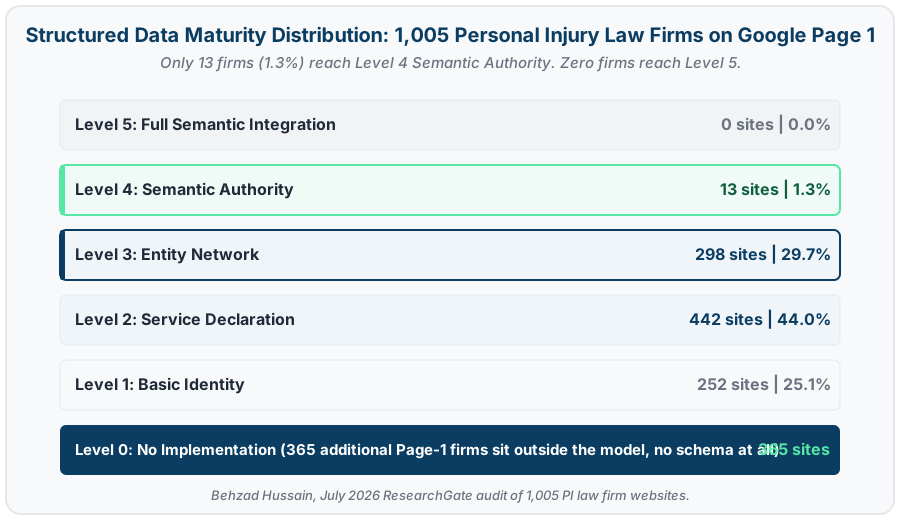
Note that Level 0 in this reading covers only the 640 firms that deployed at least one JSON-LD block. The 365 firms in the full sample that deploy no schema at all sit at a de-facto Level -1, outside the maturity model entirely.
Level 1 (Basic Identity) is a firm shipping Organization or LocalBusiness with name, url, and maybe logo. The identity is declared, but nothing else is wired up. A quarter of schema-adopting Page-1 PI firms sit here.
Level 2 (Service Declaration) adds a service-oriented type (LegalService, Service, or LocalBusiness) with basic properties such as address and telephone. This is the plurality of the sample, 44%. It is the level a firm reaches when a competent developer or an SEO plugin has been through the site once but nobody has audited the payload against Google’s specific extraction requirements.
Level 3 (Entity Network) adds cross-node wiring with @id, structured PostalAddress, sameAs to external profiles, and often Person or Attorney nodes linked to the firm via worksFor. About 30% of the sample reaches this level, which is where structured data begins to compound: the firm’s mentions across pages fuse into a coherent entity graph rather than living as isolated payloads.
Level 4 (Semantic Authority) is where a firm is declaring the full property set on every industry-defining type: LegalService with hasOfferCatalog, areaServed, openingHoursSpecification, priceRange, and knowsAbout; Person schema on every attorney bio with hasCredential, alumniOf, memberOf, and sameAs to the state bar; brand-quality Organization payload with sameAs to Google Business Profile, LinkedIn, and Facebook; FAQPage and BreadcrumbList on every practice-area page; and Article schema on every legal-content page. Only 13 firms in the entire sample of 1,005 reach this level, or 1.3%.
Level 5 (Full Semantic Integration) is where a firm has moved past declaring individual payloads and into treating the entire site as a semantically coherent graph, with every attorney, every practice area, every jurisdiction, every result, and every content piece anchored to a persistent @id and cross-referenced across pages. Zero firms in the sample reach this level.
The distribution is the practical case for treating schema as a competitive lever rather than a hygiene item. 69% of the sample sits at Level 1 or Level 2. A firm that moves to Level 3 clears the median. A firm that moves to Level 4 joins a set of thirteen firms across the entire United States personal injury vertical.
The Leader Board: The Top-Ranked Firms by Schema Completeness and Rich Results
Table 7 of the paper lists the ten domains with the highest observed SCI, and Table 8 lists the ten domains with the most Rich Results feature eligibility. Both are worth looking at because they identify the specific implementations that a firm reading this article can study.
Top ten sites by Schema Completeness Index:
| Rank | Domain | SCI | SERP Position |
|---|---|---|---|
| 1 | schreckpersonalinjurylawyer.com | 19 | 2 |
| 2 | cochranfirm.com | 18 | 6 |
| 3 | bottlingerlaw.com | 18 | 9 |
| 4 | doctorspracticinglaw.com | 17 | 1 |
| 5 | gideonasen.com | 17 | 3 |
| 6 | yelvertonlitigators.com | 17 | 3 |
| 7 | barkanmeizlish.com | 17 | 4 |
| 8 | davis-adams.com | 17 | 4 |
| 9 | ruizlawnv.com | 17 | 5 |
| 10 | cochranlaw.com | 17 | 6 |
Top ten sites by Rich Results feature eligibility count:
| Rank | Domain | RR Features | SCI | SERP Position |
|---|---|---|---|---|
| 1 | zehllaw.com | 7 | 13 | 1 |
| 2 | rodenlaw.com | 7 | 14 | 1 |
| 3 | salvilaw.com | 7 | 15 | 2 |
| 4 | lambergoodnow.com | 7 | 14 | 2 |
| 5 | stewartlawoffices.net | 7 | 13 | 3 |
| 6 | greenberglawyers.com | 7 | 16 | 4 |
| 7 | christensenhymas.com | 7 | 14 | 4 |
| 8 | askadamskutner.com | 7 | 14 | 5 |
| 9 | fitzgeraldlawcompany.com | 7 | 11 | 7 |
| 10 | roblevine.com | 6 | 15 | 1 |
Two observations from the leader boards. First, the highest observed SCI is 19 out of a possible 25 (schreckpersonalinjurylawyer.com at SERP position 2), and the highest observed Rich Results feature count is 7 out of 10 (achieved by nine different domains). Even the leader board leaves ceiling on the table: no firm captured all ten eligible surfaces, and no firm cleared 20 on the SCI. Second, the top RR-features table is dominated by SERP positions 1 to 5, but domains such as bottlingerlaw.com (SCI 18, position 9) and fitzgeraldlawcompany.com (7 RR features, position 7) demonstrate that a lower-ranked firm with a stronger schema payload can, and does, appear on the leader board.
Practical Fixes, Prioritized by the Data
The paper’s Section 7 offers eight prioritized recommendations. I have re-ordered and expanded them here based on the size of the observed adoption gap and the strength of the linkage to specific mechanisms in Google’s patents and published research.
Fix 1: Ship a Homepage @graph with Three Nodes
The homepage is the URL Google most reliably canonicalizes as the firm’s root node and the URL that carries the greatest external link equity. It is also the page that Google’s stateful chat patent most often consults as the anchor document for a firm-name query. A well-formed homepage payload combines three top-level nodes in a single @graph: an Organization (or its subclass LegalService) declaring the firm as an entity, a WebSite declaring the site container and enabling the Sitelinks Search Box rich result via potentialAction, and a WebPage or AboutPage declaring the homepage itself. All three nodes should carry @id values so downstream pages (attorney bios, practice-area pages) can reference the same @ids and register as parts of one entity graph rather than disconnected fragments. This is the disambiguation pattern that Google’s additive-context and reference-disambiguation patents target.
The homepage @graph pattern: three nodes cross-linked by @id
Downstream pages reference the same @id values so every attorney bio and practice-area page joins one entity graph.
Fix 2: Deploy a Brand-Quality Organization Payload
Only 4.7% of the sample currently ships name, url, logo, sameAs, and description together. That is the brand-quality gate. Add founder, foundingDate, contactPoint, and, most importantly, sameAs links to the Google Business Profile URL, LinkedIn company page, Facebook page, bar-association profile, and authoritative directory listings. This is the payload that Google’s third-party entity onboarding pipeline consumes, and it is the payload that drives the knowledge-panel treatment codified in Google’s 2013 knowledge-panel patent. In concrete terms: unless the firm is declared as a resolvable entity with unambiguous external identity links, it will be inferred rather than recognized, and inference collapses first under high-competition conditions such as multiple firms sharing a common surname in the same jurisdiction.
Fix 3: Deploy LegalService with the Full Geographic Property Set
Populate address as PostalAddress, geo as GeoCoordinates, areaServed, openingHoursSpecification, priceRange, and knowsAbout. Use hasOfferCatalog with an OfferCatalog of sub-services (car accident, truck accident, medical malpractice, wrongful death) to expose specific practice areas as first-class offerings. In the paper’s data, hasOfferCatalog is populated on only 14.1% of LegalService adopters, areaServed on only 53.5%, and openingHoursSpecification on only 34.4%. Filling those three properties alone lifts most Level 2 firms into Level 3.
Fix 4: Publish Person Schema on Every Attorney Bio
The single largest under-invested surface. At minimum: name, jobTitle, worksFor linked by @id to the firm, image, hasCredential as EducationalOccupationalCredential for bar admission, alumniOf for the law school, memberOf for bar associations, knowsAbout for practice areas, sameAs to the state-bar registry listing and LinkedIn profile, and award for any honors. These are the attributes that Google’s disambiguation patents key on when two attorneys share a common name, and they are the attributes Google’s fact-corroboration machinery cross-checks against the state bar registry and law-school alumni directories. Only 20.6% of firms ship any Person or Attorney schema today; among those that do, worksFor is populated on 15.5%, alumniOf on 8.2%, and hasCredential is essentially absent. This is where the largest per-firm gain is available.
Fix 5: Add BreadcrumbList to Every Practice-Area and Attorney Page
Only 7.2% of Page-1 firms deploy BreadcrumbList schema, and only 25.2% qualify for the Breadcrumb rich result. Implementation cost is minimal: a BreadcrumbList with two or three ListItem nodes, each with position, name, and item. This is the lowest-cost path to a Rich Results eligibility increment on every non-homepage URL.
Fix 6: Publish FAQPage Schema on the Top-Question Set for Each Practice Area
Only 18.5% of Page-1 firms ship FAQPage schema, and only 22.6% qualify for the FAQ rich result. Even after Google’s 2023 FAQ narrowing, AI Overviews and generative-answer surfaces preferentially source structured Q&A because a marked-up question and answer is trivial to extract as a typed field, while inferred FAQs from prose require the extractor to guess boundaries.
Fix 7: Emit @id on Every Major Node and Reuse It Across Pages
@id is the input that Google’s additive-context and reference-disambiguation systems rely on to fuse the firm’s mentions into a single entity. 80.3% of schema-using firms deploy @id on at least one node, but most do not reuse the same @id values across pages. A durable pattern: define the firm’s canonical @id on the homepage (for example, https://firm.com/#organization), define the WebSite @id (for example, https://firm.com/#website), and reference those @id values from every downstream page that mentions the firm or hosts a Person node.
Fix 8: Match Schema Attributes Byte-for-Byte to Google Business Profile, Bar Registry, and Directory Listings
Google’s 2014 patent on ranking and importing business listings ties the ranking of business-listing surfaces to consistency of business-listing attributes across sources. Divergent attribute values (a phone number that differs between the site and the Google Business Profile, an address that differs between the site and the state bar registry) depress the ranking of business-listing surfaces because they fail the cross-source corroboration check. The fix: audit every property named in the LegalService and Organization payloads against the Google Business Profile listing, the state bar registry entry, and the top three directory listings the firm participates in. Where they diverge, reconcile them.
@id.How long does it take to fix schema on a law firm website? The homepage @graph and brand-quality Organization payload usually inside a single afternoon for a firm working with a competent developer. LegalService with the full geographic property set adds another few hours. Person schema on every attorney bio scales with attorney count, but even a 50-attorney firm can complete Person schema deployment inside two focused work weeks. BreadcrumbList and FAQPage are one-day templates. The full Level 4 payload for a mid-sized firm is a two-to-four-week project, front-loaded on the homepage and LegalService payloads that produce most of the marginal return.
What This Means for AI Overviews and the Generative Answer Layer

The findings acquire additional weight in the context of generative answer engines. When Google’s stateful chat consults a page as part of a multi-turn session, or when a third-party language model grounds a response in web-retrieved content, the presence or absence of structured data determines whether the model receives the firm’s identity as a typed field or has to infer it from surrounding prose.
The 36% of firms in this sample that publish no schema are effectively invisible to that inference-shortcut path. The 63% that do publish schema but stop short of Level 3 are visible but under-specified: the extractor sees an Organization with name and url but no sameAs, no logo, no description. In a multi-turn session where a claimant is comparing three firms, the firm whose payload declares hasOfferCatalog naming the specific practice area, areaServed naming the specific county, aggregateRating with a corroborated review count, and sameAs to the Google Business Profile, is the firm the model can answer the follow-up question about with a specific citation. The firm whose payload declares only name and url is the firm the model glosses over.
The competitive pressure of AI-answer surfaces is therefore likely to increase the marginal return from complete markup over the coming years, not decrease it. The 1.3% of firms currently at Level 4 will capture a disproportionate share of AI-Overview citations and stateful-chat surfaces because their pages hand the model typed fields the model can quote verbatim. The 25.1% of firms at Level 1 will continue to appear in the ten-blue-links SERP but will lose visibility on the surface where the search behavior of the next generation of claimants is actually moving.
Study Limitations
The sample is drawn from Google Page-1 SERPs collected via a single commercial SERP API over a bounded window. Geographic coverage is deliberately one city per state; this design maximizes state-level coverage but may under-represent secondary metropolitan markets in populous states such as California, Texas, and Florida.
The targeted crawl fetches the homepage plus up to four ranking practice-area pages, which captures the surfaces most likely to carry schema but does not audit deeper pages such as attorney biographies that were not themselves ranked in the SERP sample. Deeper attorney-page schema completeness is therefore probably lower than the Person or Attorney adoption number of 20.6% implies, since attorneys whose bios happen to rank are more likely to have received schema attention than the median attorney bio.
The reported Spearman correlations are associative. I did not measure the causal relationship between schema and rank; that is the domain of controlled experiments, which the paper flags as a future-research direction. Attorney-count estimation relies on HTML heuristics and may be inaccurate for firms whose team pages use unusual templates.
Future work includes longitudinal tracking of schema adoption across the same domains over multiple audits, controlled experiments on the impact of specific schema payloads on rich-result triggering, comparative studies across other legal verticals (family law, employment law, criminal defense), and direct measurement of citation frequency in AI Overviews as a function of structured-data completeness.
FAQ
Can I add schema markup without a developer?
Yes for the simplest payloads. Google’s own Structured Data Markup Helper generates basic JSON-LD blocks from a form interface, and most modern content management systems ship SEO plugins that automate homepage Organization and WebSite payloads. But the payloads that move a firm from Level 1 to Level 3 (LegalService with the full geographic property set, Person schema with hasCredential and alumniOf, Organization with a complete sameAs array) benefit from a developer or a technical SEO who can validate the JSON syntax, wire @id references across pages, and confirm the payload against Google’s Rich Results Test before it ships.
How often should a personal injury firm re-audit its schema?
Quarterly for firms actively investing in SEO; twice a year at a minimum. Google narrows Rich Results eligibility periodically (the FAQ narrowing in 2023 is the recent example), Schema.org adds and deprecates types (the Attorney type has been on schema.org’s pending vocabulary), and the firm’s own content changes: attorneys join and leave, practice areas expand, office addresses change. A quarterly audit against Google’s Rich Results Test and the Schema Markup Validator at schema.org catches drift before it reaches the SERP.
Do schema errors hurt rankings?
Not directly. Google has consistently stated that schema markup is a signal for understanding and rich-result treatment, not a ranking signal. But a schema block that fails validation can cost the firm a Rich Results treatment (a Breadcrumb, FAQ, or Review Snippet does not render for an invalid payload), and the loss of the visual SERP treatment can meaningfully depress click-through rate. Errors are also a corroboration hazard: attribute values in an invalid block may still be extracted, so a wrong telephone value in an invalid Organization block can still feed the cross-source corroboration check and mismatch the Google Business Profile listing.
Is JSON-LD better than Microdata or RDFa for a law firm site?
JSON-LD, yes. Google’s own developer documentation states JSON-LD as the preferred serialization, and every Google patent cited in the paper assumes JSON-LD as the payload format. Microdata and RDFa work but are harder to maintain because they intermingle schema attributes with HTML markup and break more often when a designer updates page templates. A firm currently on Microdata or RDFa should plan a migration to JSON-LD at the next site refresh.
References
Berners-Lee, T., Hendler, J., and Lassila, O. (2001). The Semantic Web. Scientific American, 284(5), 34-43.
Barnard, J. (2022). The Fundamentals of Brand SERPs for Business. Kalicube Pro Publishing.
Bhagavatula, C. S., Noraset, T., and Downey, D. (2015). TabEL: Entity linking in web tables. Proceedings of the 14th International Semantic Web Conference (ISWC 2015).
Blanco, R., Ottaviano, G., and Meij, E. (2015). Fast and space-efficient entity linking in queries. Proceedings of the 8th ACM International Conference on Web Search and Data Mining (WSDM 2015), 179-188.
Bollacker, K., Evans, C., Paritosh, P., Sturge, T., and Taylor, J. (2008). Freebase: A collaboratively created graph database for structuring human knowledge. Proceedings of ACM SIGMOD 2008, 1247-1250.
Brinkmann, A., Bizer, C., and colleagues. (2023). The Web Data Commons Schema.org Data Set Series. WWW 2023 Companion.
Clio. (2023). Legal Trends Report. Themis Solutions Inc.
Devlin, J., Chang, M. W., Lee, K., and Toutanova, K. (2019). BERT: Pre-training of deep bidirectional transformers for language understanding. Proceedings of NAACL-HLT 2019, 4171-4186.
Dong, X., Gabrilovich, E., Heitz, G., Horn, W., Lao, N., Murphy, K., Strohmann, T., Sun, S., and Zhang, W. (2014). Knowledge Vault: A web-scale approach to probabilistic knowledge fusion. Proceedings of ACM SIGKDD 2014, 601-610.
Google Developers. (2024). Introduction to structured data markup in Google Search. Google LLC.
Google LLC. (2013). Providing knowledge panels with search results. US Patent Publication US-2013110825-A1 (issued as US-9268820-B2).
Google LLC. (2013). Search result ranking based on trust. US Patent US-8352467-B1.
Google LLC. (2014). Corroborating facts extracted from multiple sources. US Patent US-8682913-B1.
Google LLC. (2014). Systems and methods for ranking and importing business listings. US Patent US-8626766-B1.
Google LLC. (2020). Improved onboarding of entity data. US Patent Publication US-2020118009-A1 (issued as US-11361227-B2).
Google LLC. (2021). Distantly supervised wrapper induction for semi-structured documents. US Patent US-10977573-B1.
Google LLC. (2022). Identifying entity attribute relations. US Patent US-11263400-B2.
Google LLC. (2023). Transferable neural architecture for structured data extraction from web documents. US Patent Publication US-2023014465-A1.
Google LLC. (2024). Search with stateful chat. US Patent Publication US-2024289407-A1.
Guha, R. V., Brickley, D., and Macbeth, S. (2016). Schema.org: Evolution of structured data on the web. Communications of the ACM, 59(2), 44-51.
Gupta, R., Halevy, A., Wang, X., Whang, S. E., and Wu, F. (2014). Biperpedia: An ontology for search applications. Proceedings of the VLDB Endowment, 7(7), 505-516.
Hussain, B. (2026). Schema Markup Adoption in Personal Injury Law Firm Websites: A Systematic Analysis of Structured Data Implementation Across North American Legal Services. Working paper. SSRN, DOI 10.2139/ssrn.6551638. Retrieved Jul 26, 2026.
Hussain, B. (July 2026). Schema Markup Adoption in Top-Ranking Personal Injury Law Firm Websites: A Structured Data Audit of 1,005 Google Page-1 Sites Across 50 US States. Working paper. ResearchGate Publication 410589352. Retrieved Jul 26, 2026.
Lin, B. Y., Sheng, Y., Vo, N., and Tata, S. (2020). FreeDOM: A transferable neural architecture for structured information extraction on web documents. Proceedings of KDD 2020. arXiv:2010.10755.
Meusel, R., Bizer, C., and Paulheim, H. (2015). A web-scale study of the adoption and evolution of the schema.org vocabulary over time. Proceedings of the 5th International Conference on Web Intelligence, Mining and Semantics (WIMS 2015).
Mika, P. (2015). On Schema.org and why it matters for the web. IEEE Internet Computing, 19(4), 52-55.
Singhal, A. (2012). Introducing the Knowledge Graph: Things, not strings. Google Official Blog.
Wu, W., Li, H., Wang, H., and Zhu, K. Q. (2012). Probase: A probabilistic taxonomy for text understanding. Proceedings of ACM SIGMOD 2012, 481-492.
Ready to Climb the Maturity Ladder
You have read what the top 1.3% ship. The next question is whether your firm can join them.
Structured data is a system, not a project. The eight fixes are the roadmap. The Google Business Profile consistency, the quarterly Rich Results Test audit, the attorney bio Person schema on every new hire, the FAQPage payload for every new practice-area page, are the operating discipline that keeps the payload at Level 4 as the site and the team evolve. SEO feels expensive but unclear when it lives outside that discipline. Inside it, the spend maps to a scored SCI that moves quarter over quarter.
Two ways to start. Book the Personal Injury SEO Diagnostic if you want a scored read on where your firm sits right now, delivered inside 7 to 10 days. Apply for the PI Authority Growth System if you already know the diagnosis and want the retainer team that executes the schema, entity, and intake systems every month.
Request the PI SEO Diagnostic or apply for the Growth System