
Link Building and Off Page SEO for Personal Injury Law Firms
Off page SEO is every trust signal a personal injury law firm earns outside its own website. Link building is one of those signals, the loudest and most misunderstood, but the full off page discipline also includes local citations, digital PR, brand mentions, reviews, and community sponsorships. This article walks the whole discipline the way I walk it with my PI clients: what off page SEO actually is, how state bar advertising rules bound your outreach, where Phase 3 of my PI Organic Authority Engine puts each off page component, which backlink types are worth chasing, and how to translate authority acquisition into signed cases rather than referring domain counts.
I have spent the last several years auditing personal injury law firm SEO programs, running my own studies on the vertical, and building the frameworks I share here. Behzad Hussain is my name; personal injury organic case acquisition is what I do. If you are a managing partner, marketing director, or growth lead at a PI firm, this is written for you.
Two conventions before we begin. First, when I say “link building” I mean the acquisition of hyperlinks from third party websites. When I say “off page SEO” I mean the parent discipline that includes link building plus everything else that reinforces your firm’s authority outside your own site. The industry conflates these all the time; I do not. Second, every recommendation below is filtered through state bar advertising rules. Nothing I suggest is worth a bar complaint, and nothing here should be executed without checking your specific jurisdiction’s Rule 7 language.
Table of contents
- What Off Page SEO Means for a Personal Injury Law Firm
- State Bar Advertising Rules That Bound Your Link Building Outreach
- Authority Reinforcement in the PI Organic Authority Engine
- The 12 Backlink Types Every PI Firm Should Own
- Legal Directory Selection: A Value Scorecard for PI Attorneys
- Digital PR for Personal Injury Firms
- Local Citations, Sponsorships, and Community Off Page Signals
- Barnacle SEO for PI Attorneys
- Anchor Text Strategy for a PI Firm’s Backlink Profile
- Toxic Link Auditing and Disavow Management
- Measuring Link Building ROI in Signed Cases
- Vetting and Briefing a Link Building Vendor
- Off Page SEO for the Answer Engine Era
- Work With Me on Your PI Organic Authority Engine
- Closely Related PI SEO Topics
- Frequently Asked Questions
- References
What Off Page SEO Means for a Personal Injury Law Firm
Off page SEO is the collection of signals your personal injury law firm earns outside its own website that Google uses to evaluate your authority, trust, and topical relevance for high commercial intent legal queries. Link building is one hyponym of that discipline. Local citations, digital PR, brand mentions, reviews, and community sponsorships are the others. Miss any of them and you leave measurable Query Path coverage on the table.
The comparison table below distinguishes the four canonical off page channels a PI firm needs to plan and staff separately.
| Discipline | What it acquires | Where from | Primary metric |
|---|---|---|---|
| Off Page SEO (parent) | All external trust signals | Third party websites, directories, media, users | Composite authority signal |
| Link Building | Hyperlinks pointing to the firm’s site | Third party websites | Referring domain count |
| Local Citation Building | Structured business identity entries | Business directories | Citation consistency percentage |
| Digital PR | Editorial coverage in news outlets | Journalists and publications | Coverage in cited sources |
Off Page SEO Is Not a Synonym for Link Building
Most guides collapse off page SEO into link building. That collapse is where firms lose money.
Here is the taxonomy that matters. Off page SEO is the parent umbrella. Under it sit link building, local citation building, digital PR, reputation management, brand mention acquisition, and social signal generation as distinct sibling hyponyms. Each earns its authority signals in a different way, from a different type of external source, with different measurement conventions and different compliance considerations.
The Off Page SEO Taxonomy
One parent umbrella, six sibling channels. A retainer that only covers link building leaves five channels uncovered.
A vendor talking only about “link building” is quietly narrowing your investment to one of the six channels the parent discipline covers.
Link building specifically acquires hyperlinks from third party websites. Local citation building registers your firm’s name, address, and phone across business directories without necessarily earning a link. Digital PR earns editorial coverage in news outlets, which may or may not include a link. Reputation management acquires and responds to reviews on platforms like Google Business Profile, Avvo, and Yelp. Brand mention acquisition earns unlinked citations of your firm name in third party content. Social signal generation earns shares, mentions, and engagement on social platforms.
When your agency talks to you about “link building” as the whole off page picture, they are quietly narrowing your investment and leaving citations, reviews, mentions, and digital PR uncovered. That is a strategic gap, not a semantic one.
Why the Off Page Taxonomy Matters for a PI Practice Owner
I audit firm off page programs regularly. The most common failure pattern is not weak execution on one channel; it is complete absence of half the channels because the retainer only defines “link building” as scope.
If you cannot name the six canonical hyponyms of off page SEO, you cannot brief a vendor to cover them. You will end up paying for one and leaving five uncovered.
What Google Actually Weighs When It Evaluates a Personal Injury Law Firm’s Off Site Presence
Google’s evaluation of a PI firm’s off page presence is not a single score. It is a weighted composite of several signal families. The five that matter most for a personal injury practice:
- Referring domain diversity: how many unique root domains link to the firm’s site, weighted by the authority of each source domain. The foundational mechanism sits in Lawrence Page’s 1998 patent, Method for Node Ranking in a Linked Database, US Patent 6,285,999 B1, licensed exclusively to Google, which defines every incoming link as a vote weighted by the linking node’s own accumulated rank.
- Local citation consistency: whether the firm’s name, address, and phone are consistent across authoritative business directories. This anchors the firm’s local entity identity.
- Endorsement signals from reviews and rated profiles: Google’s 2012 patent, Endorsing Local Search Results, US Patent 8,880,516 B2, describes how ratings and endorsements from associated users feed into local search ranking and personalization.
- Brand entity strength as measured by co-occurrence and reference patterns across the web: Google’s 2013 patent, Related Entities, US Patent 9,275,152 B2, describes how a system computes a co-occurrence score for a related entity based on how frequently recognized references to that entity appear alongside references to a first entity across web resources.
- Content update momentum on the linking documents themselves, including how anchor text pointing to a document changes over time, as described in Google’s 2006 patent application, Document Scoring Based on Document Content Update, US Patent Application 2007/0100817 A1.
The endorsement claim above is drawn directly from the 2012 Google patent. The highlighted passage shows the specific language the patent uses about associated users personalizing local search results ranking.

Notice what is missing from that list: raw backlink count. Raw backlink count has been a poor predictor of ranking for at least a decade. Referring domain diversity, endorsement signals, brand entity strength, and update momentum move rankings. Backlink count is a downstream artifact.
State Bar Advertising Rules That Bound Your Link Building Outreach
Every off page tactic you consider must survive your state bar’s advertising rules before it hits your marketing calendar. This is where generic link building playbooks fail personal injury firms: they were written for e-commerce or SaaS clients who do not answer to Rule 7.
“If the tactic requires an outreach message that would get you a bar complaint if opposing counsel screenshotted it, do not run the tactic.”
Behzad Hussain, on every first strategy call with a PI firm
The mapping table below shows how each ABA Model Rule constrains a specific class of off page tactic. Use it as the compliance filter before you approve any outreach message or link acquisition plan.
| ABA Model Rule | What it governs | Off page tactic constrained |
|---|---|---|
| Rule 7.1 | Truthfulness in communications about legal services | Review content, testimonial usage, case result press releases, promotional statements on third party sites |
| Rule 7.2 | Advertising, permitted payments, required disclosures | Paid links, sponsored content, paid directory listings |
| Rule 7.3 | Solicitation of prospective clients | Outreach messaging tone for guest posts, HARO responses, journalist relationships |
| Rule 7.5 | Firm names, letterheads, trade names | Anchor text and brand name usage on third party sites |
ABA Model Rules 7.1 to 7.5 as the National Baseline
The ABA Model Rules of Professional Conduct set the baseline every state modifies. For off page SEO purposes, four rules do the heavy lifting.
ABA Model Rule 7.1 requires that all communications about a lawyer’s services be truthful and not create unjustified expectations about results. This governs your review content, testimonial usage, case result press releases, and any promotional statement your firm publishes on a third party site.
ABA Model Rule 7.2 governs advertising specifically, including permitted payments for advertising services and required disclosures. This is the rule that decides whether a paid link, sponsored content placement, or paid directory listing is compliant.
ABA Model Rule 7.3 restricts direct in person or live telephone solicitation of prospective clients when a significant motive is pecuniary gain. This governs your outreach messaging tone for guest post pitches, HARO responses, and journalist relationships, especially when the recipient could be construed as a prospective client’s representative rather than a peer publisher.
ABA Model Rule 7.5 covers firm names and letterhead. It rarely applies to link building outreach directly, but it constrains anchor text and brand name usage on third party sites when the third party site could be read as a firm publication.
The constitutional foundation for lawyer advertising being permitted at all sits in Bates v. State Bar of Arizona, 433 U.S. 350 (1977). The Supreme Court’s syllabus holds that truthful attorney advertising is commercial speech entitled to First Amendment protection. Every state bar’s Rule 7 regime operates inside that constitutional floor.

For the full state by state breakdown, my article on Personal Injury Lawyer Marketing Compliance walks through California SB 37, Alabama’s 2026 amendments, Florida Rule 4-7, and every state that materially changes your outreach playbook.
State Bar Variations That Change Your Outreach Playbook
State bars diverge from the ABA baseline in ways that reshape which off page tactics are safe.
California’s Senate Bill 37, effective January 1, 2026, adds enforcement penalties of $5,000 to $100,000 per attorney advertising violation on top of the existing State Bar of California Rule 7 requirements. That elevates the cost of a compliance mistake in California from a reputational bruise to a material financial loss.
Alabama’s 2026 amendments to its Rules of Professional Conduct tighten requirements around testimonial usage and outcome comparisons. If your firm operates in Alabama, your review acquisition workflow and any case result press coverage need a fresh compliance review this year.
The Florida Bar’s Rules of Professional Conduct Rule 4-7 governs information about legal services in Florida with some of the most detailed advertising restrictions in the country, including specific limits on direct mail contact timing and content.
Texas, New York, and Illinois each have their own rule numbering and enforcement history. Do not assume ABA Model Rule language matches your state’s actual rule text verbatim.
What Compliant Outreach Messaging Looks Like for a PI Firm
Compliant outreach messaging respects three constraints simultaneously: the recipient’s editorial role (do not treat a journalist as a prospective client), the truthfulness rule (do not overstate results or credentials), and the solicitation rule (do not use language that reads as prospecting a person for legal representation).
Compliant HARO or journalist outreach template
Identify yourself and your firm. Name your specific expertise relevant to the query. Provide the substantive answer or resource the reporter needs. Offer follow up on request. Do not include an offer to represent the reporter or their audience. Do not include claims about firm results that lack a disclaimer.
The template that fails, and that I see agencies use routinely: “Our firm has won millions for accident victims. Contact us to learn more.” That is a solicitation, not a journalist pitch. It embarrasses the firm and it violates Rule 7.1 on unjustified expectations and Rule 7.3 on solicitation depending on the recipient.
The 12 Backlink Types Every PI Firm Should Own, Ranked by Defensibility
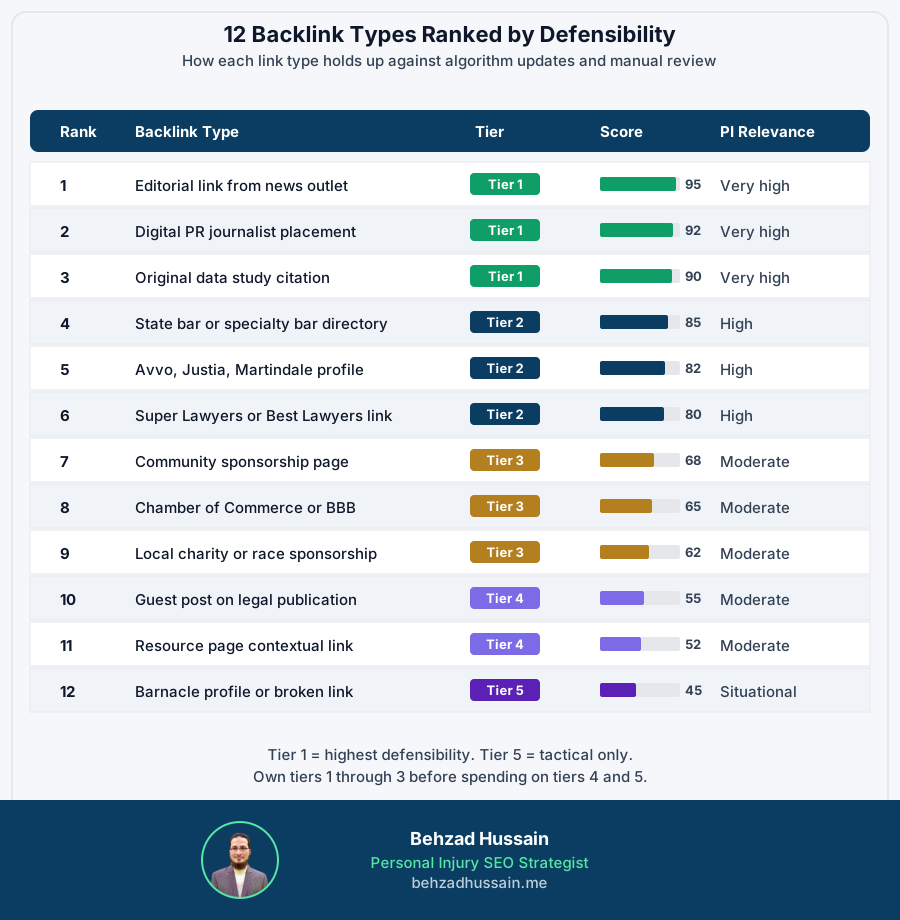
Twelve link types matter for a personal injury law firm’s backlink profile. I rank them by defensibility: how hard is it for a competitor to reproduce, and how safe is the link from algorithmic devaluation or manual action. Tier 1 links are the moat. Tier 5 links are tactical.
Is guest posting still worth the time for a PI firm in 2026? Yes, but only when the target publication has real editorial standards and a real audience overlap with your practice area. Below is the full 12 type ranking with where each fits.
The scorecard below ranks each link type across four axes: earned versus bought, source authority independence, contextual fit for the source, and algorithmic durability. Color coding matches the tier.
The Defensibility Ranking Explained
Defensibility is my model for evaluating link quality without leaning entirely on domain rating. It weighs four things: whether the link was earned or bought, whether the source domain has independent editorial authority, whether the placement makes contextual sense for the source, and whether Google is likely to devalue the class over time.
A digital PR placement in a legitimate news outlet is defensible on all four axes. A scholarship link is defensible on none. Domain rating alone will not tell you the difference. The defensibility model does.
Editorial and Digital PR Links (Tier 1)
Editorial links from real news outlets and industry publications are the highest defensibility class. They are earned through digital PR, HARO responses, journalist relationships, and pitched thought leadership pieces. They cost time and expertise rather than dollars per link.
The mechanism that makes contextual editorial placements worth more is described in Google’s 2011 patent, Ranking Documents Based on User Behavior and/or Feature Data, US Patent 7,979,417 B2, widely known as the Reasonable Surfer model. The patent weighs each link’s value by the probability a real user actually clicks it, using link position, prominence, above-the-fold placement, and surrounding context. A contextual body-copy link inside a bar association article passes materially more value than a sitewide sidebar or footer link with the same anchor text pointing to the same page.
Directory and Association Links (Tier 2)
Legal directory links and bar association listings are Tier 2. They are not editorial, but they carry high trust because the source domains (Avvo, Justia, Martindale Hubbell, state bar directories) have independent editorial curation and clear industry relevance. Every PI firm should own the full baseline directory footprint before pursuing anything else in link building.
Sponsorship and Community Links (Tier 3)
Community sponsorship links from Little League teams, race sponsorships, charity events, and local school programs sit in Tier 3. They are compliant with most bar rules when structured as genuine community support rather than paid placements. They carry local relevance and community trust weight.
Sponsorship link types worth pursuing for a PI firm:
- Youth sports team sponsorships that publish a supporter page
- Charity race and 5K sponsorships with a sponsors page
- Local school program sponsorships (scholarship carve out below)
- Chamber of Commerce and civic association memberships
- Community safety fair and public health event sponsorships
Sponsorship link types that raise red flags:
- Anything that reads as pay for placement rather than sponsorship
- Sponsorships of platforms that exist primarily to sell sponsored links to law firms
- Cross sector sponsorships with no local or topical relevance
Guest Post and Resource Page Links (Tier 4)
Guest post links and resource page links are Tier 4. Guest posts are still worth pursuing when the target publication has real editorial standards, but the marginal value has fallen since the 2010s. Resource page links, where a curated page on a partner site adds a link to your firm’s content, are more defensible per unit than mass guest posting.
“The guest post gold rush ended a decade ago. Twenty low quality guest posts do less for your ranking state than one editorial mention in a legitimate news outlet.”
Behzad Hussain, on a recent strategy call about volume outreach
Google’s own spam policy documentation names the tactics that get link work devalued or penalized. Any of the practices in the highlighted section below turns a link acquisition program from an asset into a liability, regardless of tier.

Barnacle and Broken Link Types (Tier 5 tactical)
Barnacle SEO placements (optimized profiles on Avvo, Justia, Super Lawyers, Best Lawyers that rank for your firm name in the SERP) and broken link building (replacing dead links on partner sites with links to your content) are Tier 5 tactical plays. They earn a section each below.
Legal Directory Selection: A Value Scorecard for PI Attorneys
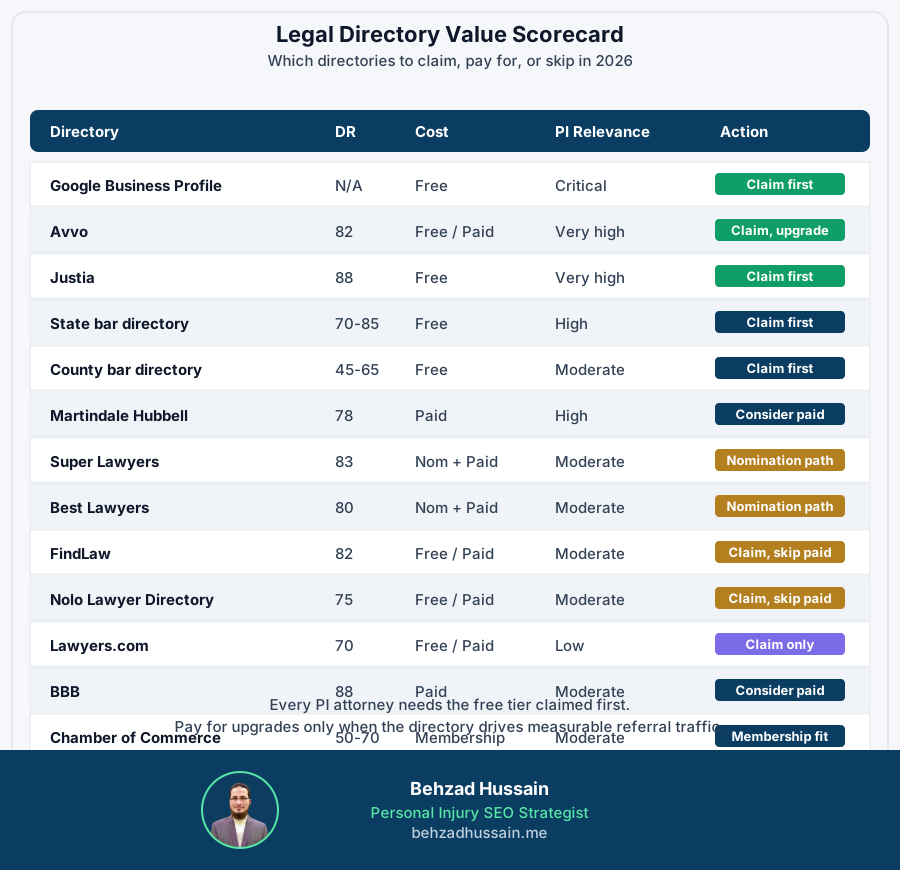
You do not need to be on every legal directory. You need to be on the right ones, with a complete and accurate profile, and you need a rational answer for which paid directories deserve your budget in 2026.
The scorecard below rates every major legal directory on four dimensions: domain authority, cost, PI vertical relevance, and my recommended action.
The Directories Every PI Attorney Should Claim First
Free claim priority for every personal injury attorney and firm:
- Google Business Profile (not a legal directory, but the highest impact free local citation)
- Avvo
- Justia
- FindLaw (free listing)
- Nolo Lawyer Directory
- Your state bar’s public attorney directory
- Your county bar’s directory
- Lawyers.com (LexisNexis) free listing
- Best Lawyers (nomination based; free profile if selected)
- Super Lawyers (nomination based; free profile if selected)
- Better Business Bureau
- Local Chamber of Commerce directory
Complete the profile on each. Add photos, publication list, practice areas, jurisdictions, and case result narratives that comply with your state’s Rule 7.1 truthfulness standard. Missing baseline directory presence signals unserious digital presence to both Google and prospective clients.
The Directories That Deserve Payment
Paid directory upgrades that earn their cost for most PI firms:
- Martindale Hubbell peer review rating and sponsored listing (particularly for referral seeking practices)
- Avvo Pro upgrade for premium profile features
- Super Lawyers profile enhancement (post nomination)
- Best Lawyers profile enhancement (post nomination)
- FindLaw sponsored listing in markets where the platform still drives real referral traffic
- Nolo sponsored placement (only in markets where Nolo carries measurable click share)
Paid directory placements are Rule 7.2 compliant when the payment is disclosed appropriately and the placement does not create false impressions of endorsement. Confirm your state’s specific disclosure requirements before enrolling.
The Directories That Can Be Deprioritized in 2026
Directories that made sense in 2015 but that I would not spend meaningful budget on today:
- Mass legal aggregator directories with no editorial curation and no verifiable referral traffic
- International legal directories with no US enforcement community reach
- Any directory that promises a specific ranking or lead volume in exchange for payment (this signals a low quality directory and often a Rule 7.2 disclosure risk)
- Directories that require reciprocal linking as a condition of listing (this crosses Google’s spam guidelines)
Deprioritizing does not mean removing your presence. It means not paying for enhancement.
Digital PR for Personal Injury Firms: The Highest Quality Link Source
Digital PR is the highest defensibility off page channel for a personal injury law firm because it earns editorial coverage from sources with independent authority, and because the compounding effect of ongoing coverage builds brand entity strength that other channels cannot buy.
How often should a personal injury attorney respond to HARO queries? Two to five responses per week is the cadence I recommend to most retainer clients, scaled to the attorney’s actual availability and topical fit. Below that, momentum stalls; above that, response quality drops and burnout kicks in.
The table below distinguishes real editorial digital PR from press release syndication that most authoritative sources ignore.
| Dimension | Real Digital PR | Press Release Theater |
|---|---|---|
| Source authority | Independent editorial staff makes placement decisions | Syndicated network republishes without editorial review |
| Audience | Real PI adjacent readers | Search bots and nobody else |
| Google weight | High | Near zero |
| Cost model | Time and expertise investment | Fixed distribution fee per release |
| Bar compliance | Requires Rule 7.1 review of any claim | Same, plus scrutiny of syndicated network quality |
What Counts as Real Digital PR for a PI Practice
Real digital PR earns coverage in publications with editorial staff who make placement decisions independently. Fake digital PR pays for placements on syndicated press release networks that most authoritative sources ignore.
The difference matters for two reasons. First, Google evaluates the source domain’s independence and editorial authority when weighing a link or mention. Paid press release syndications carry near zero weight; earned editorial placements carry high weight. Second, the audience overlap: real editorial coverage reaches actual PI case referral audiences (personal injury adjacent publications, local news, legal industry outlets). Press release syndication reaches search bots and nobody else.
The theoretical basis for why editorial coverage from topical experts compounds authority faster than generalist coverage traces to Krishna Bharat and George Mihaila’s 2000 University of Toronto paper, Hilltop: A Search Engine Based on Expert Documents, technical report CSRG-405. Bharat’s patent on the same mechanism was acquired by Google in 2003. Hilltop introduced the concept of “expert documents” (pages that curate authoritative resources on a topic) as an authority-lifting signal. For personal injury, expert documents include state bar sections on PI, court self-help centers, medical association resources on injury, and reputable legal publications that curate PI attorneys. Being cited from these sources is the exact signal Hilltop describes.
HARO and Journalist Query Response for PI Attorneys
HARO (Help a Reporter Out) and comparable journalist query services like Qwoted and Featured are the entry channel for digital PR. Reporters post queries seeking expert sources; attorneys respond with substantive commentary on relevant topics.
The PI beat categories that produce the highest response rate:
- Personal injury law general commentary (insurance disputes, negligence explanations)
- Auto accident and insurance company practices
- Product liability and defective products
- Nursing home negligence and elder care
- Premises liability and slip and fall analysis
- Workplace injury and workers compensation
- Wrongful death procedural context
- Medical malpractice explanatory content
- Regional safety data commentary (crash statistics, injury trends)
HARO response template that works
Identify the attorney (name, firm, jurisdiction, relevant expertise). Address the reporter’s specific question with a two to four paragraph substantive answer. Offer one follow up option. Close with attorney credentials for verification. Do not include marketing language, do not overstate results, do not use the response as a client solicitation.
Verdict, Settlement, and Case Result Media Coverage (with Compliance Guardrails)
Case result media coverage is a compound authority signal: it earns backlinks, brand mentions, and it demonstrates courtroom outcomes to prospective clients. It is also the highest compliance risk off page tactic because of Rule 7.1 truthfulness requirements and state specific outcome disclosure rules.
Compliant case result coverage requires: accurate factual reporting of the case, appropriate disclaimers about specific case results not guaranteeing outcomes in other cases, verification that the client has consented to public disclosure, and confirmation that the disclosure does not violate any settlement confidentiality provisions.
Original Data Publishing as a Digital PR Engine
The most defensible digital PR channel is publishing original data. A PI firm that publishes original crash safety data for its region, original settlement trend analysis, or original safety patterns from its case files becomes a cited source for local news and legal publications.
Data publishing ideas for PI firms that produce coverage:
- Regional crash data dashboard by intersection or corridor
- Annual settlement value trend by injury type in the firm’s markets
- Comparative safety analysis of local roads, vehicles, or public spaces
- Anonymized case timeline analysis (average duration by claim type)
- Local worker safety data by industry
- Insurance carrier response time analysis by claim type
- Public safety event follow up analysis (community safety data)
Original data publishing is a compound investment: one asset earns ongoing citations, updates keep the asset relevant, and the citations reinforce your firm’s entity strength for the topics the data covers.
Local Citations, Sponsorships, and Community Off Page Signals for PI Firms
Local citations, community sponsorships, and local off page signals anchor your firm’s entity identity in Google’s local ranking systems and supply the trust signals that Map Pack visibility depends on. This layer is where solo attorneys and multi office firms have equal opportunity to compete regardless of budget.
The Baseline Local Citation Footprint Every PI Firm Needs
Every PI firm should have consistent name, address, and phone entries on the following baseline citations:
- Google Business Profile
- Apple Maps
- Bing Places
- Yelp
- Better Business Bureau
- Chamber of Commerce directory
- Yellow Pages
- Foursquare
- Facebook business page
- LinkedIn company page
- Instagram business profile (where the firm has social presence)
- Any local city or county business directory that carries editorial curation
Beyond the baseline, add 30 to 50 additional citations across legal and general business directories over the first 12 months, prioritizing directories with domain authority above 40 and clear editorial standards.
The mechanism reading these citations is Google’s 2010 patent, Corroborating Facts Extracted from Multiple Sources, US Patent 8,682,913 B1. Facts extracted as attribute-value pairs from multiple sources (your firm’s name, address, phone, hours, category, credentials) are corroborated by cross-source agreement. Inconsistent or contradicted listings depress the corroboration signal for the entire firm entity, even when a competent Google Business Profile is otherwise complete.
Community Sponsorships Ranked by Link Value and Bar Compliance
The matrix below plots the sponsorship types PI firms commonly consider. High link value with high community fit is the pursue zone. Low link value with low community fit is the avoid zone.
Community Sponsorship Value Matrix
Where each sponsorship type falls on link value and community fit for a PI firm.
- Aggregator sponsor pages
- Cross sector sponsor lists
- Local school sports sponsorships
- Charity race sponsorships
- Civic association memberships
- Aggregator link farms
- Pay per placement lists
- Quiet donations (no sponsor listing)
- Volunteer programs
Focus sponsorship budget on the PURSUE quadrant. Do the DO ANYWAY quadrant for reasons other than SEO.
High link value, high community fit sponsorships: local high school athletic sponsorships in your firm’s geographic market, established charity race sponsorships (Susan G. Komen, Special Olympics local chapters, MADD chapters), and civic association memberships with published sponsor lists.
High link value, low community fit sponsorships: aggregator sponsorship sites that carry law firm sponsor lists with no genuine community connection. Avoid these; they read as pay for link.
Low link value, high community fit sponsorships: quiet donations that do not earn a public sponsor listing. These are ethically valuable and worth doing anyway; they are just not off page SEO plays.
Low link value, low community fit sponsorships: do not spend budget here.
Why Scholarship Programs Are No Longer Worth It for PI Firms
Scholarship link programs, once a staple of law firm link building, have lost most of their off page SEO value. Google’s public guidance and observable ranking impact both suggest that scholarship links from .edu domains have been largely devalued when the underlying scholarship exists primarily to earn a link.
“I would not spend a client’s budget on a scholarship link program in 2026. The dollar goes further in almost any other Tier 2 or Tier 3 channel.”
Behzad Hussain, when PI firms ask about scholarship link ROI
If the firm has a genuine reason to fund a scholarship (a founder’s memorial, a firm value alignment), fund it, but do not count on the link value.
Anchor Text Strategy for a PI Firm’s Backlink Profile
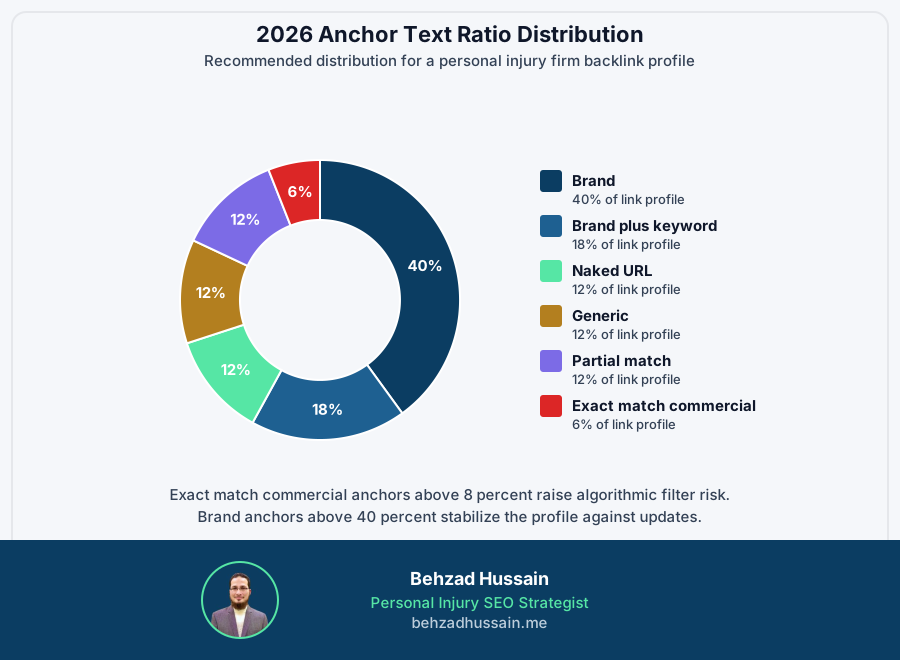
Anchor text is the clickable text of a hyperlink pointing to your site. It signals topical relevance to Google. Over optimized anchor text (too many exact match commercial anchors) triggers algorithmic filters. Under optimized anchor text (all brand or naked URL) misses opportunities to signal relevance for target queries.
What anchor text ratio triggers a Google Penguin era filter for a law firm? There is no published exact threshold, but observable data suggests an exact match commercial anchor share above roughly 10 to 15 percent of the total backlink profile puts the firm at elevated risk of filter treatment for those anchor terms.
Anchor Text Categories a PI Firm Should Track
Six anchor text categories deserve tracking:
| Category | Example | Safe frequency |
|---|---|---|
| Brand | Smith Johnson Law | 35 to 45% |
| Brand plus keyword | Smith Johnson personal injury lawyer | 15 to 20% |
| Naked URL | smithjohnson.com/personal-injury/ | 10 to 15% |
| Generic | click here, read more, this article | 10 to 15% |
| Partial match | personal injury lawyer resources | 10 to 15% |
| Exact match commercial | Houston car accident lawyer | 5 to 8% max |
Recommended Anchor Text Ratios for a PI Practice in 2026
My recommended distribution for a healthy PI firm backlink profile in 2026 is charted below. The exact match commercial share is the pressure point; every additional exact match commercial anchor beyond the ceiling raises the algorithmic filter risk for the specific anchor phrase.
Google’s 2006 patent application, Document Scoring Based on Document Content Update, US Patent Application 2007/0100817 A1, describes how anchor text changes over time factor into document scoring, which underscores that anchor patterns are monitored continuously, not just at a snapshot.

Common Anchor Text Mistakes I See in Prior Agency Work
Most PI firms I audit inherit an anchor profile shaped by whichever agency ran outreach in the prior three to five years. The recurring mistake pattern:
The correction is not fast. Anchor rebalancing is a slow process that requires disciplined new link acquisition in the correct anchor categories over many months. Do not attempt to shortcut it by disavowing existing exact match anchor links; that usually harms more than it helps.
The reason a rapid rebalance campaign backfires is described in Google’s 2008 patent, Information Retrieval Based on Historical Data, US Patent 7,346,839 B2. The patent enumerates temporal signals including the age of linkage, appearance and disappearance of links, weights based on link freshness, spikes in link growth, and the relatedness of anchor text over time. A sudden concentrated push of new anchors is visible to the temporal model as either a topical change or a manipulation attempt. Gradual, diversified acquisition reads as natural.
Toxic Link Auditing and Disavow Management for PI Firms
Toxic links reach a PI firm’s backlink profile through several channels: negative SEO from competitors, prior agency work that used low quality tactics, inherited artifacts from a purchased domain, and unsolicited spam scraping. Left unmanaged, a toxic link accumulation can trigger algorithmic filters or, in extreme cases, manual actions.
How Toxic Links Reach a PI Firm’s Profile
Common sources of toxic links a PI firm inherits:
- Private blog network (PBN) links from prior agency work
- Directory submissions to spam directories
- Foreign language comment spam and forum profile links
- Automated tool generated links from scraping platforms
- Reciprocal link exchanges from cross linked spam networks
- Competitor negative SEO campaigns using cheap tool generated links
- Inherited artifacts from a domain the firm purchased
- Scraper site copies of the firm’s content with tracked links
Google’s 2004 patent, Method for Detecting Link Spam in Hyperlinked Databases, US Patent 7,509,344 B1, describes methods for identifying manipulative link networks by calculating spam likelihood values across the link graph. In practice, this means Google routinely identifies and devalues obvious spam patterns, but the disavow file remains useful for handling links that fall in the gray zone Google’s automated systems have not yet caught.

The graph-structural approach was extended in Google’s 2009 patent, Link-Based Spam Detection, US Patent 7,533,092 B2, which estimates each page’s effective link mass (the fraction of its PageRank attributable to manipulative link patterns) and demotes pages whose effective mass suggests inflation. The academic foundation for both patents is Zoltan Gyöngyi, Hector Garcia-Molina, and Jan Pedersen’s 2004 VLDB paper, Combating Web Spam with TrustRank, which introduced semi-supervised trust propagation from a small seed set of trusted pages along the link graph. For a personal injury firm, this means being close in link graph distance to bar associations, courts, government agencies, and reputable legal journalism keeps the firm inside the trust neighborhood; being close to link farms, PBNs, or reciprocal spam networks pulls the profile the other direction on the same graph.
The Quarterly Toxic Link Audit Workflow for a PI Practice
The audit workflow I run every quarter for retainer clients is charted below. Each step is discrete, verifiable, and produces documentation that supports the quarterly compliance and vendor governance passes.
Quarterly Toxic Link Audit Workflow
Eight discrete steps from backlink pull to disavow submission and audit documentation.
- Pull the full referring domain list from Ahrefs (or your backlink tool of choice)
- Cross reference with Google Search Console links report
- Segment referring domains by suspicious flags (unusual TLDs, low DR with high link count to your site, foreign language on English content sites, keyword stuffed anchor patterns)
- Manually review the top 100 suspicious referring domains for genuine placement context
- Confirm the toxic status of each domain with a second review pass
- Prepare or update the disavow file with the confirmed toxic domain list
- Submit the disavow file via Google Search Console
- Document the review in the quarterly audit log
The audit takes two to four hours per quarter for most firms. It is not glamorous work. It prevents the compound accumulation of toxic profile debt that eventually costs more to fix than to prevent.
When to Use the Disavow File and When Not To
The disavow file is appropriate when a toxic link cluster is verifiable, when the firm cannot get the links removed through outreach, and when the cluster is significant enough to plausibly affect ranking evaluation. It is not appropriate for one off low quality links that Google will ignore automatically, and it is not appropriate as a substitute for cleaning up the underlying source (a prior agency’s ongoing work, for example).
| Scenario | Disavow? | Rationale |
|---|---|---|
| Verified toxic cluster from a spam network | Yes | Cluster is large enough to plausibly affect ranking; outreach removal is not feasible |
| Isolated low quality link from a defunct blog | No | Google will devalue automatically; disavow adds noise |
| Ongoing PBN placements from a current vendor | Fix source, then disavow | Cleaning downstream without stopping upstream is a treadmill |
| Suspected negative SEO from a competitor | Yes, if verified | Document the pattern; submit disavow; monitor for continuation |
| Post penalty recovery after a manual action | Yes, comprehensive | Full profile audit and rebuild required |
Measuring Link Building ROI in Signed Cases, Not Referring Domains for PI Firms
The measurement failure I see across most PI firm off page programs is stopping at referring domain count. Referring domain count is an input metric. Signed case count is the outcome. The scorecard that matters connects the two.
Can a solo PI attorney measure signed case attribution without a full analytics stack? Yes, with a simplified six metric scorecard that any solo practice can maintain manually if it lacks a full attribution platform.
The Six Metric Scorecard for a PI Firm’s Off Page Program
The scorecard below names the six metrics I track for every retainer client. Any three of them moving positively together suggests the off page program is compounding.
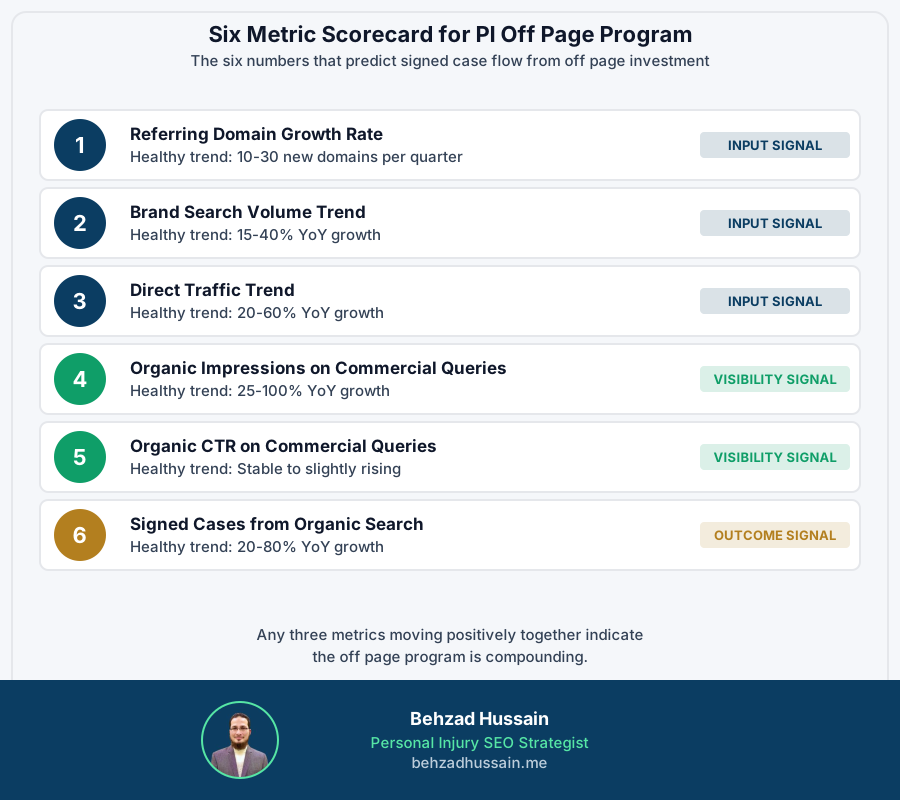
Brand search demand earns a spot on the scorecard because Google’s 2015 patent, Site Quality Score, US Patent 9,031,929 B1 (inventors April R. Lehman and Navneet Panda), defines its numerator as user interest in the site as reflected in user queries directed to the site. The score is applied site-wide. Off page work that raises branded query volume lifts every page on the firm’s site simultaneously; off page work that produces referring domains but no branded search lift is compounding in only one of the two ways Google evaluates authority.
How to Attribute Signed Cases to Off Page Investment
Attribution model steps I recommend to retainer clients:
- Add a “How did you hear about us?” question to your intake form and script
- Categorize responses into channel buckets (organic search, referral, past client, paid ad, other)
- Track signed case counts by channel monthly
- Track cost per signed case by channel (marketing spend divided by signed cases from that channel)
- Trend the cost per signed case from organic search alongside your off page investment
- When cost per signed case from organic falls while off page investment stays flat or grows, the program is working
The attribution is imperfect. Multi touch attribution is difficult in a contingency practice where signed cases arrive weeks or months after first search. Directional trends over quarters and years matter more than exact single case attribution.
What Numbers Should Actually Move for a Personal Injury Practice
Healthy trend expectations for a mid sized PI firm with a competent off page program:
| Metric | Baseline expectation | Healthy trend |
|---|---|---|
| Referring domain growth | Adds per quarter | 10 to 30 new unique domains |
| Brand search volume | YoY change | 15 to 40 percent growth |
| Direct traffic | YoY change | 20 to 60 percent growth |
| Organic impressions on commercial queries | YoY change | 25 to 100 percent growth |
| Organic CTR on commercial queries | Trend | Stable to slightly rising |
| Signed cases from organic search | YoY change | 20 to 80 percent growth |
Numbers below these ranges suggest execution problems. Numbers well above may indicate strong momentum or measurement artifact; verify before celebrating.
Vetting and Briefing a Link Building Vendor for a Personal Injury Firm
Most PI firms outsource some or all of the off page program to an agency or freelancer. The vendor selection decision is where budget waste starts. A framework for vetting, briefing, and auditing vendors is the difference between a program that compounds and a program that consumes retainer fees.
Red Flags in a Vendor Sales Pitch for PI Legal SEO
Red flags that mean I would not sign the retainer:
- Guaranteed number of links per month with no quality specification
- Guarantees of ranking for specific keywords
- Refusal to name the actual publications or platforms where placements will happen
- Refusal to share the exact anchor text usage plan
- Reliance on private blog networks or paid link marketplaces
- No mention of state bar advertising rule compliance
- Case study firms whose backlink profiles show visible spam patterns
- Aggressive discount pressure on a first sales call
- Refusal to work on a month to month basis after the initial commitment
The Questions I Ask Before Signing a Link Building Retainer
The vetting question set:
- Show me three PI firm case studies with backlink profile screenshots from Ahrefs
- Show me one recent placement with the actual published URL and the client’s authorization to reference it
- Describe your typical anchor text distribution across a monthly build
- Describe your process for auditing existing toxic links before you begin new outreach
- Describe your state bar rule compliance review process for outreach messaging
- Describe your reporting cadence and format
- What is your policy on private blog networks and paid link marketplaces
- What is your process for cancelling the retainer if the deliverables do not match the brief
- What is the pricing per link and how is it calculated
- Who specifically will do the outreach work, and are they in house or subcontracted
Any refusal to answer any of these questions is a hard no.
The Quarterly Vendor Audit for a Personal Injury Law Firm
The audit framework I use for every vendor review, run quarterly. If any quadrant fails, the vendor gets a written remediation plan. If two or more quadrants fail across two consecutive audits, terminate the retainer.
Deliverable Audit
Were the placements delivered as briefed, and does the actual placement quality match the promised quality?
Compliance Audit
Does the outreach messaging comply with the firm’s state bar rules for the jurisdictions the firm serves?
Anchor Audit
Does the anchor text distribution match the plan for brand, brand plus keyword, naked URL, generic, partial match, and exact match commercial ratios?
Impact Audit
Are referring domain growth and brand search volume moving as expected given the actual placement volume delivered?
Off Page SEO for the Answer Engine Era: When Attorney Links Become AI Citations
“Backlinks are being partially replaced by citation weight in the answer engine era. The change is gradual, not sudden, but the direction is clear.”
Behzad Hussain, on every first strategic call about AI Overview readiness
Brand mentions and citation frequency in sources that LLMs and answer engines actually read are competing with traditional backlinks as authority signals.
What Changes When AI Overviews Rank a Personal Injury Query
Traditional SERP visibility depends on your page appearing in a ranked list. AI Overview visibility depends on your firm’s content or entity being cited by the generative response, whether or not that citation is a followed link.
For a personal injury query, the AI Overview may synthesize an answer from three to eight sources. Being one of those cited sources requires a different off page signal profile than being a top ranked classical result.
Traditional SERP
Ranked list of 10 blue links.
- Referring domain count matters
- Anchor text signals topical relevance
- Followed links carry authority
- Domain rating trends predict ranking
AI Overview Response
Synthesized answer citing 3 to 8 sources.
- Brand mention frequency matters
- Entity co-occurrence signals authority
- Unlinked citations carry weight
- Structured data completeness predicts inclusion
In my 2026 audit of 1,005 top ranking personal injury law firm websites across all 50 states, published on ResearchGate, structured data adoption varied by more than 60 percentage points between the highest and lowest state medians. The firms that had complete Person, LegalService, and Attorney schema markup were both traditional ranking leaders and disproportionately represented in AI Overview citations for informational PI queries.
Why Brand Mentions Now Compete With Backlinks for Authority Weight
Google’s 2013 patent, Related Entities, US Patent 9,275,152 B2, describes how a system computes a co-occurrence score for related entities based on how frequently references to those entities co-occur across web resources. That mechanism does not require a hyperlink.

The unlinked mention mechanism also sits in Google’s 2014 patent, Ranking Search Results, US Patent 8,682,892 B1, whose inventor Navneet Panda is the same engineer whose name attached to the Panda quality update. The patent treats branded and navigational queries as “reference queries” and counts them as “implied links” for ranking. The count of reference queries directed at a resource contributes to its ranking alongside the count of independent inbound links. Off page brand building that produces branded search downstream (podcast appearances, published legal writing, YouTube presence, speaking engagements, sponsorships) creates implied links even when no HTML anchor exists.
What PI Firms Should Do Today to Earn AI Citations Tomorrow
Action steps that make a PI firm citation eligible in generative search:
- Complete structured data markup for the firm entity (LegalService, Person for each attorney, WebSite, Organization)
- Publish original data that answer engines can cite (crash reports, settlement trend analyses, injury pattern data)
- Maintain consistent firm entity representation across every citation source (name spelling, address format, attorney credentials)
- Earn coverage in publications that LLMs demonstrably train on (established news outlets, Wikipedia adjacent knowledge bases, established legal industry publications)
- Monitor unlinked brand mention volume and quality quarterly
- Optimize FAQ content on the firm’s own site for extractability (front loaded direct answers, 40 to 70 word paragraphs)
- Audit AI Overview outputs for practice area queries quarterly and note which sources are cited
- Build first party author byline programs for attorneys on external publications
The AEO shift does not replace traditional off page SEO. It layers on top. Firms that treat this as an optional experiment fall behind firms that treat it as the natural extension of Phase 3 authority reinforcement.
Work With Me on Your PI Organic Authority Engine and Off Page Program
If any part of the above resonated because your current program is off track, I can help. Each engagement starts with the same question I opened this article with: what off page signals is your firm earning, and are they converting to signed cases?
Diagnostic
Personal Injury SEO Diagnostic
A 7 to 10 day deep audit of your firm’s technical stability, intent capture, authority reinforcement, and case acquisition optimization layers. Walkthrough call and prioritized roadmap included.
Retainer
PI Authority Growth System
Monthly retainer that runs the full engine as a system. Every off page channel this article covers, alongside the technical and content structure work. Best for firms ready to invest in a long term SEO asset.
Advisory
Fractional Search Strategist
For firms that already have an agency or in house team and need senior strategic oversight instead of another execution layer. Direct advisory access and roadmap ownership.
Frequently Asked Questions About PI Firm Link Building
How many backlinks does a personal injury law firm need to rank on page one?
Referring domain count matters more than raw backlink count. Most top ranked PI firm sites in competitive metros have 100 to 500 unique referring domains, growing at 10 to 30 new domains per quarter. In smaller markets, 40 to 150 referring domains often suffice. The absolute number matters less than the referring domain quality distribution and the anchor text profile shape.
How long does link building take to move rankings for a PI firm?
Directional ranking movement typically appears at 3 to 6 months. Meaningful ranking consolidation for competitive commercial queries typically takes 9 to 18 months. Post algorithm update stability shows in the second year. Any vendor promising ranking movement in the first 30 to 60 days is either over promising or executing tactics that will trigger a filter later.
How much should a personal injury law firm spend on link building per month?
For a solo PI attorney in a Tier 3 metro, a compliant off page program including link building runs $2,000 to $4,000 per month at minimum. For a mid sized firm in a Tier 2 metro, $5,000 to $12,000 per month. For a top tier metro firm competing with the largest PI advertisers, $12,000 to $30,000 per month. Below the minimums, execution quality collapses. Above the ceilings, additional spend usually goes to depth rather than net new signals.
Are scholarship link programs still worth it for law firms in 2026?
No. Google has largely devalued scholarship links from .edu domains when the scholarship exists primarily to earn a link. If you have a genuine scholarship program for values reasons, fund it, but do not budget it as an off page SEO investment.
What is a fair cost per link for legal outreach?
Cost per link varies by class. Editorial links from real news outlets earned through digital PR typically cost $300 to $1,500 in fully loaded staff time per placement. Directory and association link acquisition costs $30 to $150 per placement including the audit and application work. Guest post placements on legitimate industry publications typically cost $200 to $600 in staff time per placement, more if the publication has editorial review fees. Anything below $50 per link for a supposedly editorial placement is almost certainly a low quality link that will devalue quickly.