
SEO for Oregon Personal Injury Lawyers: Organic Case Acquisition
SEO for Oregon personal injury lawyers is the work of turning organic search into signed cases in a market that lives and dies in one metro. Most of the state’s injury search demand runs through Portland, OR and its tri county core, the law that shapes every case is Oregon’s own, and the firms that win treat their website as an Oregon legal entity rather than a brochure. This guide is the system I use to build that.
Generic SEO advice loses in Oregon because it ignores two things at once: how heavily demand concentrates in the Portland, OR metro rather than spreading across the state, and how Oregon law shapes what a credible injury page has to say. A statewide page cannot outrank a firm that owns Portland, OR and its suburbs, and a car accident page that misstates the fault rule or the damages cap reads as a national template. This guide fixes both.
What follows is the whole system: the Portland, OR first local strategy, the Oregon statutes that must shape your case type content, technical and on page structure, schema and entity work, AI search readiness, advertising compliance, and the honest channel and cost math that turns rankings into retainers.
What this guide covers
- Oregon demand concentrates in the Portland, OR metro
- How injured Oregonians search
- What kind of SEO an Oregon firm needs
- Local SEO and the Oregon Local Pack
- Technical stability and the cost of retrieval
- On page content and the query network
- The Oregon statutes that shape your content
- Off page authority in Oregon
- Schema and entities for an Oregon firm
- AI search and GEO
- Attorney advertising compliance 7.1 to 7.5
- SEO versus PPC and Local Services Ads
- What it costs and how to measure it
- Get a diagnosis before more guesswork
- Frequently asked questions
- References
Oregon personal injury search demand concentrates in the Portland, OR metro
Oregon is a single dominant metro market, and that one fact reshapes every SEO decision a firm makes here. Portland, OR is the state’s largest city at 639,448 residents, and the Portland-Vancouver-Hillsboro metro holds about 2.5 million people, more than half the state, though a large share of that metro sits across the river in Washington. Oregon’s total population is about 4.27 million. Salem, OR; Eugene, OR; Gresham, OR; Hillsboro, OR; Bend, OR; Beaverton, OR; and Medford, OR follow well behind Portland, OR. There is no second Los Angeles, CA here, no scatter of co equal powerhouses. There is Portland, OR, and then everywhere else.
The numbers below frame the market a firm is actually competing in: one dominant city, a metro that crosses a state line, and a steady volume of serious crashes that drive injury search.
That concentration cuts both ways. The demand is easier to map than in a sprawling state, because you know where the cases are. The competition for it is fierce, because every serious Oregon firm already points its marketing at the same tri county core of Multnomah, Washington, and Clackamas counties. A firm that treats Oregon like a big empty state and spreads thin city pages across all 36 counties loses to the firm that owns Portland, OR and its suburbs completely.
Most firms I audit have the order backwards. They pour budget into Google Ads and lead resellers, watch the cost per signed case climb, and file organic search under “later.” The market punishes that sequence. Personal injury keywords are among the most expensive in all of paid search, and in a metro where a handful of firms bid every accident term, renting the top of the page by the click is a tax you pay forever. Organic search is the one channel where an Oregon firm builds a durable position instead of leasing a temporary one.
The Portland, OR metro also crosses a state line, and that matters for how you scope a page. A crash on one side of the Columbia is an Oregon case under Oregon law; a crash on the other side is a Washington case. A service page that blurs the two invites the wrong leads and misstates the law.
Know which side of the river your case lives on.
Behzad Hussain, on scoping the Portland, OR metro
The competition is not only other firms. It is a wall of SEO agencies and marketing vendors selling the same checklist: claim your Google Business Profile, gather reviews, publish some city pages, buy some links. That checklist is not wrong. It stops at the Oregon border, and it never touches the two things that actually separate an Oregon firm from a generic one, the substantive Oregon law that shapes every case type and the Portland, OR weighted demand a single statewide page can never capture. This guide is an Oregon specific application of SEO for personal injury attorneys and law firms, the broader discipline.
How injured Oregonians search, from the emergency room to the retainer
Injured Oregonians search in a sequence, not a single query, and that sequence is the map your whole site has to cover. A driver rear ended on I-5 near the Terwilliger curves does not open Google and type “best personal injury attorney Portland, OR” first. They search “neck pain after car accident,” then “does PIP pay for my MRI in Oregon,” then “how long do I have to sue in Oregon,” and only later, sometimes days on, “car accident lawyer near me.” Each search is a step, and the firm that shows up helpfully at step one is the firm still in the browser tab at step four.
The map below lays out that path in four stages, from the first symptom search to the retainer search, with the kind of page that captures each one.
The post crash query path in Oregon
From the emergency room to the retainer, mapped to the page type that captures each stage.
The firm that answers stage one earns the click at stage four.
Do injured people really start with a search instead of a referral? Yes, and the shift is not close anymore. A generation that once asked a cousin for a lawyer now asks its phone from the passenger seat of a tow truck, which means the firm that answers the informational question earns the first relationship. Referrals still matter in Oregon’s tight legal community. They are no longer the front door.
Capturing the whole query network beats chasing a handful of commercial keywords. Google records the sequence a searcher follows across a session, and a firm that satisfies the early informational questions builds the signal that it deserves to rank for the expensive commercial ones. You are not writing a blog to fill a calendar. You are claiming every step of the path a signed case walks before it becomes a signed case.
The post crash mobile search moment
The first search after a crash happens on a phone, often one handed, often in pain. Your pages have to load fast, answer the question in the first sentence, and put a call button where a thumb already rests. An Oregon firm that makes an injured person pinch and zoom through a slow page has lost the case to the firm whose page answered cleanly on the first tap. Speed and clarity are not polish in that moment. They decide whether the call happens.
What kind of SEO an Oregon personal injury firm actually needs
An Oregon personal injury firm needs every canonical type of SEO working together, not one tactic in isolation. The discipline breaks into eight recognized types, and a firm that funds only one competes with one arm. On page SEO shapes the content and structure of your practice area and city pages. Off page SEO earns the links and mentions that build authority. Technical SEO keeps the site crawlable, fast, and correctly interpreted. Local SEO wins the map and the city searches. Content SEO and topical authority cover the full query network. Generative Engine Optimization gets you surfaced inside AI answers. Mobile SEO serves that post crash moment. Multilingual SEO reaches the Oregonians who search in a language other than English.
The eight types below are the complete set your program has to account for, each grouped under the phase of the engine it belongs to.
The eight canonical SEO types, mapped to the PI Organic Authority Engine
The engine sequences the canonical types; it does not replace them.
Technical Stability
Technical SEO: crawl, render, index, speed, and clean structure, so Google can process the site cheaply.
Intent Capture
Local SEO, On page SEO, Content SEO and topical authority, and Mobile SEO: the query path and the geography.
Authority and Entity Reinforcement
Off page SEO, entity and citation work, and Multilingual reach: links, brand demand, and entity consistency.
Case Acquisition Optimization
Generative Engine Optimization and conversion: getting surfaced in AI answers and turning visits into signed cases.
I organize all eight inside a working model I call the PI Organic Authority Engine, which runs in four phases. Phase 1, Technical Stability, lowers the cost for Google to crawl and understand your site. Phase 2, Intent Capture, aligns your structure to the query path and the geography. Phase 3, Authority and Entity Reinforcement, builds links, entities, and brand demand. Phase 4, Case Acquisition Optimization, turns visibility into signed cases. The engine does not replace the eight canonical types. It sequences them, so technical work comes before content, content before links, and everything before conversion.
Order is the whole point. Most Oregon firms I audit have spent on all four phases at once, in the wrong sequence, with no diagnosis of which one actually blocks their cases. They built city pages on a site Google cannot crawl efficiently, or chased links to pages that convert nobody. You cannot fix what nobody has diagnosed. The Oregon firms I see compounding share one habit. They stabilized the crawl and the structure before they wrote a single city page.
Local SEO and the Oregon Local Pack: relevance, distance, prominence
Local SEO decides whether your firm appears in the Local Pack, the three business listings with the map that sit above the organic results for a geo search. Google ranks that pack on three factors it names directly in its own Business Profile guidance: relevance, distance, and prominence. Relevance is how well your profile matches the search. Distance is how close your listed location is to the searcher. Prominence is how well known your firm is, drawn from signals like links and reviews. An Oregon firm that understands those three levers stops guessing about the map, which is where the local SEO for personal injury law firms discipline earns its keep.
Google names these three factors in its own Business Profile guidance. Your website schema supports prominence; it does not drive the pack.
Below is the source Google publishes on how those factors work, with the ranking language highlighted.

A point most vendors get wrong: your website schema does not drive the Local Pack. The Google Business Profile does. Schema helps Google understand your firm as an entity across your whole web presence, which supports prominence over time, but the pack itself is a Business Profile product. Treat the two as connected, not identical.
Google Business Profile for an Oregon firm, and the staffed office rule
Your Google Business Profile has to represent a real, staffed office, and this is where multi office Oregon firms get into trouble. Google’s guidelines for representing your business are explicit that virtual offices and remote mailboxes are ineligible, and that a listable location must be staffed and able to receive clients during its posted hours. Follow the Google Business Profile optimization for PI law firms steps below to keep an Oregon profile compliant and competitive.
- Set the primary category to Personal Injury Attorney, then add secondary categories only for services you genuinely staff.
- List an address a client can actually visit during the hours you post, never a virtual suite or a mailbox.
- Earn reviews continuously and respond to them, since reviews feed the prominence factor.
- Keep the firm name, address, and phone identical across the profile, the site, and every directory.
Google’s own guidelines spell out the staffed office requirement, highlighted below.

I audited a Portland, OR metro firm last year that ran four Google Business Profiles at four addresses, two of them shared coworking suites with no staff. They thought they were covering the metro. They were one complaint away from a suspension, and their two real offices were being dragged down by the association. We consolidated to the genuine locations, and the real offices climbed.
Portland, OR first, then the secondary cities: why one statewide Oregon page loses
One “Oregon” page loses because injured people search for a city, not a state. A person in Eugene, OR types “Eugene, OR injury lawyer,” not “Oregon injury lawyer,” and Google serves a local result. A single statewide page cannot be strongly relevant to Portland, OR, Eugene, OR, and Medford, OR at once, so it ends up relevant to none of them. Oregon’s shape makes the fix unusually clear, though. Because demand concentrates so heavily in the Portland, OR tri county core, the winning architecture is Portland, OR and its suburbs first, built with real depth, then a short secondary list of Salem, OR; Eugene, OR; Gresham, OR; Hillsboro, OR; Bend, OR; Beaverton, OR; and Medford, OR, each earning its own page only when the firm has a genuine connection there.
An Oregon geo architecture, Portland, OR first
The tri county core carries most of the demand; secondary cities earn a page when the firm has a real presence there.
Portland, OR
Multnomah County
The core. Largest city and the deepest injury search demand; the metro reaches into Washington, so scope Oregon venue clearly.
Beaverton, OR and Hillsboro, OR
Washington County
The west side suburbs of the tri county core, high volume and part of the same metro market.
Gresham, OR
Multnomah County
East metro, still inside the Portland, OR core and its search demand.
Salem, OR
Marion County
The capital and second population center, a distinct secondary market down the valley.
Eugene, OR
Lane County
South Willamette Valley hub, its own market with a university population.
Bend, OR and Medford, OR
Deschutes and Jackson Counties
Central and Southern Oregon markets, geographically separate and worth a page only with a real local presence.
Build Portland, OR and its suburbs to real depth before you add a secondary city. Ten thin city pages lose to three deep ones.
Can a smaller Oregon firm outrank an entrenched Portland, OR firm? Rarely for the statewide term, but that is the wrong target. A Bend, OR firm that builds genuine depth for Bend, OR and Deschutes County beats a Portland, OR giant in Bend, OR every time, because distance and local relevance favor the firm that actually serves the searcher. The play is not to fight for “Oregon injury lawyer.” It is to own your cities and counties completely, starting with the metro that holds most of the demand.
The trap is the doorway page. Ten near identical city pages with the name swapped are thin content, and Google treats them as such. Each city page has to carry something real: local court and venue detail down to the county circuit court, local crash patterns, offices or attorneys tied to that area, genuine local knowledge. Build fewer city pages with real substance before you build many with none.
The gap here is measurable in my own data. In my audit of 1,005 Google page one personal injury websites, 57.2 percent of the sites that used schema at all left out areaServed entirely, the exact property that tells a search engine which cities and counties a firm serves. Most firms compete for local searches while withholding the one signal that names their service area. In a state where the demand clusters this tightly, that omission is expensive.

Spanish and multilingual coverage for Oregon communities
Spanish and multilingual coverage reaches the Oregonians who search for a lawyer in a language other than English. About 14 percent of the state is Hispanic or Latino, and roughly 15 percent of residents speak a language other than English at home, with Spanish the most common. The Portland, OR metro also carries sizable Vietnamese, Russian, Ukrainian, and Chinese speaking communities. A firm with genuine bilingual intake and fully translated pages, not a machine translated afterthought, reaches cases its English only competitors never see. Build the language coverage you can actually staff, because an intake call that switches to English at the first question converts no better than no page at all.
Technical stability and the cost of retrieval on an Oregon firm site
Technical stability lowers the cost for Google to crawl, render, and index your site, and that cost is the hidden ceiling on everything else. Google spends a finite budget crawling any site. A firm with thousands of thin or duplicate URLs, slow responses, and messy internal links makes itself expensive to process, and an expensive site gets crawled less and trusted less. Googlebot crawls your URLs, the index stores the pages worth keeping, and the ranker orders what survives. The goal is a clean site where every indexed page earns its place, which is the foundation the technical SEO for personal injury law firm websites work protects.
Google’s own crawl budget guidance describes how crawl demand and crawl capacity set how much of a site gets fetched, highlighted below.

Does a faster site actually change rankings, or only user experience? It changes both, and the ranking effect is indirect but real. A fast, clean site gets crawled more often and more deeply, so new pages get discovered and updated pages get reassessed faster, which compounds into better coverage over time. Speed is not a vanity metric here. It is crawl efficiency, and crawl efficiency is how a site keeps its whole catalog fresh in the index.
The work is unglamorous and decisive. Prune dead and duplicate URLs. Fix internal redirect chains and broken links. Get response times down. Use clean semantic HTML so Google can find the part of each page that answers the query. None of it photographs well for a pitch deck, and all of it moves rankings more reliably than another round of city pages on a broken foundation.
On page content that covers the Oregon personal injury query network
On page content covers the Oregon personal injury query network when every real question a client asks has a page that answers it well. This is where topical authority is built. A firm becomes the representative source for its topics by covering them with depth and freshness, not by publishing one thin page per keyword. The query network for an Oregon car accident case alone runs to dozens of real questions, from PIP and medical treatment to fault, insurance, value, and deadlines.
The table below groups that network into clusters, with the kind of page each cluster feeds, so the coverage becomes an architecture instead of a pile of blog posts.
| Query cluster | Sample questions a client asks | Page it feeds |
|---|---|---|
| Injury and treatment | neck pain after a crash, do I need an MRI, how long does whiplash last | Educational injury articles |
| Insurance and PIP | does PIP pay my bills, what if the other driver has no insurance | PIP and insurance guide |
| Fault and value | can I recover if I was partly at fault, what is my case worth | Comparative fault and case value page |
| Deadlines | how long to sue in Oregon, what if a city was at fault | Statute of limitations and tort claims page |
| Choosing a lawyer | car accident lawyer near me, do I even need a lawyer | Practice area and city page |
The content that earns authority shares a structure. The list below defines what a query network page has to do.
- Answer the specific question directly, in the first sentence, in the client’s own words.
- Cover the sub questions a real client asks next, so the page satisfies the whole intent.
- Link to the practice area page it supports, turning informational interest into commercial intent.
- Stay accurate to Oregon law, since a wrong statute of limitations on a page destroys trust in a category where trust is everything.
I see the same failure across firms new to this. They write for keywords instead of for the query path. They have a page targeting “car accident lawyer Portland, OR” and nothing that answers the twenty questions a Portland, OR crash victim asks first. Google reads that as a firm that wants the commercial click without earning the informational trust, and it favors the source that earned both.
The Oregon statutes that must shape your case type content
Oregon statutes shape your case type content because the law here is specific, and getting it right is both a trust signal and a differentiation moat no competitor checklist touches. A short set of deadlines and damage rules changes what your pages must say. Every figure below is drawn from the Oregon Revised Statutes and the controlling Oregon Supreme Court decisions, not from another marketing page, and every practice area page should reflect the ones that apply to it.
The board below puts the four deadlines that matter most in one view, so a practice page can state the right one instead of a national default.
| Deadline | Applies to | Statute |
|---|---|---|
| 2 years | Personal injury (negligence) | ORS 12.110 |
| 3 years | Wrongful death, from discovery | ORS 30.020 |
| 180 days | Notice of a claim against a public body (injury); 1 year for wrongful death | ORS 30.275 |
| 2 years | Filing suit against a public body, after notice | ORS 30.275 |
This is the section that separates an Oregon firm’s site from a template. When I bring a firm’s practice pages in line with actual Oregon law, two things happen. The pages start ranking for the specific legal questions clients ask, and the intake team stops fielding calls from people whose deadline already passed.
Accuracy is a marketing asset in personal injury law.
Behzad Hussain, on treating compliance and content as one job
The two year injury deadline under ORS 12.110, and the three year wrongful death clock
The Oregon statute of limitations for a personal injury claim is two years, set by ORS 12.110, which covers an action for any injury to the person of another. Two years is the default a client needs to know, and your car accident, premises, and product pages should state it plainly. Wrongful death runs on a different clock. Under ORS 30.020, a wrongful death action must be filed within three years of when the injury causing death was or reasonably should have been discovered, and no later than three years after the death. Medical malpractice adds its own wrinkle, two years from discovery under ORS 12.110, subject to an outer limit. A page that collapses all three into a single “two years” line is telling some readers the wrong deadline.
Suing a city, county, or transit district: the 180 day Oregon Tort Claims Act notice
A claim against an Oregon city, county, transit district, or the state carries a 180 day notice deadline, not two years, under ORS 30.275. This is the deadline that ends cases before they start. A person injured by a TriMet bus, on a dangerous public road, or on government property has 180 days from the injury to give the public body written notice of the claim, and one year for a wrongful death claim, before the separate two year deadline to file suit even applies. The dollar figures move too. The Oregon Tort Claims Act caps damages against public bodies and adjusts those caps every year, reaching $2,708,100 against the state and $902,700 against a local public body for the period beginning July 1, 2026. Any page touching bus crashes, road design, or public property should lead with the 180 day rule, because a reader who waits the “usual” two years on a government claim has no case left.
Modified comparative negligence and the fifty one percent bar under ORS 31.600
Oregon follows modified comparative negligence with a fifty one percent bar, which means an injured person recovers only if their share of fault is not greater than the combined fault of the people they are suing. Under ORS 31.600, a claimant who is 50 percent at fault or less recovers, with the award reduced by their own percentage, and a claimant who is 51 percent or more at fault recovers nothing. This is the sharpest way Oregon differs from its West Coast neighbors, and it changes how honest case value content reads here.
Oregon’s fifty one percent fault bar
Recovery shrinks with the client’s share of fault, then drops to zero once fault passes 50 percent.
Client 30 percent at fault: recovers 70 percent
Client 50 percent at fault: recovers 50 percent
Client 51 percent at fault: recovers nothing
California and Washington run pure comparative negligence, where recovery never hits zero. Oregon is the West Coast exception.
California and Washington both run pure comparative negligence, where an injured person recovers a reduced share even at high fault. Oregon does not. A vendor who reuses California copy on an Oregon site will tell a partially at fault client the wrong thing about their case.
In Oregon, fault is a cliff, not just a discount.
Behzad Hussain, on porting content across state lines
A client who was 40 percent at fault still recovers 60 percent of their damages. A client who crosses 50 recovers zero, and your content has to say so.
The $500,000 noneconomic cap that now applies only to wrongful death
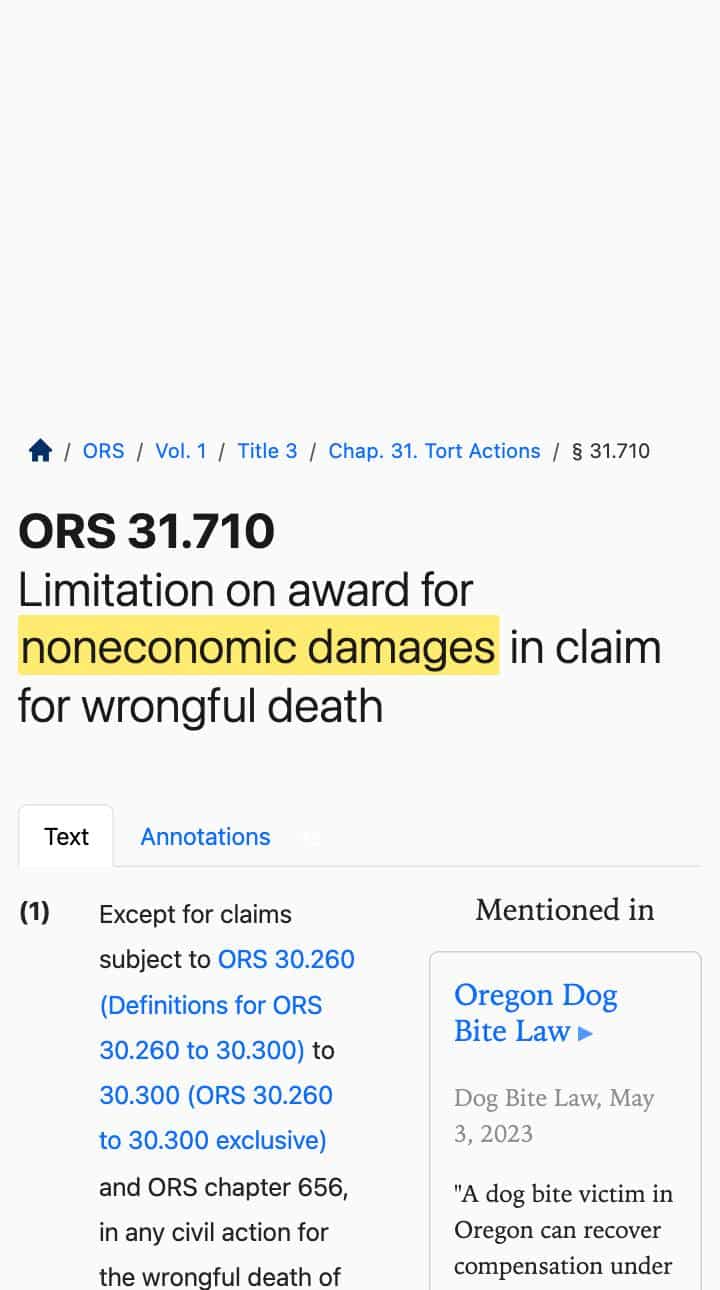
Oregon’s $500,000 statutory cap on noneconomic damages applies only to wrongful death claims, which is the reverse of what most Oregon firm sites tell readers. Under ORS 31.710, as amended in 2021, the $500,000 limit reaches any civil action for the wrongful death of a person, and it does not cap noneconomic damages in an injury claim where the victim survives. A surviving Oregon injury client faces no statutory ceiling on pain and suffering at all.
How Oregon’s noneconomic cap narrowed to wrongful death
The $500,000 cap once reached injury cases. Two decades of litigation and a 2021 amendment left it applying only to wrongful death.
Current law after the 2021 amendment to ORS 31.710: surviving injury claims are uncapped; wrongful death is capped at $500,000.
That was not always true, and the path to it is the content no vendor page carries. The cap once applied broadly to bodily injury, and the Oregon Supreme Court fought over it for two decades. The court struck it as applied to a jury’s personal injury award in Lakin v. Senco Products in 1999, reworked the constitutional analysis in Horton v. Oregon Health and Science University in 2016, and held in Vasquez v. Double Press in 2019 that it could not constitutionally reduce a severely injured person’s recovery to an insubstantial remedy. The 2021 amendment settled the injury side by removing the cap there. Wrongful death is the one place it survived, the application the court upheld in Greist v. Phillips in 1995, because wrongful death is a statutory claim outside the remedy clause.
The statute itself now carries the wrongful death scope in its own text, highlighted below.
Do not publish a flat $500,000 injury cap
Since the 2021 amendment to ORS 31.710, the cap applies only to wrongful death. A surviving injury victim in Oregon faces no statutory noneconomic cap, so a page quoting a blanket $500,000 limit understates what an injury case is worth.
I see the flat version on Oregon firm sites constantly, usually copied from a national template built for a state that still caps injury damages. It is the clearest tell that a firm outsourced its content to someone who never read the current statute. Getting this right is not just compliance. A page that explains the cap honestly signs the seriously injured client who was told elsewhere that their case was worth a fixed ceiling.
Add on PIP and the right to sue under ORS 742.524
Oregon is an add on Personal Injury Protection state, not a true no fault state, which means PIP pays first but the injured person keeps the full right to sue. Under ORS 742.524, every Oregon auto policy carries at least $15,000 in PIP medical benefits for expenses incurred within two years of the crash, and PIP pays regardless of who caused it. There is no tort threshold to clear before filing a liability claim, which is what separates Oregon from the true no fault states.
Add on PIP in Oregon: two tracks at once
PIP pays medical bills first regardless of fault, and the injured person keeps the right to sue the at fault driver.
Oregon is add on, not true no fault. Calling it a “no fault state” tells readers they cannot sue, which is false.
The practical content point is that Oregon drivers have two tracks running at once, their own PIP for immediate medical bills and a liability claim against the at fault driver for the rest. A page that describes Oregon as “no fault” scares readers into thinking they cannot sue, which is false. Minimum liability limits are 25/50/20 under ORS 806.070, and uninsured and underinsured motorist coverage is mandatory under ORS 742.502, which is the coverage that carries an Oregon crash victim when the at fault driver has nothing.
Off page authority: Oregon links, citations, and brand search demand
Off page authority is the set of signals that come from outside your site: links, citations, and the branded searches people run for your firm. Google reads these as votes for prominence, the same factor that feeds the Local Pack. An Oregon firm builds off page authority through local relevance, not generic link volume, which is the heart of link building and off page SEO for personal injury law firms. The sources below carry real weight for an Oregon injury firm.
- Local Oregon news coverage, earned through genuine story angles and original data.
- Civic, bar association, and community sponsorships that produce a real listing or mention.
- Consistent citations across legal and general directories, with identical firm data everywhere.
- Branded search demand, the searches people run for your firm name plus a city or case type, driven by real visibility on and offline.
The mistake I see most is buying links to a site that cannot convert the traffic they send. Authority amplifies whatever it points at. Point it at a weak page and you have paid to send Google to your worst work.
Original ODOT crash data as a link magnet
Original Oregon crash data earns links that no outreach campaign can buy, because journalists and local sites cite real numbers. The Oregon Department of Transportation publishes the raw material. Oregon recorded 538 traffic fatalities in 2024, down about 9 percent from 587 in 2023, at a rate of 1.43 deaths per 100 million vehicle miles traveled. A firm that turns that data into a clear local analysis, the crash trend on a specific Portland, OR corridor or the fatality pattern in its county, gives local media something to link to.
This is the digital PR play I recommend to Oregon firms over almost any other link tactic. It is compliant, it is genuinely useful, and it ties the firm to its geography in exactly the way Google’s prominence factor rewards. One firm I worked with built a county level crash map from public ODOT data and earned more quality local links from that single asset than from a year of manual outreach. What it did not do was invent a “deadliest road in Oregon” headline the data could not support, because a claim a reporter can debunk costs more trust than it earns.
Schema and entities for an Oregon personal injury firm
Schema markup is structured data that tells search engines what your firm is and how its pieces relate, and for an Oregon firm the right types are specific. Use LegalService as the core business type, not the deprecated Attorney type. Use Person with worksFor to connect each attorney to the firm. Use Service with areaServed to name the cities and counties you cover. Use BreadcrumbList for site structure. My deeper guide to schema markup for personal injury law firms covers the full implementation; the point here is that most firms get the basics wrong.
The schema entity graph for an Oregon firm
LegalService at the center, connected to the attorney, the services and areas served, the site structure, and the deprecated type it replaces.
Use LegalService, not the deprecated Attorney type. Person with worksFor connects each lawyer to the firm.
The Attorney type is a common stale choice. Schema.org deprecated Attorney in favor of the broader LegalService, and that deprecation is roughly a decade old, not the 2024 event some marketing pages claim. An Oregon firm still shipping Attorney markup is following advice that predates the correction.
Two rich result realities save you from wasted effort. FAQ rich results are gone for a law firm site, so FAQ schema no longer earns the expandable questions it once did. And review stars from your own reviews are not available, because Google treats reviews an entity controls about itself as ineligible for the star feature. A firm marking up its own five star reviews on its own site earns nothing but risk.
Never ship self review stars
Never ship Review or AggregateRating schema about your own firm on your own site expecting stars. Google treats self controlled reviews as ineligible for the rich result. Third party review platforms are where those stars live.
My own audits show how rare correct schema is. In my study of 1,005 Google page one personal injury sites, only 35.3 percent used LegalService at all, and across that study and my earlier 500 firm study, zero sites reached full semantic integration, the level where the entity, its attributes, and its relationships are all described. Schema is not a primary ranking lever, and I say so plainly. In the page one data, the correlation between schema quality and position was near zero.
Schema is a tiebreaker, not a magic button.
Behzad Hussain, to firms expecting markup to rescue a weak site
It earns its place by making your firm legible to search engines and AI systems, not by moving you up ten spots. Both figures come from my own audits of adoption across the ranking set.

AI search and GEO: getting cited in AI Overviews, ChatGPT, and Perplexity
Generative Engine Optimization is the work of getting your firm surfaced and cited inside AI answers, and it is already changing how injured Oregonians find lawyers. When someone asks an AI assistant for a personal injury lawyer in Portland, OR, the systems that answer are AI Overviews inside Google, ChatGPT search, and Perplexity. Each finds sources differently, and none of them needs a secret markup trick, which is the honest core of generative engine optimization for personal injury law firms.
The table below lays out how each surface finds sources and what actually makes a firm eligible to be named, marked as a practitioner assessment where no vendor publishes a formula.
| AI surface | How it finds sources | What helps (practitioner assessment) |
|---|---|---|
| Google AI Overviews | Standard Google index; no special structured data required | The same clear, accurate content that wins regular search |
| ChatGPT search | Its own crawler, OAI-SearchBot | Being findable by OAI-SearchBot; strong entity presence |
| Perplexity | Its own crawler, PerplexityBot | Extractable, well structured answers it can cite |
Google is direct that AI Overviews and AI Mode need no special structured data beyond standard search fundamentals. ChatGPT search finds and surfaces sites through its own crawler, OAI-SearchBot, so being findable by that crawler matters, and it is not the same as being indexed by any other engine. Perplexity surfaces and links sites through PerplexityBot. The practical work is the same work that wins regular search: clear, accurate, well structured content that states facts plainly, so a model can extract and attribute them.

One honest caveat belongs on the table above. No search engine publishes a per source formula for AI citation, so any claim about exactly which pages get cited is a practitioner assessment, mine included, not a documented rule. What I see in the field is that AI systems lean heavily on the large legal directories when naming firms, which means a firm invisible in that layer is often absent from the answer even when its own site is strong. Being named by the AI requires being present where the AI looks.
Oregon attorney advertising compliance under Rules 7.1 to 7.5
Oregon attorney advertising rules constrain what your marketing content can say, and every SEO decision has to respect them because the Oregon State Bar enforces them against your license, not your marketing budget. The rules that govern lawyer marketing are the Oregon Rules of Professional Conduct 7.1 through 7.5. The checklist below captures what an Oregon firm’s content has to clear, and my guide to personal injury lawyer marketing compliance works through the mechanics.
- Rule 7.1 bars any false or misleading communication about a lawyer or the lawyer’s services, which reaches every claim, statistic, and testimonial on your site.
- Rule 7.2 governs advertising, and Rule 7.3 restricts real time and targeted solicitation of people known to need legal services, which is why automated outreach to fresh crash victims is dangerous ground.
- Rule 7.4 is reserved in Oregon, which shapes how you may claim specialization, covered below.
- Rule 7.5 governs firm names and letterheads, which reaches the firm name you build a brand and a domain around.
The through line is Rule 7.1. Because so much of Oregon’s advertising regulation runs through a single false or misleading standard rather than a thicket of specific ad rules, the burden sits on you to make sure every number, badge, and result on the site is accurate and not misleading in context.
Why a certified personal injury specialist claim is a compliance trap in Oregon
Calling yourself a certified personal injury specialist in Oregon is a compliance trap, because no such certification exists and Rule 7.4 is reserved. Oregon operates no state program that certifies attorneys as specialists in personal injury, so there is no certifying body to name and no certification to hold. A claim that a lawyer is a “certified” or “board certified” personal injury specialist, without a legitimate certifying organization identified, is exactly the kind of statement Rule 7.1 treats as misleading.
An Oregon lawyer can describe their experience, their focus, and their results honestly. They cannot imply a specialty certification the state does not offer. I see “certified personal injury specialist” on Oregon firm sites regularly, usually lifted from a template built for a state that does certify specialists, and it is a Rule 7.1 exposure every time. If your site says it, take it down before a competitor reports it.
SEO versus PPC and Local Services Ads for an Oregon injury firm
SEO, PPC, and Local Services Ads are three different channels, and an Oregon firm needs to know what each one buys. SEO builds an owned asset that compounds. PPC, meaning Google Ads, rents the top of the page by the click at the highest prices in legal search. Local Services Ads, the Google Screened product for lawyers, puts a verified listing above everything else and charges per lead. The table below lays out the tradeoffs.
| Channel | What it buys | Timeframe | When it stops paying |
|---|---|---|---|
| SEO (organic) | An owned asset that compounds | Slow to start, durable once built | Keeps working after spend slows |
| PPC (Google Ads) | Rented top of page, by the click | Instant on, instant off | Visibility ends the moment you stop |
| Local Services Ads | A verified listing, charged per lead | Instant once screened | Leads end the moment you stop |
The honest framing is owned versus rented. PPC and Local Services Ads turn on immediately and turn off the moment you stop paying, which means paying premium legal click and lead prices for as long as you want visibility. SEO is slow to start and durable once built. The firms that win use paid channels to cover the gap while organic authority compounds, then let organic carry the load paid can never afford at scale. Neither replaces the other. A firm that treats Local Services Ads as a permanent substitute for organic authority is renting a house it could have been buying.
What Oregon personal injury SEO costs, and how to measure it in signed cases
Oregon personal injury SEO costs less than renting visibility forever, and the only measurement that matters is cost per signed case, not cost per click. I will not quote a monthly figure, because the honest answer depends on the firm, the metros, and the competition, and every specific number floating around vendor pages is folklore with no methodology behind it. What I will do is reframe the question.
How long before an Oregon firm sees signed cases from organic search? Longer than paid and shorter than most firms fear, usually a few quarters to real movement in the Portland, OR market, with the exact timing set by the site’s starting condition and the competition. The firms that quit around month four quit right before the compounding starts, which is the most expensive mistake in the whole channel.
Rented visibility versus owned authority over time
Paid stays flat and ends when the spend ends. Organic starts slow and compounds.
Rented: PPC and Local Services Ads flat while you pay, gone when you stop
Owned: organic authority slow to start, compounds and stays
Measured in cost per signed case, owned authority pulls ahead of rented visibility the longer it runs.
Measure the channel the way you measure a case, by outcome. Traffic is not the metric. Signed cases are. A firm ranking for expensive keywords with a weak intake and a slow site is burning the most valuable visibility in legal search, and I would rather see a firm rank for fewer terms and convert them than rank for everything and sign nobody.
Visitors are not the metric, signed cases are.
Behzad Hussain, to every marketing director who opens with a traffic chart
The compounding economics of an owned organic asset are the entire argument, and they only show up if the site turns the visibility into retainers.
If you want a diagnosis before another quarter of guesswork
Every section above ends in the same place: a gap you can probably feel but cannot yet name. That is what I built the Personal Injury SEO Diagnostic to fix. I run a scored review of your firm’s site across technical stability, intent capture, entity authority, and case acquisition, mapped to the Oregon market and the cities you actually compete in, delivered in 7 to 10 days and followed by a 60 to 90 minute strategy call. One firm I audited last quarter left that call with a prioritized six month plan and stopped paying for traffic that never became a signed case.
Stop guessing, start diagnosing
Get a clear read on what is blocking your cases
You cannot fix what nobody has diagnosed. Get a written diagnostic across all four phases, delivered in 7 to 10 days, plus a 60 to 90 minute strategy call and a prioritized roadmap.
Request the Personal Injury SEO DiagnosticFrequently Asked Questions
Is SEO worth it for a solo or small Oregon personal injury firm, or only for large firms?
SEO is worth it for solo and small Oregon firms precisely because it is the one channel where they can out work a bigger budget instead of being outspent by it. A focused firm that owns Portland, OR’s suburbs or a single secondary city completely beats a statewide giant in those places. Paid channels reward the deepest pockets. Organic rewards the firm that covers its cities and its law most thoroughly, which is a fight a smaller firm can win.
Do I need a separate website for each office, or one site with city pages?
You need one strong website with well built city pages, not a separate site per office. Splitting authority across multiple domains divides the links and signals a single site would concentrate. One authoritative domain with genuine city and office pages almost always outperforms a scatter of thin microsites, and it is far easier to keep compliant and consistent with the Oregon bar rules.
Will AI search replace the need for an Oregon personal injury firm website?
No, AI search raises the value of a strong website rather than replacing it. AI systems surface and cite real sources, and a firm with clear, accurate, well structured content is the kind of source they name. A firm with no substantive site gives the AI nothing to cite and disappears from the answer. The website is what makes the citation possible.
Can I mention case results and settlements on my Oregon firm site without breaking the advertising rules?
Yes, you can present real case results on an Oregon firm site if the presentation is not false or misleading under Rule 7.1. Accurate results, in context, without any guarantee or implication that a similar result is assured, are permitted. What crosses the line is a promise of outcome or a result framed to suggest every case ends the same way, which is the misleading territory the Oregon State Bar enforces.