Most citation advice sold to personal injury firms is a counting exercise: get listed on 200 sites, buy the package, watch the rankings climb. The counting is the mistake. A personal injury firm moves in local and AI search on a short, specific set of citations and legal directories, and burns budget on the rest. This guide tiers that set by the two things Google actually rewards, then shows you where the next hour of citation work pays and where it is busywork you are financing.
What a Local Citation Actually Does for a Personal Injury Firm
A local citation is any place online that states your firm’s name, address, and phone, whether that is a Google Business Profile, a legal directory profile, or a sentence in a news story. The name, address, and phone are the atomic unit, the NAP. Every citation restates that identity on a surface Google and the AI answer engines can read.
Here is the part the volume pitch skips. A citation is not a link to be counted. It is an assertion about your firm, and every assertion either agrees with or contradicts every other one. “A citation is a witness statement about your firm, and Google only believes you are one firm when the witnesses agree,” I tell every firm on our first call. That single idea reorganizes the whole topic. The question stops being how many listings you have and becomes whether they tell the same story.
Citations come in two shapes. A structured citation lives in defined fields on a directory: your Google Business Profile, an Avvo profile, a state bar listing, each with a name field, an address field, a phone field. An unstructured citation is a mention in a news article, a sponsorship page, or a bar association writeup, with no form behind it, just your firm named in a sentence. The structured ones assert your identity precisely; the unstructured ones build the familiarity Google calls prominence. A mature personal injury firm carries both, and neither substitutes for the other.
Do local citations still matter for law firm SEO in 2026? Yes, but not the way the volume pitch claims. They matter as identity corroboration and as one input into prominence, not as a scoreboard where more listings equals higher rank. A firm with 12 consistent, relevant citations beats a firm with 120 contradictory ones, every time.
Why Google’s Own Definition of Prominence Kills the “List Everywhere” Pitch
Google ranks local businesses on three factors it names publicly: relevance, distance, and prominence. Relevance is how well your profile matches the search. Distance is how close you are to the searcher. Prominence is the one the citation industry leans on, and Google’s own Business Profile help is blunt about what it means.
Google defines prominence as “how well-known a business is,” and says it is based partly on “how many websites link to your business and how many reviews you have.” Google’s own help page uses “popularity” and “prominence” interchangeably for this same factor, so do not be thrown if you see either word on the page.
Read that again, because it is the whole argument. Google’s public definition names links and reviews. It does not say list your business on as many directories as possible. It does not mention citation volume at all. The “get listed 200 times” pitch is selling against a definition that never asked for it.
Google is blunter still in the same help. On the page explaining what determines local ranking, Google states there is “no way to request or pay for a better local ranking.” The screenshot below shows that line in Google’s own words. It does not mean citations are useless; it means the mechanism is corroboration and prominence, not a purchase.
Source: Google Business Profile Help, “Understand factors that determine local ranking.” Highlight added.
This is why I stopped letting clients pay for citation volume years ago. The listings that carry weight do so because they are relevant to a legal audience, because they are trusted enough to be indexed, or because they carry reviews, not because they exist. “Ranking without signed cases is a vanity metric, and so is a citation count nobody can tie to a case,” I say on strategy calls. Most firms I audit have paid an agency for fifty citations and cannot tell me which one moved a ranking. That is not a knock on the firm. It is a knock on how the service is sold.
The Citation Tier Model: Which Directories Move Rankings for a PI Firm
The citations and directories that matter sort into four tiers by relevance, authority, and whether they are actually indexed. I built this tier because the flat “top 20 directories” list is the exact thing that wastes firm budgets. It treats a state bar directory and a scraped business aggregator as equals. They are not.
Tier 1 is the anchors, the listings that define your entity and feed the local pack. Tier 2 is the legal-vertical directories that earn their place through relevance to a legal audience. Tier 3 is paid legal profiles, where you have to ask whether you are buying a ranking signal or a badge. Tier 4 is everything you should stop paying for. The tier model below is the article’s spine.
The PI Firm Citation Tier Model
Tier 1Anchors
Google Business Profile, Apple Business, Bing Places, state bar directory
Define your entity and feed the local pack and AI answers. Build these first.
Tier 2Legal-vertical
Avvo, Justia, FindLaw, Martindale-Hubbell, Nolo, Super Lawyers
Relevance to a legal audience. Claim the free profiles, keep them consistent.
Tier 3Paid / optional
Premium FindLaw, Super Lawyers badge, enhanced Avvo
Buy the badge for conversions if intake data supports it, not for rankings.
Tier 4Ignore
Low-relevance general directories, bulk-submission packages
No legal relevance, no indexation, no reviews. Stop paying for these.
The tier model sorts citations by relevance, authority, and indexation, not by count. Citation work sits inside your broader Local SEO for personal injury law firms program.
Tier 1: The Anchor Citations Every PI Firm Needs First
Tier 1 citations are the four listings that define your firm as a local entity and feed the map and assistant surfaces: Google Business Profile, Apple Business, Bing Places, and your state bar directory. Every other citation you build is measured against these. Get them right before you spend a dollar anywhere else.
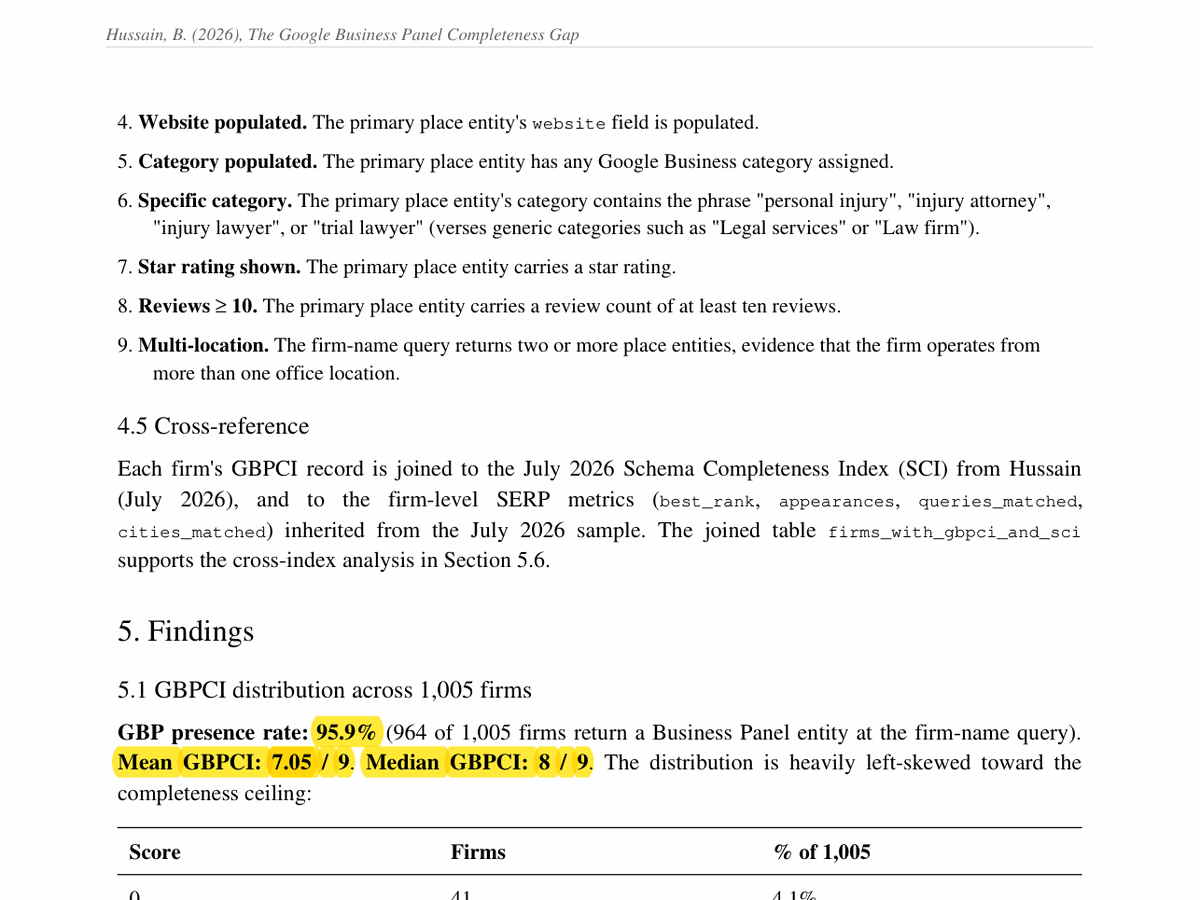
The strange part is that most firms already have these and still get them wrong. In my 9-attribute audit of 1,005 US personal injury firms, “The Google Business Panel Completeness Gap,” 95.9% of firms already had a Google Business Profile. Presence is not the problem. Accuracy is. In the same audit, 43.0% of firms did not use a specific personal-injury category (the study counted any category naming personal injury, injury attorney, injury lawyer, or trial lawyer), and profile completeness showed no correlation with organic search rank at all, a Spearman rho of -0.011. That null result matters: your Google Business Profile feeds the local pack and AI answers, a different pipeline from your organic blue links. Completing it does not lift your organic rank, and anyone who tells you it does is selling.
Presence is not the problem. Accuracy is.
95.9%
of 1,005 PI firms already have a Google Business Profile
43%
do not use the specific “personal injury attorney” category
−0.011
correlation between profile completeness and organic rank
Figures from my study, The Google Business Panel Completeness Gap (1,005 US personal injury firms).
The finding above comes straight from the study’s own page, reproduced below with the presence and completeness numbers highlighted.
Source: Behzad Hussain (2026), The Google Business Panel Completeness Gap, findings section. Highlight added.
Google Business Profile, the Anchor Every Other Citation Is Measured Against
Your Google Business Profile is the single citation that defines your firm’s local identity, and it is the reference every other listing should match. Set the exact legal or DBA name, one canonical address or service area, one phone number, and the specific “personal injury attorney” category.
The best-run PI firms I audit treat that profile as the source of truth and force every directory to agree with it. When the profile and the directories disagree, the profile is not the thing you change; the directories are. Categories are a relevance signal, not decoration. A firm listed under “law firm” or “attorney” instead of “personal injury attorney” is telling Google it is less relevant to the exact search it wants to win. Set the specific primary category, then add secondary categories only where they are true. Fill the services and description fields with real practice areas, set office hours, and keep the phone a single canonical line. Most PI firms I audit miscategorize their own listing and never notice, because nobody sold them the category, they sold them the volume.
Apple Business and Bing Places, the Map and Assistant Listings
Apple Business and Bing Places are the two anchor citations outside Google, and they now reach maps, Siri, and Copilot.
Apple renamed Apple Business Connect to Apple Business, announced March 24, 2026 and launched April 14, 2026, and your Apple Maps listing lives there now; existing Business Connect data migrated automatically, so if you claimed a listing before, check that it carried over cleanly. The screenshot below is Apple confirming that the Business Connect tools moved into Apple Business. Bing Places feeds Bing and the Copilot answers built on it. Neither will match your Google traffic, but both are cheap to claim, both carry your NAP into surfaces Google does not own, and both are the kind of corroborating witness that raises entity confidence.
Source: Apple Newsroom, “Introducing Apple Business” (announced March 24, 2026). Highlight added.
Your State Bar Directory, the Highest-Trust Citation You Already Own
Your state bar member directory is the highest-trust citation available to a law firm, and you already own it by being licensed.
“Your bar directory is the highest-trust listing you will ever own, and most firms never check it,” I said on a recent audit. It is government-adjacent, it is authoritative, and it publishes your name and admission status whether you manage it or not. Confirm the name and any listed contact data match your anchor NAP. A bar directory that disagrees with your Google Business Profile is a high-trust source contradicting you, which is worse than a low-trust one doing the same.
Tier 2: The Legal-Vertical Directories That Earn Their Place
Tier 2 is the legal-vertical directories, the lawyer-specific platforms that earn their weight through relevance to a legal audience and, in a few cases, real search traffic. These are the names the lists rattle off: Avvo, Justia, FindLaw, Martindale-Hubbell, Nolo, Super Lawyers, Lawyers.com, and Best Lawyers.
The difference from a flat list is that you rank them by relevance and authority, then claim the free profiles first and treat the rest as optional.
How many legal directories does a personal injury firm actually need? Far fewer than the lists suggest. Your bar directory from Tier 1 plus two or three high-relevance legal directories claimed and kept consistent will cover most of the available gain. The tenth directory rarely does anything the third did not already do.
A relevance grid beats a ranked list, because it forces the two questions that matter: is this directory relevant to a legal audience, and is it trusted enough to be indexed and shown. The grid below scores directory types on that basis rather than on a popularity count.
Directory types scored on what moves rankings, not on popularity
Directory type
Legal relevance
Authority / trust
Priority
State bar member directory
High
High
Tier 1, build first
Legal-vertical directory (Avvo, Justia, FindLaw)
High
Medium
Claim free profile
Peer-recognition directory (Super Lawyers, Best Lawyers)
High
Medium
Earned honor, optional
Review-bearing general (Yelp, BBB)
Medium
Medium
Claim, keep consistent
Generic business directory / bulk package
Low
Low
Skip
Judge any legal directory on three tests before you spend an hour on it. Relevance is first: a directory built for lawyers and legal consumers corroborates your identity to the exact audience Google associates with legal queries, which a general business directory does not. Authority is second: a directory trusted enough to be crawled and indexed can carry your name into search, while a thin one cannot. Indexation is the test people skip: search a unique phrase from your live profile in Google, and if the profile does not appear, Google never saw it, and it is doing no SEO work at all.
The claim discipline is simple. Claim the free profile, set the same NAP as your anchor, write a truthful bio, and move on. Do not let a directory sit unclaimed with scraped data, because an unclaimed profile still speaks as a witness, and it often speaks wrong, an old partner’s name, a suite you left three years ago. I had a firm come to me last year paying for three directory subscriptions whose profiles were not even indexed, which means Google never saw them at all. “If a listing is not indexed, it is a business card in a drawer, not an SEO asset,” I tell clients who show me their directory receipts.
Tier 3: Paid Legal Directory Profiles, Ranking Signal or Just a Badge
Paid legal directory profiles are Tier 3 because they mostly buy visibility and trust with prospects, not a ranking signal, and the two get sold as if they were the same thing.
A premium FindLaw placement, a Super Lawyers badge, an enhanced Avvo profile: these can help you convert a visitor who is already looking, and a genuine peer-selected honor can carry real credibility. What they rarely do is move your position in Google’s local or organic results on their own.
The distinction worth holding is between a pay-to-play placement and an earned recognition. A premium slot that any firm can buy signals budget, not merit, and prospects have learned to read it that way. A peer-reviewed or selectively awarded honor is different, because a third party applied a standard. Neither is a ranking lever, but the earned one converts, and the bought one mostly does not.
Is a paid FindLaw or Super Lawyers profile worth the monthly cost? It depends on whether you are buying a ranking signal or a badge, and for most firms it is the badge. A badge is worth paying for when your intake data shows prospects mention it, or when your market is competitive enough that the credibility swing closes cases. It is not worth paying for as a rankings tactic, because the ranking lift the salesperson implies is not what Google’s prominence definition rewards. I tell firms to decide these on conversion evidence, not on a promise about rank.
Tier 4: The Citations to Stop Paying For
Tier 4 is the citations to stop paying for: low-relevance general directories, scraped aggregator listings you cannot control, and citation “packages” that bulk-submit your NAP to sites no client will ever read. These are where the volume pitch lives, and where firm budget quietly disappears.
The tell for a Tier 4 citation is that it fails all three tests at once. It is not relevant to a legal audience, it is not trusted enough to be indexed, and it carries no reviews. A listing on a generic global business directory checks none of the boxes Google’s prominence definition rewards. Worse, a bulk-submission package often creates listings you cannot later edit, so when your address changes, those become the contradictions you spend next year hunting. The marginal-hour question decides it: if the next hour of citation work goes into a Tier 4 listing instead of fixing a Tier 1 inconsistency, that hour is wasted. The best marketing directors I work with spend citation budget on relevance, a clean bar listing and two legal directories, not on hitting a number.
Where Yelp, BBB, and the General Directories Fit
Yelp, the Better Business Bureau, and a few strong general directories sit above Tier 4 but below the legal-vertical set, because they carry reviews and real trust even though they are not lawyer-specific.
Yelp is a review-bearing citation, which puts it ahead of any inert directory, and Yelp’s own business help center confirms its listing content is licensed into Apple Maps, so a clean Yelp listing does double duty. The caveat is Yelp’s review filter, which routinely hides legitimate reviews, so treat Yelp as a citation and a trust surface, not as a place to chase a review count. The Better Business Bureau still carries a trust signal some prospects check, and its profile is another consistent-NAP witness. A local chamber of commerce listing earns its place when the membership is genuine, because it ties your firm to a real local organization. None of these outrank a clean bar listing or a relevant legal directory, but each is a legitimate corroborating source when the NAP matches. I tell firms to claim the review-bearing generals, keep them consistent with the anchor, and stop there rather than working down a list of weaker sites.
NAP Consistency Is Entity Math, Not Neatness
NAP consistency means your name, address, and phone read identically across every citation, and it is the mechanism that decides whether search treats you as one firm or several. This is not about tidiness. It is entity resolution.
When two listings disagree, “Smith and Jones LLP” on one and “Smith and Jones Law Firm” at a slightly different suite on another, search has to decide whether those are one entity or two, and every contradiction lowers its confidence in either. The conflicts are almost always small and almost always invisible until you look for them. A suite number written two ways, “Suite 400” and “Ste 400” and “#400.” A tracking phone number on one directory and the real line on another. A pre-move address that never got updated. The table below shows the kind of drift I find on a first audit, the same firm described three different ways across three surfaces.
The same firm, three surfaces, three stories (illustrative example of the drift a first audit surfaces)
Field
Google Business Profile
Legal directory
Old aggregator record
Name
Smith & Jones Injury Lawyers
Smith & Jones Law Firm
Smith Jones LLP
Address
100 Main St, Suite 400
100 Main St, Ste 400
220 Elm St (old office)
Phone
(713) 555-0100
(713) 555-0177 (tracking)
(713) 555-0100
Two conflicts do the most damage in personal injury practices. Call tracking numbers are the first: a unique tracking line on each directory looks smart for attribution and quietly tells Google you are several different businesses, so keep one canonical number in your citations and route tracking through your own site instead. The legal name versus DBA question is the second: pick the exact string clients see on your Google Business Profile, “Smith and Jones Injury Lawyers” or the registered LLP name, and use that one everywhere rather than mixing them.
Fixing it is less about perfection than about a single source of truth. Set your canonical NAP once, exactly as it appears on your Google Business Profile, then make every other listing match that string character for character. The diagram below shows why: when the surfaces agree, they resolve to one confident entity; when they disagree, they split into two weaker ones.
Entity resolution rewards agreement across sources and penalizes contradiction.
One multi-office firm I work with in Texas keeps a single spreadsheet of its exact name, address, and phone per office, and their entity resolves cleanly because there is nothing to reconcile. The technical SEO for personal injury law firm websites that governs crawling and indexation is what lets those consistent citations actually get read.
The Data-Aggregator Layer: Fix the Source, Not Fifty Symptoms
Data aggregators are the wholesale services that feed business identity data to directories, maps, and apps at scale, and they are the reason a wrong address you fixed keeps coming back.
Most firms never see this layer, so they fix the symptom, the visible listing, and miss the source that repopulates it. The national aggregators that feed most US directory data have consolidated to three that matter: Data Axle, Foursquare, and Localeze, which now sits under TransUnion. The old talking point about four big aggregators is out of date. Foursquare absorbed the Factual data when the two companies merged in 2020, and Localeze moved under TransUnion when TransUnion completed its acquisition of Neustar in December 2021. If your NAP is wrong at one of these three, that error can flow downstream into dozens of directories you never submitted to, and correcting those directories one by one does nothing, because the source keeps refilling them.
Why you fix the source, not the symptoms
Data AxleFoursquareLocaleze (TransUnion)→MapsDirectoriesAppsAssistants
Fix the sourceCorrected record propagates clean NAP downstream.
Fix only the symptomThe uncorrected source repopulates the old error within weeks.
The aggregator layer syndicates your NAP at scale, which is why source-first correction is the only order that holds.
The Localeze consolidation is a matter of public record, not vendor folklore. The SEC filing below is TransUnion’s own press release, filed as an exhibit to its Form 8-K, announcing the completed Neustar acquisition on December 1, 2021, the deal that brought Localeze under TransUnion.
Source: TransUnion and Neustar Announce Transaction Close, SEC Form 8-K Exhibit 99.1, December 1, 2021. Highlight added.
The order of operations is the whole game. “Fix the source, not the fifty symptoms,” I tell every firm cleaning up an old address. Correct the aggregator records first, then clean the downstream listings, then verify. You can submit corrections to each aggregator directly, or use a managed listing service to push a corrected record once and let it propagate; the managed route is worth it when a firm has many offices or a bad record spread everywhere, while a single-office firm can do it by hand in an afternoon. Do it in the wrong order and you will be back in a month wondering why the old data returned.
Reviews Are Citations Too: Two Signals in One Profile
Review-bearing profiles are the highest-value citations you can build, because they carry your NAP and your reviews in the same place, and Google’s prominence definition names reviews directly.
A Google Business Profile, an Avvo profile, a Yelp listing: each one is a citation and a review surface at once. That is two of the signals Google actually described, delivered by one profile. This is why review-bearing citations outrank inert ones for your attention. Profile completeness and reviews travel together on the platforms that matter. In the completeness audit, the rated firms in my sample sat at a median of 87.5 reviews, and review depth is one of the few citation attributes that plausibly tracks with local visibility because it is a prominence input Google names, not one a vendor invented. Recency and responses matter too: a steady flow of recent reviews you actually reply to reads as an active business, while a wall of three-year-old reviews reads as a dormant one. Prioritize the two or three citations that carry reviews before you touch a directory that carries none.
That 2019 change is not folklore either; it is in Google’s own words on the Search Central blog, shown below with the operative sentence highlighted.
Source: Google Search Central Blog, “Making Review Rich Results more helpful,” September 16, 2019. Highlight added.
How Local Citations Feed Entity Confidence and AI Answers
Consistent citations raise your firm’s entity confidence, and entity confidence is what AI answer engines lean on when they decide whose name to cite.
This is the angle almost no citation post covers, and it is the one that will matter most over the next few years. Google and the AI systems built on its index do not just match strings anymore; they resolve entities, and they build confidence in an entity from facts stated consistently across independent sources. Your citations are those sources.
Think about what corroboration looks like in practice. When your bar directory, your Google Business Profile, an Avvo profile, and a local news mention all state the same firm name, the same address, and the same practice area, an AI answer engine sees four independent sources agreeing, and its confidence that your firm exists as described climbs. When they disagree, that confidence stalls, and a system choosing which firm to name in an answer picks the one it is sure about. Consistency is the input; being nameable in an AI answer is the output.
From consistent citations to an AI-nameable firm
Consistent citations
Same NAP across bar, GBP, directories, mentions
→
Entity confidence
Search resolves you as one trusted firm
→
AI answer citation
The system names the firm it is sure about
In my study of 1,005 firms, The Person Entity Confidence Gap, 78.7% triggered no knowledge panel at all and only 3.5% resolved as a person entity; those that did carried a 2.95x organic-traffic multiplier after controlling for rank and schema.
Entity confidence tracks with traffic and is built from the same corroboration consistent citations provide.
Those panel-class numbers come straight from the study’s findings pages, reproduced below with the 78.7% no-panel row and the 3.5% person-entity class highlighted.
Source: Behzad Hussain (2026), The Person Entity Confidence Gap, panel-class distribution and taxonomy. Highlight added.
“Consistency is not neatness, it is the math that decides whether an AI answer trusts your name.”
Behzad Hussain, Personal Injury SEO Strategist
You can read the underlying data in my personal injury law firm research. Citations do this work alongside brand demand. In my 1,000-firm study, “The Brand Demand Flywheel,” firm brand-search demand tracked organic traffic at a Spearman rho of 0.41, and it stayed significant after I controlled for domain authority, backlinks, and rank, which makes it one of the few off-page levers that holds up net of everything else. Unstructured citations, the mentions in news and sponsorships that carry no form, are what build that brand demand over time. They do not rank you by themselves. They make you known, which is the exact word Google uses for prominence.
The AI answer engines reach this data through their own crawlers, and the honest picture is that no vendor publishes a per-directory list of which citations earn an AI citation. Google’s AI Overviews draw on the same index and entity graph that power Google Search. ChatGPT’s search crawler and Perplexity’s crawler fetch and cite live pages, directory profiles included, when those pages corroborate a firm’s identity. My read, from auditing which firms get named in AI answers, is that the firms with clean, consistent citations and a resolved entity are the ones these systems name, because a system that has to choose picks the firm it is confident about. That is an assessment from client work, not a documented ranking rule, and I flag it as one.
Multi-Office and Moved-Office Citation Playbooks for PI Firms
Multi-office and moved-office situations are where citation strategy gets hard, because every real office needs its own consistent set of listings and every old address needs to be purged at the source.
The rules that work for a single-location firm break quietly when a firm has three offices or relocates one. For a multi-office firm, each legitimate office gets its own anchor listings with its own NAP, never a duplicate of another office and never a shared profile split across locations. The parts of a clean multi-office citation set are listed below.
One Google Business Profile per real, staffed office, each with its own address and local phone.
A matching set of legal-directory and bar listings per office, each pointing to that office’s NAP.
One canonical firm name used identically across every office listing.
No duplicate profiles for the same office, because duplicates split reviews and ranking signals.
Moving an office is where I see the most damage. I see this pattern repeatedly: a firm moves, updates Google, and forgets the aggregator record, so the old address resurfaces on the map for months. The fix follows the source-first order, shown below.
The moved-office fix, in order
Old address
Persists after the move
Resurfaces
Aggregator record repopulates it
Fix the source
Correct aggregators, then GBP, then directories
Propagates
Clean NAP flows downstream over weeks
Update the aggregator records first, then Google, then every downstream directory, then watch for the old address returning.
Do not open a second Google Business Profile at the new address, because a duplicate splits your reviews and your ranking signals across two listings.
What State Bar Advertising Rules Say About Your Directory Profiles
State bar advertising rules govern what you can say on a directory profile, and the two that bite most often concern honesty and specialist claims.
Your directory profiles are lawyer advertising, the same as your website, and the bar treats them that way. The American Bar Association’s Model Rule 7.1 requires that anything you communicate about your services not be false or misleading, which covers your bio, your claimed practice areas, and how you present a directory’s own rating or badge.
Specialist language is the sharper trap. Under the ABA’s Model Rule 7.2(c), you cannot state or imply that you are a certified specialist unless a state-approved or ABA-accredited organization certified you, and you name that organization. Calling yourself a personal injury lawyer who focuses on or concentrates in injury cases is fine under Rule 7.1 if it is true. Calling yourself a “certified personal injury specialist” without the certification behind it is not, and some states, California among them, do not certify personal injury as a specialty at all, which makes the claim impossible to support there.
How to Audit Your PI Firm’s Citations Without Buying a Tool
You can audit your firm’s citations with a browser, a spreadsheet, and an hour, no paid tool required. The point of the audit is not a score; it is to find the contradictions that are splitting your entity and the paid listings that are not earning their cost.
The steps below run in order, source-first.
The one-hour citation audit
Write your canonical NAP once, exactly as it appears on your Google Business Profile. This is the string everything else must match.
Search your firm name in Google and open every listing that appears, comparing each NAP to your canonical string and flagging every difference.
Check the three anchor surfaces outside Google: Apple Business, Bing Places, and your state bar directory. Confirm each matches.
Search your old address or old phone if you have ever moved or ported a number, because that is how you find the ghosts still feeding bad data.
List every paid directory subscription and confirm each profile is actually indexed, by searching a unique phrase from the profile in Google.
Correct at the source first, aggregators and Google, then the downstream directories, then re-verify in two to four weeks.
The minimum viable citation set
Google Business Profile
Apple Business
Bing Places
State bar directory
Avvo
Justia
FindLaw
One review-bearing general (Yelp)
Run the audit once a quarter; listings drift on their own, and a clean set six months ago is not a clean set today.
Which citations should a brand-new PI firm build first? Build the eight that anchor your entity before you touch anything else: Google Business Profile, Apple Business, Bing Places, your state bar directory, and two or three high-relevance legal directories with the free profile claimed and consistent. That set, kept clean, outperforms any 200-site package, because it is relevant, trusted, and contradiction-free.
Where Citation Strategy Fits in Your PI SEO Program
Citations are one instrument in a larger system, and they pay off only when they sit alongside a clean site, real reviews, and genuine brand demand.
On their own, even a perfect citation set supports your entity; it does not carry your rankings by itself. That is why I run citation work as part of the Personal Injury Organic Authority Engine rather than as a standalone service, and why the honest deliverable is a prioritized fix list, not a bigger number.
The senior call your vendor won’t make
Stop financing citation volume. Fix the entity underneath it.
The firm one suite over keeps taking your cases, and your current vendor keeps building citations instead of fixing the entity underneath them. As your Fractional Personal Injury Search Strategist, I own the direction: what to build, what to kill, and what to fix at the source, reported to you every month.
Citations or backlinks: which should a PI firm prioritize?
Prioritize whichever is more broken, but understand they do different jobs. A citation asserts your identity, your name, address, and phone, on a directory or map. A backlink passes authority from another site to yours. For a firm with inconsistent listings, fixing citations comes first because contradictions actively hurt entity resolution. For a firm with clean citations, authority-building links move the needle further.
Should I pay a service to build citations, or do it manually?
Do the anchor and legal-vertical listings manually, because they need accuracy more than speed, and a person catches contradictions a bulk submitter creates. A managed aggregator correction can be worth it to fix the wholesale source at scale, but paying to bulk-submit your NAP to hundreds of low-relevance directories buys volume you do not need and cannot easily correct later.
How do I handle two Google listings for one office?
Merge or remove the duplicate, do not leave both live. Two profiles for one office split your reviews and your ranking signals and confuse which listing Google should trust, so keep the profile with the reviews and history and use Google’s process to remove or merge the other. Then make sure no directory is still pointing to the dead one.
Do our attorneys need their own citations, or just the firm?
Both, and they do different jobs. Firm citations resolve the business entity that shows in the local pack and on the map. Attorney citations, the bar directory listing and the lawyer-directory profiles tied to a named person, feed the person entity that a knowledge panel and many AI answers key on. A firm with a strong business entity but no consistent attorney citations leaves the person layer, and the traffic that comes with it, on the table.
How long until fixed citations affect local visibility?
Expect several weeks, not days. After you correct the source and the downstream listings, search engines re-crawl and reconcile on their own schedule, and old data held by an aggregator can take a full cycle to clear. Consistency compounds; a clean set held for months outperforms a burst of new listings.