Google Business Profile Grader for Personal Injury Law Firms: The Working Tool and the GBPCI Benchmark Playbook
Grade your firm’s Google Business Profile in under 90 seconds: answer 8 quick questions covering the 9 GBPCI attributes and see your score, your percentile against 1,005 top ranking US personal injury firms, and the exact gaps to close, instantly and with no email gate.
Free. No email. Runs entirely in your browser.
Search your firm name on Google in another tab, read the panel that renders, and answer from what it actually shows.
1Does a Business Panel appear when you search your firm name?The place box with map, address, and reviews on a brand name search.
2Is a street address shown on the panel?A populated address field, not just a service area.
3Is a phone number shown?A call button or visible number on the panel.
4Does the panel link to your website?A website button pointing to your firm’s domain.
5Does the panel show a star rating?A visible star average, which appears once you have reviews.
6Do you have at least 10 Google reviews?Review count in double digits or higher.
7Do 2 or more verified office locations appear?Only count real, staffed, verified offices.
8Is a Google Business category assigned, and which primary category?Check the exact category label, not the practice areas listed lower down. This counts for 2 of the 9 attributes: any category, plus the specific personal injury one.
0/ 9 GBPCI
Answer the questions above to see your score and percentile.
GBPCI is the Google Business Panel Completeness Index, my published 9 attribute measure, not an official Google score. This grader is a self serve diagnostic, not a guarantee of ranking or of signed cases.
A Google Business Profile grader for personal injury law firms scores your firm’s Business Panel on the nine attributes that Google’s place template exposes, then tells you where you sit against the real distribution of top ranking firms. Most graders invent their rubric. This one runs on the Google Business Panel Completeness Index, or GBPCI, the nine attribute measure I built and published after auditing 1,005 US personal injury firms that already rank on Google Page 1. Below the tool, I explain what each attribute means, why completeness wins the map pack but not the organic links, and the fixes that move your grade the most.
Answer the eight questions above about your firm’s Google Business Profile as it renders today, not as you wish it looked. The grader scores nine attributes (the category question counts for two), marks each as present or absent, sums them into a 0 to 9 GBPCI score, and places that score against the 1,005 firm benchmark.
Use it in this order:
Open your firm’s brand name search on Google in a separate tab. Type the firm name the way a past client would, then read the panel that renders on the right on desktop or at the top on mobile.
Answer each question from what that panel actually shows. The category question is the one firms get wrong most, so check the exact category label, not the practice areas listed lower down.
Read your score and percentile. The tool marks which attributes you are missing.
Work the fix list top down. It orders your gaps by how much they move the grade and how quickly you can close them.
The score renders in your browser. Nothing you enter is sent anywhere, and there is no email wall before the result. “A grader that gates your own score behind a lead form is not a diagnostic, it is a trap,” I tell every marketing director who asks why this one skips the form.
What the Grader Measures: the 9 GBPCI Attributes
The grader measures nine binary attributes of your Google Business Profile, each worth one point, summed into a GBPCI score from 0 to 9. I defined these nine in my 1,005 firm Business Panel completeness study, and the grader applies the exact same rubric to your firm that the study applied to the sample.
The nine attributes are listed below.
Business Panel present: a place entity returns when someone searches your firm name.
Address populated: the primary place entity carries a street address.
Phone populated: the panel shows a phone number.
Website populated: the panel links to your site.
Category populated: any Google Business category is assigned.
Specific category: the category names personal injury, injury attorney, injury lawyer, or trial lawyer, not a generic “Law firm” or “Legal services.”
Star rating shown: the panel carries a star rating.
Reviews at or above 10: the review count reaches double digits.
Multi location: two or more verified offices return.
Six of these nine map to fields your intake team already knows: name, address, phone, website, hours, category. The other three, specific category, review depth, and verified multi location, are where firms separate. “The first four attributes are table stakes, the last five are the whole game,” I said on a strategy call with a three office firm last month.
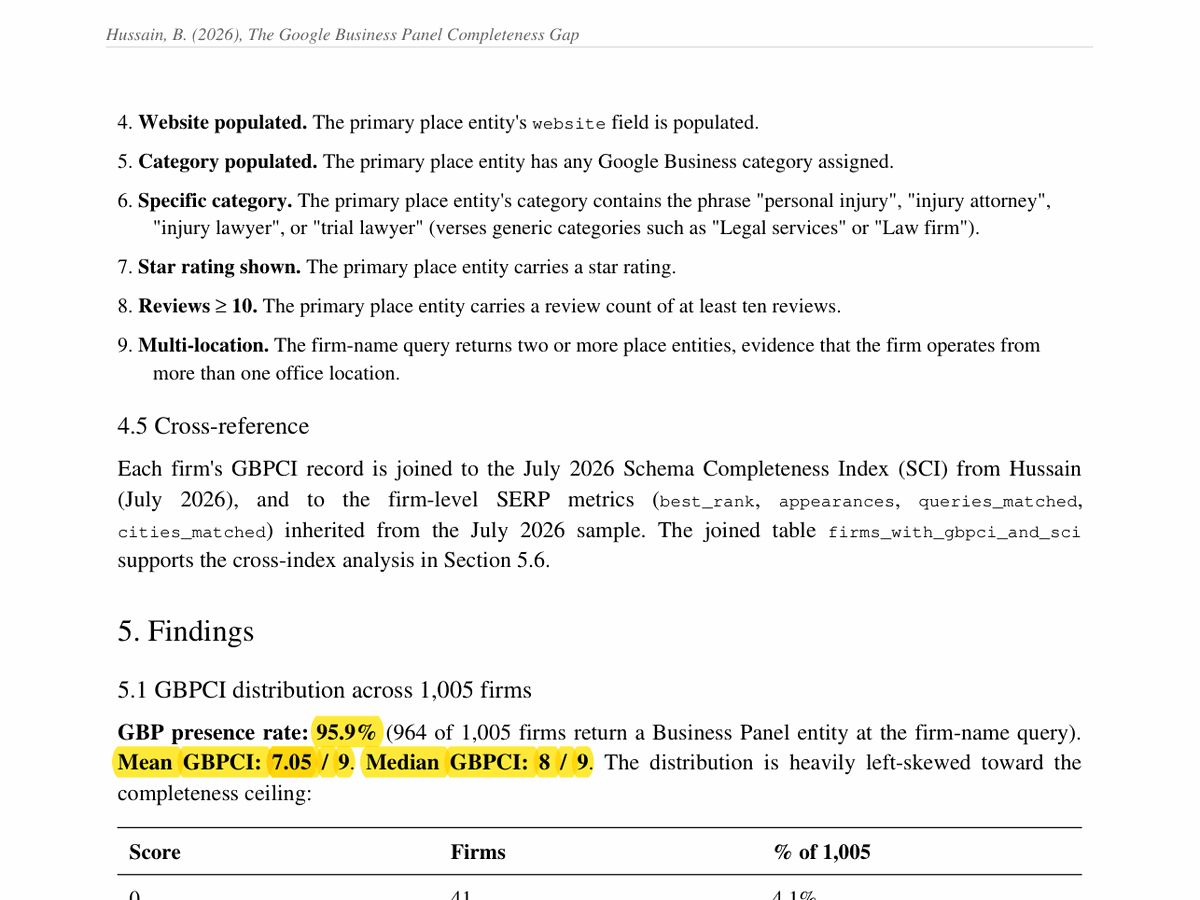
The Business Panel itself is worth naming precisely. When a searcher types a firm’s brand name, the large panel that renders is a Google Business Panel, a place template entity fed by your Google Business Profile. It is not the Wikipedia backed person Knowledge Panel that shows for a famous managing partner. My audit found a Business Panel for 95.9 percent of firms but a person Knowledge Panel for only 3.5 percent, so the Business Panel is the entity surface almost every firm actually owns.
The screenshot below is the findings section of my paper, with the presence rate and the mean and median GBPCI highlighted. It is the source the grader scores you against, and it carries the nine attribute definitions the tool uses.
Source: Behzad Hussain, The Google Business Panel Completeness Gap, a 9 attribute audit of 1,005 US personal injury law firms. The highlighted lines show 95.9 percent Business Panel presence and a mean GBPCI of 7.05, median 8 of 9. The full methodology lives in my 1,005 firm Business Panel completeness study.
The 9 Attributes, Ranked by How Often Page 1 Firms Have Them
Page 1 personal injury firms hold the nine attributes at very different rates, from 95.9 percent down to 50.1 percent. The chart below comes from the 1,005 firm sample and shows exactly where the field is strong and where it is thin.
Business Panel present95.9%
Phone populated95.5%
Address populated95.3%
Website populated94.0%
Category populated (any)77.0%
Star rating shown73.6%
Reviews at or above 1066.2%
Specific personal injury category57.0%
Multi location (2+ offices)50.1%
The top four attributes cluster between 94 and 96 percent. These are the bones, and almost every ranking firm has them. The gap opens at attributes five through nine. Only 57.0 percent of Page 1 firms use the specific personal injury category, and only 66.2 percent carry ten or more reviews. Those two numbers are where a grader earns its keep, because they are inside your control and half the field leaves them on the table.
Why a Personal Injury GBP Grader Beats a Generic Business Profile Audit Tool
A personal injury GBP grader beats a generic business profile audit tool because it grades you against your real competitive set and against published data, not an invented internal rubric. Every free grader on the market outputs a confident number. Almost none of them will tell you what population that number is measured against, because they have no population.
I have watched firms print a “78 out of 100” from a generic grader, feel good, and change nothing, while the firm one block over sits at nine attributes complete and takes the map pack. The generic score measured that firm against nail salons and plumbers. It never asked whether the category said “Personal injury attorney” or “Law firm,” which is the single attribute that decides which competitive set Google ranks you inside.
The three differences that matter are compared below.
Generic GBP grader versus this research backed grader
Dimension
Generic GBP grader
This grader (GBPCI)
Benchmark population
None, or all local businesses
1,005 top ranking US personal injury firms
Methodology
Unpublished internal rubric
Published 9 attribute study you can read
Vertical
Generic small business
Personal injury law only
Result placement
A score out of 100
Percentile against real ranking firms
Honesty about ranking
Implies completeness lifts rankings
States the organic rank null result
Lead gate
Often an email wall before results
Instant, no gate on the score
Three things separate this grader from the generic tools: a benchmark population, so the percentile means something in your market; a published methodology, so the nine attributes and the full distribution come from a paper you can read; and an honest scope, because it tells you what completeness does not do, which no sales grader will.
For a broader firm wide self assessment across the four pillars I score client sites on, the PI Authority Scorecard is the companion instrument. The GBP grader zooms into one surface; the Scorecard covers the whole engine.
What a Complete Business Panel Does for a Personal Injury Firm, and What It Does Not
A complete Business Panel builds trust and wins local and AI answer visibility, but it does not lift your organic Page 1 ranking. This is the honest half most graders skip, and it is the half that saves you from spending on the wrong thing.
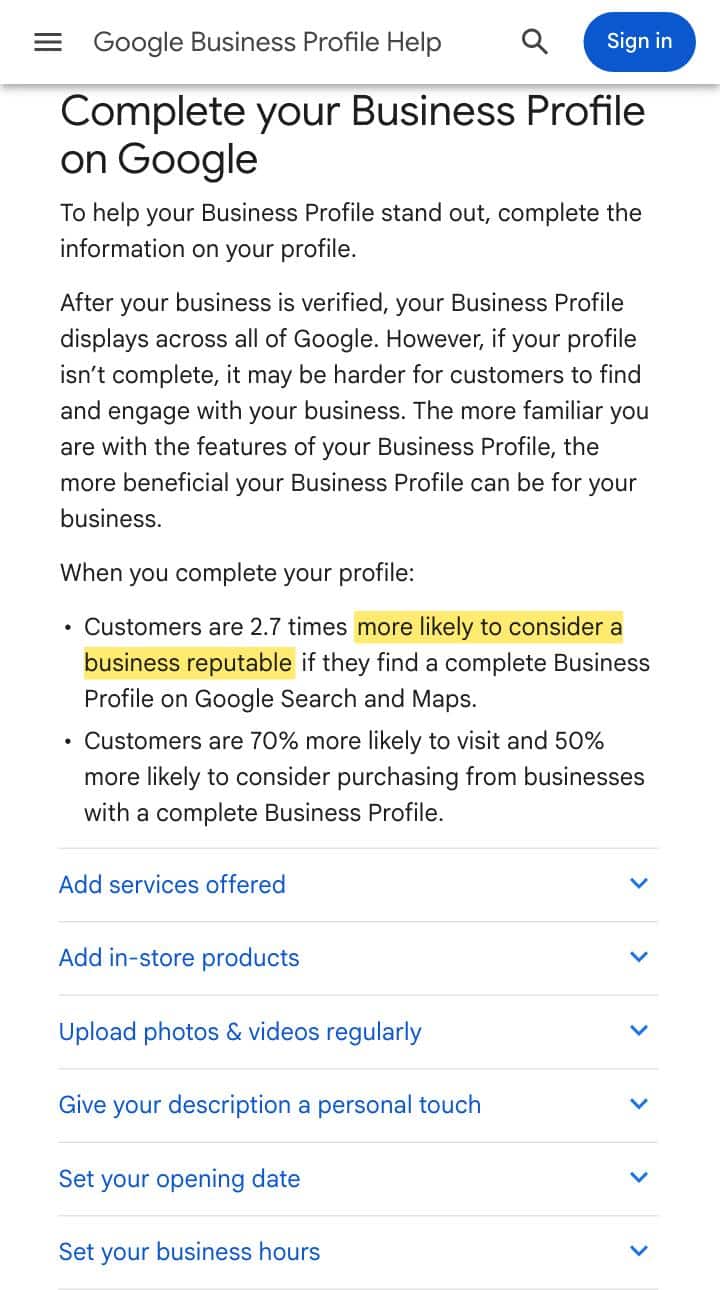
Start with what completeness does. Google’s Business Profile documentation states that customers are 2.7 times more likely to consider a business reputable when they find a complete Business Profile, and 70 percent more likely to visit. For a personal injury firm, the panel is the first impression a brand name search delivers, and the map pack is where a “car accident lawyer near me” search resolves before the organic links even load.
Completeness also feeds the answer layer. Google’s AI Overviews and AI Mode pull from the same category, review, and attribute signals your Business Panel exposes, so a firm with a thin or miscategorized profile is a firm the AI answer skips when a searcher asks it to name a personal injury lawyer nearby. The panel you grade here is one of the inputs deciding whether an AI answer surfaces your firm at all.
The four numbers below frame what the panel does and does not move.
2.7xmore likely to be seen as reputable with a complete profile (Google)
95.9%of Page 1 PI firms have a Business Panel
7.05mean GBPCI of 9 across 1,005 firms
-0.011correlation between GBPCI and organic rank (not significant)
The Google figures come straight from Google’s own Business Profile documentation, captured below with the reputable line highlighted.
Source: Google Business Profile Help, Complete your Business Profile on Google. The highlighted line states customers are 2.7 times more likely to consider a business reputable with a complete Business Profile; the line below adds 70 percent more likely to visit.
Now the part I had to publish to be believed. In my 1,005 firm audit, GBPCI showed no meaningful correlation with organic Page 1 rank, a Spearman coefficient of -0.011. Mean GBPCI barely moved across rank buckets: 7.02 for firms ranking 1 to 3, 7.15 for 4 to 6, 6.98 for 7 to 10. “Business Panel completeness wins the map pack and the AI answer, not the blue links, and any vendor who tells you otherwise is selling,” I say on first calls when a firm expects a complete profile to fix a page two ranking.
That null result is not a reason to ignore the panel. It is a reason to place it correctly. The Business Panel and the organic content pipeline are two different systems. One firm I audited had a flawless nine attribute panel and still ranked eighth organically because its practice area pages were thin, and the fix lived in local SEO for personal injury law firms and on page structure, not in the profile. Another firm had strong organic pages and a five attribute panel bleeding map pack visibility to weaker firms with complete profiles. Grade the panel, fix the panel, then do not expect the panel to do the content pipeline’s job.
The Personal Injury Category Gap: the Most Common Grader Failure
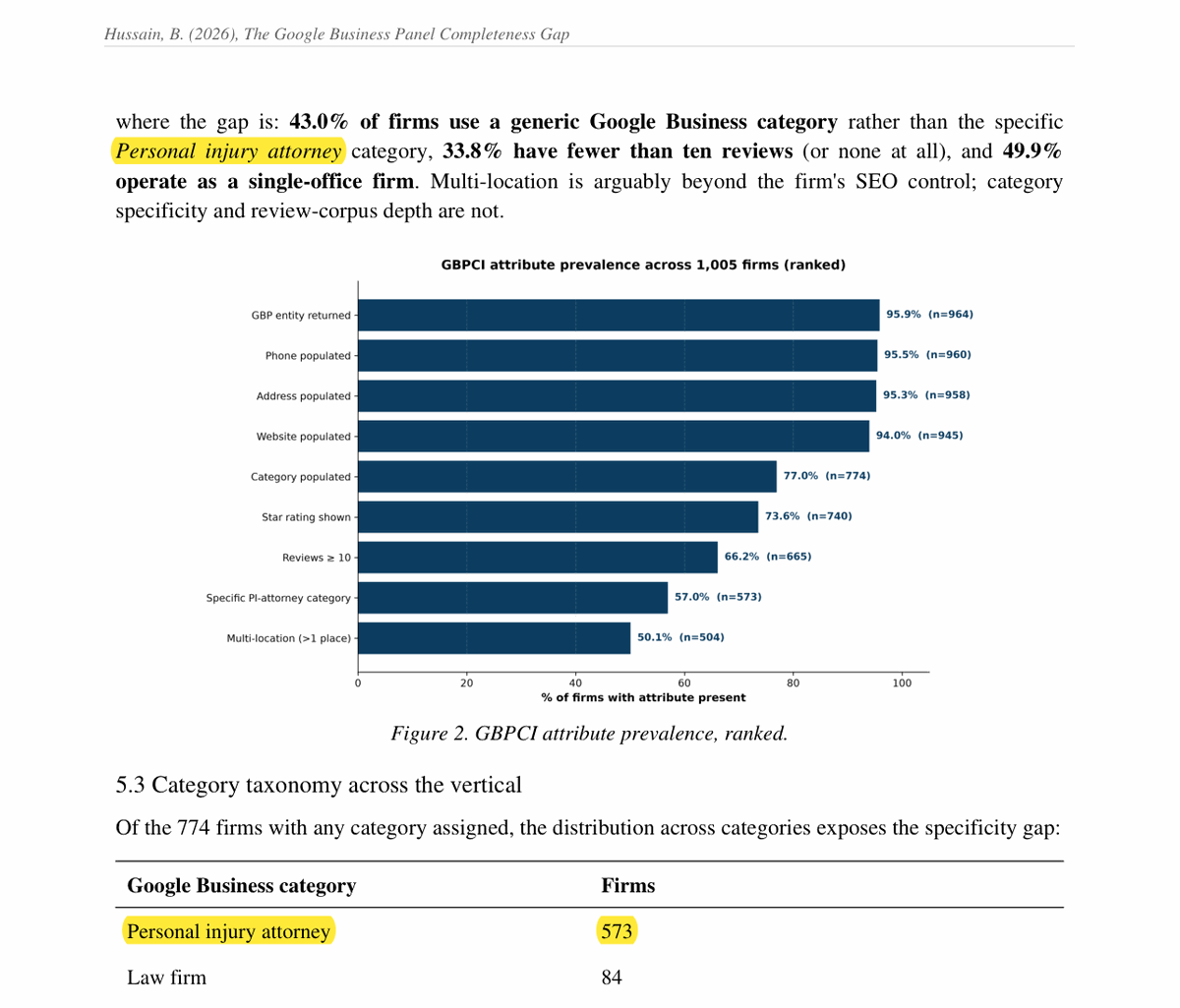
The personal injury category gap is the attribute most firms fail, and it is the one that quietly costs the most. In my audit, 43.0 percent of firms did not use the specific personal injury category.
Of the 774 firms that had assigned any category at all, only 573 used “Personal injury attorney.” The rest sat under a label that files them in the wrong competitive set. Category choice is not cosmetic. Google’s patent record, cited in my study, includes an application on defining relevant content area based on category density, US Patent Application 2014/0074820 A1, which ranks a business inside its assigned category. Pick “Law firm” as your primary category and Google ranks you against estate planners, criminal defense shops, and immigration practices for the same local queries, instead of against the personal injury firms you actually compete with for signed cases.
The screenshot below is the taxonomy passage from my paper, with the 43.0 percent gap and the specific category count highlighted.
Source: Behzad Hussain, The Google Business Panel Completeness Gap. The highlighted text shows 43.0 percent of firms use a generic Google Business category rather than the specific Personal injury attorney category, with 573 of 774 categorized firms on the specific one.
The table below shows where the 774 categorized firms landed.
Primary Google Business category across 774 categorized personal injury firms
Google Business category
Firms
Personal injury attorney (the specific one)
573
Law firm
84
Attorney
32
Criminal justice attorney
23
Legal services
12
Medical lawyer
11
Insurance attorney
4
Divorce lawyer
4
General practice attorney
3
Social security attorney
2
Estate planning attorney
2
Non profit organization
2
The miscategorizations that make me wince are the 23 personal injury firms filed as “Criminal justice attorney” and the 2 filed as “Non profit organization.” Those are usually an outdated primary category from a firm that once did other work, or a virtual assistant who picked the wrong label at setup. “I have moved a firm from ‘Law firm’ to ‘Personal injury attorney’ and watched map pack impressions climb inside six weeks, no other change,” I told a partner who doubted a single dropdown could matter.
Reading Your Score Against the 1,005 Firm GBPCI Distribution
Read your GBPCI score against the distribution of 1,005 Page 1 firms, not against a perfect 9. The median firm in my study scored 8 of 9, and the distribution is heavily skewed toward the top, so an average looking profile is already an 8.
What is a good Google Business Profile score for a personal injury firm? A good score is 8 or higher, because 8 is the median across 1,005 top ranking firms and 232 firms, 23.1 percent, reached a perfect 9. Anything at 7 or below sits in the bottom half of the ranking field, and anything at 4 or below means a core attribute like category or reviews is missing entirely.
The distribution below shows how the 1,005 firms spread across the 0 to 9 scale.
410
01
02
13
614
1355
406
1277
3688
2329
GBPCI score (0 to 9), firm count above each column, n = 1,005
The distribution has a shape worth understanding. Scores of 1 and 2 do not exist in the data. A firm either has no panel at all, scoring 0, which happened for 41 firms, or once it has a panel it almost always carries address, phone, and website too, jumping straight to 4 or higher. The mode is 8, held by 368 firms. The percentile your grader reports comes from this real curve, so a score of 6 does not mean 67 percent, it means you sit below most of the field.
“Stop chasing the tenth review star and start asking why you are a 6 when the median firm is an 8,” I tell firms who fixate on rating perfection while missing whole attributes.
How to Raise Your Google Business Profile Grade
Raise your grade by closing the missing attributes in order of impact, starting with category and reviews, because those are the two high gap attributes inside your control. The fix list your grader produces follows the same priority order I use on client profiles, ranked by gap size times ease.
Work the fixes below in order.
Claim and verify the profile if you scored 0. Populate name, address, phone, and website in one pass, which moves you from 0 to 4 immediately. Keep every field byte identical to your website, since Google rewards a consistent declared record.
Set the primary category to “Personal injury attorney.” This is one dropdown, and 43.0 percent of the field has it wrong, so it is the highest impact single action on the list.
Build the review corpus past 10, then toward the median of 87.5 and beyond. Volume and recency both count. A steady monthly pace of new reviews outperforms a one time burst that then goes stale.
Add verified offices only if they are operationally real. Do not fabricate locations for a completeness point.
Keep the profile and your site consistent over time, because the two records corroborate each other and drift between them weakens both.
Which fix moves the grade the most? The specific category assignment moves it most for the effort, because it is a single action that 43.0 percent of the field still gets wrong, and it re files your firm against the correct competitors. Reviews move the grade more in absolute terms but take months; category takes minutes.
Does adding fake office locations raise the score? No, fabricated locations do not safely raise the score, because Google’s entity display priority can demote or hide unverifiable locations, and a suspended profile scores worse than an honest single office one. One firm I worked with had inflated its office count with executive suite addresses, lost two listings to suspension, and dropped out of the map pack in two metros before we rebuilt it on real, staffed offices only.
Where the Business Panel Grade Fits in Your Firm’s Entity Signals
Your Business Panel grade is one of three independent entity signals Google reads about your firm, and the three do not predict each other. This is the strategic point most firms miss, and it is where a complete profile compounds into something a competitor cannot easily copy.
The three signals are your on page schema, measured by the Schema Completeness Index, your Business Panel completeness, measured by GBPCI, and your person level presence, measured by Person Entity Confidence. In my data these are statistically independent. GBPCI and the Schema Completeness Index correlate at just +0.036, effectively zero. A firm can hold a perfect nine attribute panel and still publish thin, unstructured pages, or run rich schema and neglect its profile. The three loops below sit in different parts of a firm, which is exactly why almost nobody optimizes all three.
Loop 1Schema Completeness IndexOn page structured data. Measured 0 to 25 across the same 1,005 firms.Owned by the web developer
Loop 2GBPCI (this grader)Business Panel completeness, 0 to 9. Off site, fed by your Google Business Profile.Owned by marketing
Loop 3Person Entity ConfidenceWhether a managing partner earns a Knowledge Panel and gets named in AI answers.Owned by nobody, usually
GBPCI and schema correlate at +0.036. Three complete signals that agree is a moat.
Independence is the opportunity. Because the three loops sit in different parts of a firm, the website developer owns one, the marketing team owns another, and no one owns the third, almost no firm optimizes all three together. The firm that does presents Google three mutually corroborating entity signals at once.
Three complete signals that agree with each other is a moat, because your competitor has to fix three disconnected teams to match it.
Behzad Hussain, on where PI firms should invest next
The grader shows you where your Business Panel sits. The Personal Injury SEO Diagnostic shows you why your local and organic case flow is stuck, and hands you a prioritized roadmap to fix it. I read your panel, your pages, your schema, and your map pack together, then tell you what to do first.
A written, prioritized roadmap in 7 to 10 days, plus a 60 to 90 minute walkthrough call.
Frequently Asked Questions About Grading a Personal Injury Business Profile
Is the grader free, and where does my data go?
The grader is free and runs entirely in your browser. Nothing you enter is transmitted, stored, or emailed. The score, percentile, and fix list compute on your device, and there is no lead form standing between you and your result.
Is GBPCI an official Google score?
No, GBPCI is not a Google metric. It is the Google Business Panel Completeness Index, a nine attribute measure I defined and published after auditing 1,005 US personal injury firms. Google does not publish a completeness score, so GBPCI exists to give firms a benchmark grounded in real ranking firm data.
Does the grader work for a multi office or multi state firm?
Yes, grade the primary Business Panel that renders on your main firm name search. Multi location counts as one of the nine attributes, so a firm with two or more verified offices earns that point. For a large multi state firm, grade each market’s primary panel separately, since category and review depth vary office to office.
What is the difference between my firm’s Business Panel and a Knowledge Panel?
A Business Panel is a place template fed by your Google Business Profile, and it appears for 95.9 percent of firms on a brand name search. A person Knowledge Panel is an entity panel for a notable individual, and it appears for only 3.5 percent of firms, usually a well known managing partner. This grader scores the Business Panel, the surface almost every firm actually has.