
Google Business Profile Completeness for Personal Injury Law Firms: What 1,005 Firms Reveal
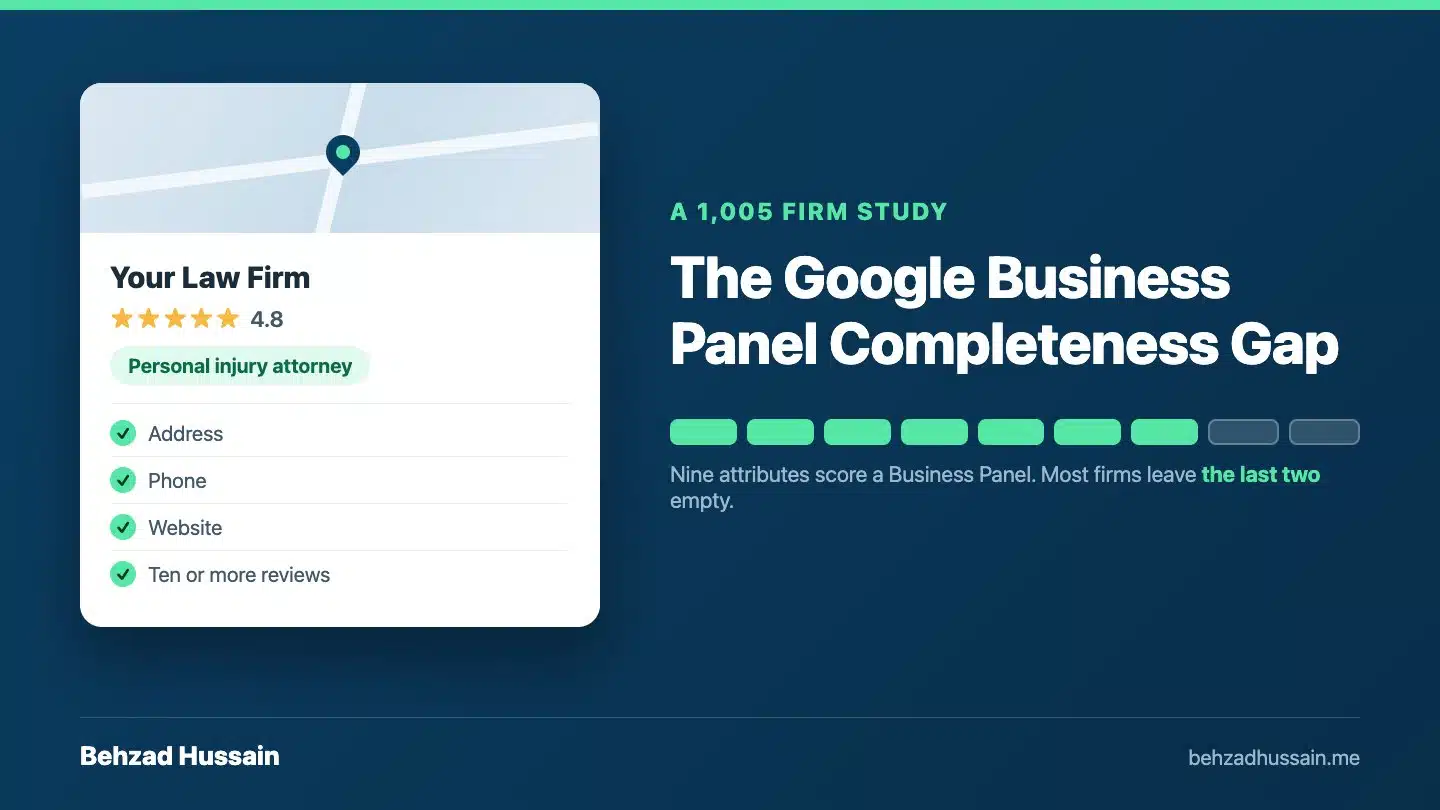
When a searcher types your firm’s name into Google, the large panel that renders on the right is almost never a Wikipedia backed profile. It is a Google Business Panel, drawn straight from your Google Business Profile, and its completeness is measurable. I audited that panel across 1,005 top ranking US personal injury firms and scored each on nine attributes. The average firm sits at 7.05 out of 9. The gaps that separate the winners are cheaper to close than most partners assume.

Behzad Hussain
Organic lead acquisition strategist for personal injury law firms
Behzad Hussain is an organic lead acquisition strategist for personal injury law firms in the US, UK, and Canada. This piece is built on my own 1,005 firm audit of Google Business Panel completeness, the third in a series of entity studies that also measured on page schema and the person side Knowledge Panel across the same top ranking sample.
On this page
- The panel your firm actually gets
- The nine attribute score (GBPCI)
- Where the vertical is complete and thin
- The Google Business category gap
- Why review depth beats star rating
- Does completeness move organic rank?
- The two entity loops firms never connect
- Feeding AI Overviews and answer engines
- The Business Panel fixes, ranked by the data
- Score your own Business Panel
- What this 1,005 firm study does not claim
- Where it fits organic case acquisition
- Closely related topics
- Frequently asked questions
- References
The panel your firm actually gets on a brand search
The panel that renders when someone searches your firm’s brand is a Google Business Panel, a place template surface fed by your Google Business Profile, not the person style Knowledge Panel that a Wikipedia article produces. In my audit of 1,005 top ranking personal injury firms, 95.9% returned a Business Panel at the firm name query. The companion study I ran on the person side found the managing partner’s own Knowledge Panel appears for only 3.5% of firms. Those two panels are not two rungs on one ladder. They are two different Google surfaces, built from two different data sources, and they behave nothing alike.
The distinction is not academic, and it is not mine. Google’s knowledge panel patent, Providing Knowledge Panels With Search Results, US-11836177-B2, separates the two at the claim level. One claim specifies the person template placeholders, an image, a description, biographical facts. A separate claim specifies the place template placeholders, a map image, a place description, and at least one place fact such as address, hours, or category. Your firm’s brand panel is a place template render. Its placeholders are populated from your verified Business Profile, which is why the profile, not your website, controls what shows up in it.
This matters more than it sounds like it should, because the Business Panel is the first thing a searcher sees when they check you out. Before they read a word of your website, they see your rating, your review count, your photos, and a click to call button, all rendered from the profile. That panel is doing intake triage for you whether you manage it or not. A searcher comparing three firms on a Tuesday night rarely opens three websites. They scan three panels. The same completeness discipline applies to the firm’s listings on Apple Business Connect, which feeds Apple Maps, and on Bing Places, which feeds Bing’s local results, but Google is where personal injury case volume concentrates, so it is where this study looks.
Here is the shape of the two panel classes side by side, with the share of firms that get each.
I watch partners chase the wrong panel constantly. A firm will spend a quarter trying to earn a Wikipedia page and a “real” Knowledge Panel while the panel they already have, the one 95.9% of their competitors also have, sits half filled. “You already have the panel that matters,” I tell every firm on our first call. “The question is whether it is complete, not whether it exists.” One firm came to me convinced they needed a PR campaign to manufacture a Knowledge Panel. Their Business Panel was missing a category and sitting at 14 reviews. We ignored the Knowledge Panel entirely and their intake calls from search climbed within two months.
The nine attribute score behind a complete Business Panel
Business Panel completeness is a nine attribute score I call the Google Business Panel Completeness Index, or GBPCI. Each attribute is a yes or no. Your GBPCI is the count of the nine you have populated, from 0 to 9. I built it to be mechanical on purpose, so a firm can score itself in five minutes and an agency can score every competitor in a market at scale.
The nine GBPCI attributes
Score one point per attribute present. GBPCI is the total, from 0 to 9.
The reason I made it deliberately simple is that most audits a firm buys are unmeasurable. A vendor tells you your profile “needs work” and hands you a task list with no baseline and no way to check the competitor down the street. GBPCI is the opposite. It is nine boxes, all of them visible on the public panel, so you can score yourself and score the three firms beating you in the map pack in the same fifteen minutes, and know exactly which boxes they have that you do not.
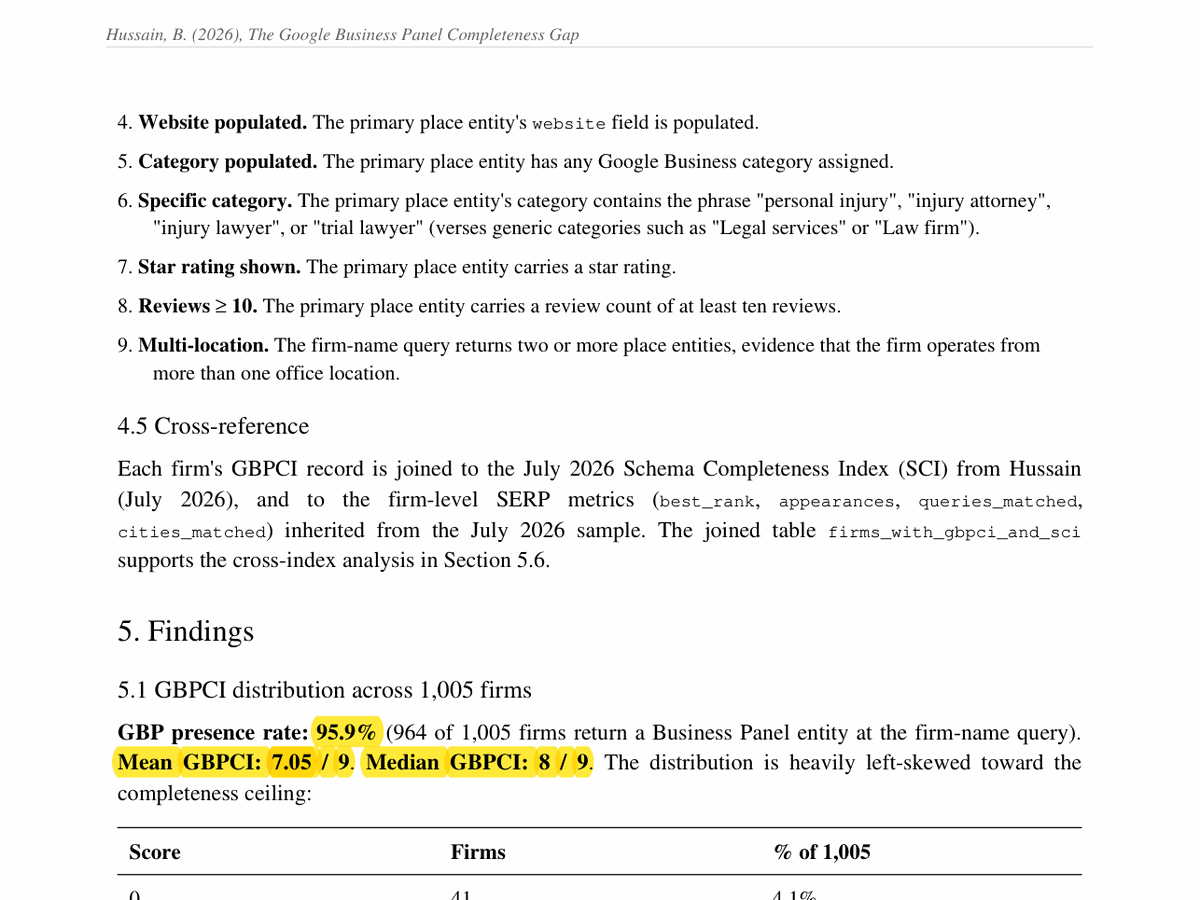
Across the 1,005 firms, the mean GBPCI is 7.05 and the median is 8. The distribution below is not a bell curve. It is pinned against the ceiling: 368 firms score exactly 8, another 232 score a perfect 9, and 41 firms score 0 because no Business Panel surfaced for their brand at all.
Here is the detail I find most telling. Scores of 1 and 2 do not exist in the data. Not a single firm scored a 1 or a 2. That is not a quirk of the scoring rule: a firm either has nothing, and scores 0, or it has claimed a profile and Google has populated the mechanical basics, address, phone, website, at which point the firm jumps straight to a 4 or higher. There is no meaningful population of firms stuck at a 1 or a 2. You are either off the board or you are most of the way up it. The whole game, for a firm already ranking on Page 1, is played between a 4 and a 9.
You do not have to take my summary of the distribution on faith. Here is the passage straight from the study, with the headline numbers marked.
Where the personal injury vertical is complete and where it is thin
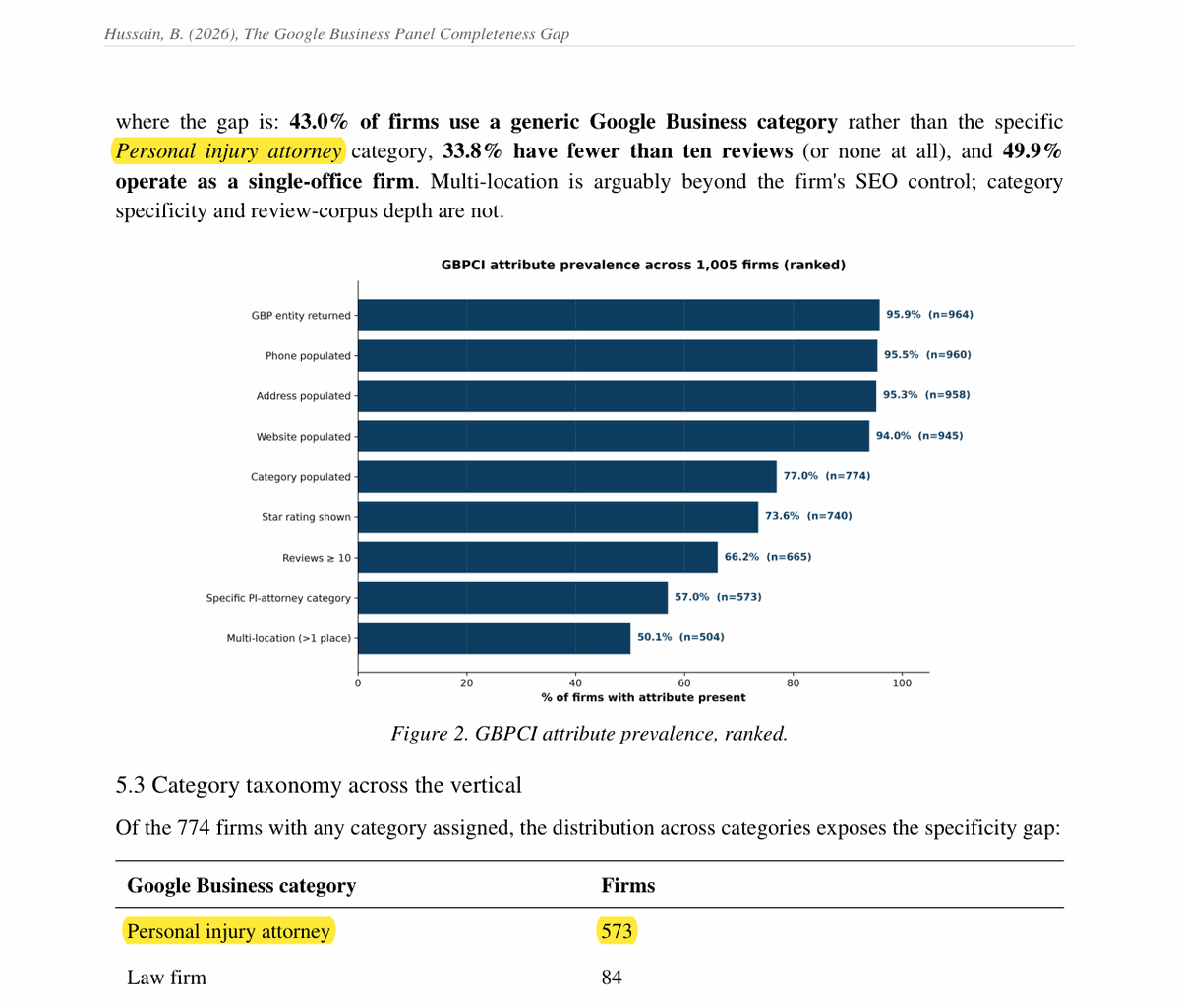
The vertical is complete on the bones and thin on the joints. The four foundational attributes cluster tightly near the top: a panel returns for 95.9% of firms (964 of 1,005), phone is populated for 95.5% (960), address for 95.3% (958), and website for 94.0% (945). The mechanical hygiene of a Business Panel is close to universal among firms that already rank on Page 1. That work is done, and because it is done everywhere, it wins you nothing. Table stakes do not differentiate.
The gap sits in the five attributes below the bones. Ranked by how many firms clear each, the drop from the bones to the joints is steep, and it is the same picture in every market I audit.
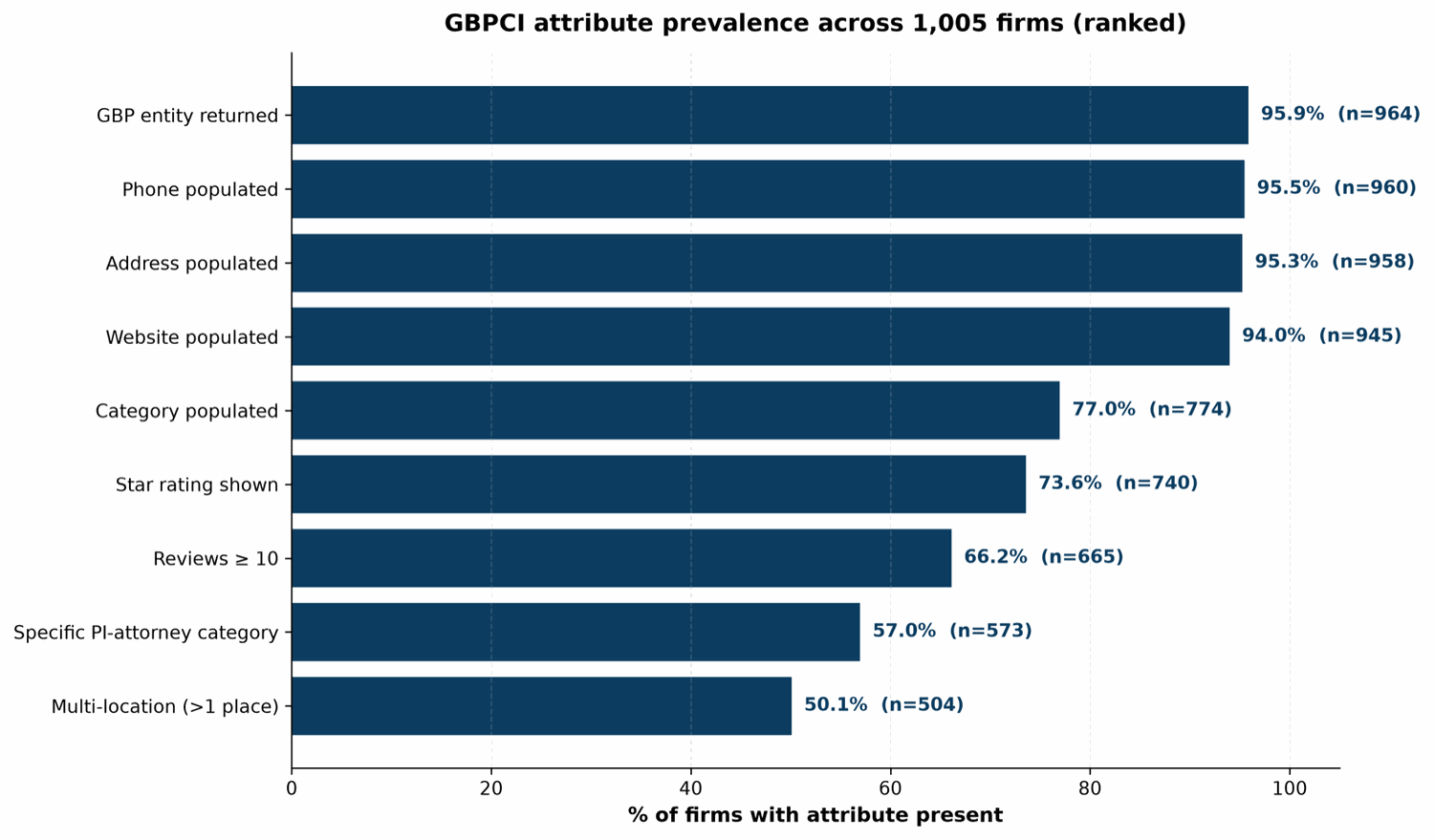
Read those five joint numbers as a to do list ranked by how many of your competitors have not done it yet: a category of any kind for 77.0% of firms, a star rating for 73.6%, ten or more reviews for 66.2%, the specific personal injury category for only 57.0%, and more than one office for 50.1%. Multi location is largely outside your control, you either run more than one office or you do not, and I would never tell a firm to open an office for a panel point. The other four are inside your operational control and cheap to close. Two of them, category specificity and review depth, are where I spend most of a firm’s first ninety days, because they are the attributes with the widest gap and the shortest path to closing it. “The bones get you a panel,” I tell marketing directors. “The joints get you the case.”
The nine attributes are not the whole panel. They are the nine I could measure at scale across 1,005 firms from Google’s public data. The rendered panel also carries photos, hours, a Q and A section, and posts, and those matter to a searcher deciding between you and the firm next to you. I left them out of the score because they are not exposed consistently enough to measure across a thousand firms, not because they are optional. Treat the nine as the floor you can benchmark and the rest as the finish work that separates a complete panel from a persuasive one.
The Google Business category gap that costs firms the most
Category specificity is the single largest firm controlled gap in the vertical. Of the 774 firms that have any category assigned, 573 use the specific “Personal injury attorney” category. That leaves 201 categorized firms, plus another 231 with no category at all, using something less specific or nothing. Put differently, 43.0% of the full sample is not using the one category that tells Google what they actually do.
The long tail of what firms use instead is worth seeing, because it shows how far the specific category outnumbers every generic alternative.
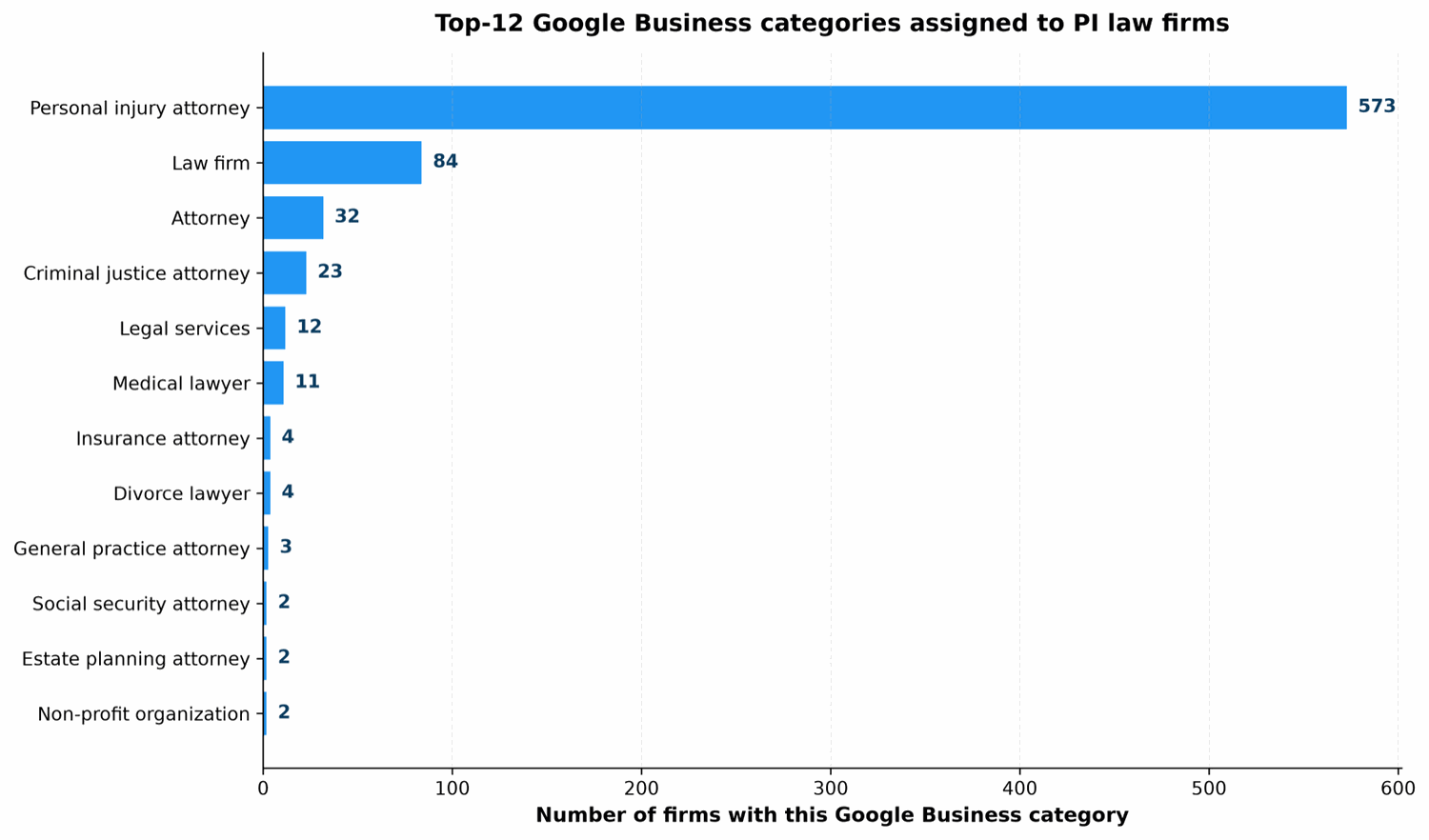
After “Personal injury attorney” at 573, the next most common categories are “Law firm” at 84, “Attorney” at 32, “Criminal justice attorney” at 23, and “Legal services” at 12. A handful of firms are categorized as “Medical lawyer,” “Insurance attorney,” even “Non profit organization.” A personal injury practice filed under “Criminal justice attorney” is not a rounding error. It is a firm competing in the wrong room, against public defenders and DUI shops, for searches that will never sign a plaintiff’s case.
What is the best Google Business category for a personal injury attorney? “Personal injury attorney” as the primary category, with secondary categories added for the specific case types you handle, workers comp, medical malpractice, wrongful death. This matters because of how Google’s category density mechanism works. Google’s patent on the subject, Defining Relevant Content Area Based On Category Density, US-2014074820-A1, describes surfacing businesses to a searcher based on how many verified businesses in a given category sit nearby. A firm categorized as “Law firm” is measured against every legal business in the area, the estate planners, the tax attorneys, the family lawyers. A firm categorized as “Personal injury attorney” is measured against personal injury firms. Changing your primary category is one click in the Business Profile dashboard, and it changes the competitive set you are ranked inside.
The study puts a number on the gap and names the specific category. Here is the passage.
One of my clients, a three office firm in a mid size metro, had run for years under “Law firm” because the vendor who set up the profile a decade ago picked it and nobody revisited it. We changed the primary category to “Personal injury attorney” and left everything else untouched. That single edit is the highest impact GBP change I make, and most firms have never audited whether theirs is right. When I run a competitor set for a new client, the first column I fill in is the primary category, because roughly two in five of the firms they are losing to lack the right one, and that is a gap you can close this afternoon.
Why review corpus depth beats star rating for law firms
Among firms with complete panels, review corpus depth is the differentiator, not star rating. The 740 firms carrying a star rating average 4.66 stars, with a median of 4.8. The median firm is already at the rating ceiling. Almost nobody in the top ranking layer of this vertical has a rating problem. What separates them is how many reviews sit behind that rating.
Review counts are heavily skewed. The median firm has 87.5 reviews, the mean is 262.5, dragged up by a long right tail, and the 90th percentile firm has 578. Plot every rated firm and the pattern is unmistakable: rating clusters against the ceiling while review count spreads across three orders of magnitude.
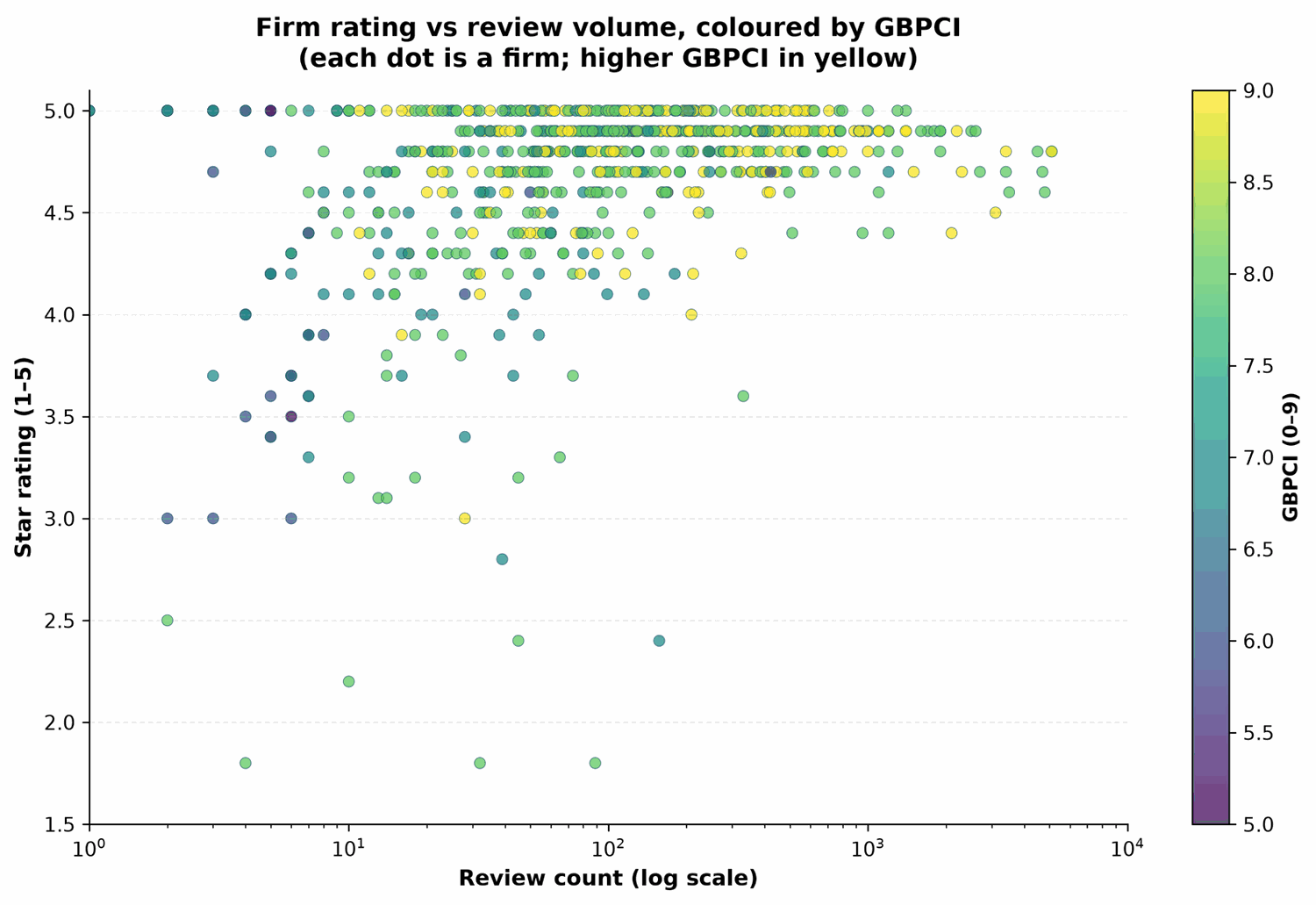
The firms at the very top of the sample, the ones scoring a perfect 9 on GBPCI, carry review corpora in the thousands across multiple offices. A firm with 5,100 reviews at 4.8 stars occupies a different tier of Google’s local graph than a firm with 8 reviews at a perfect 5.0, even though both look “five star” at a glance.
How many Google reviews does a personal injury firm need to compete? Ten to clear the basic threshold, then the real target is the vertical median of 87.5 and beyond, because below the median you are in the bottom half of the top ranking firms on the one review signal that still has room to move. Google’s review ranking patent, Sentiment Detection As A Ranking Signal For Reviewable Entities, US-9317559-B1, describes ranking entities using sentiment detected across the review corpus, and a related patent, Identifying Local Experts For Local Search, US-9792330-B1, describes weighting reviews from established local reviewers more heavily. Neither mechanism compensates a thin corpus with a couple of glowing reviews. Count and sentiment both count, and recency matters too: a firm with 90 reviews that added three last month reads as more alive than a firm with 130 that added none this year.
“Stop obsessing over your star rating,” I said on a strategy call last month with a firm stuck at 40 reviews. “You are at 4.9. Your competitor is at 4.6 with 300 reviews and they are eating your intake. Depth is the game now.” The marketing director had spent a year protecting a rating that was never the problem.
There is a compliance line running under all of this that generic advice ignores. You are bound by your state bar’s advertising rules and by Google’s own review policy, and personal injury is one of the most scrutinized categories on both. You cannot gate reviews, soliciting only the happy clients and filtering the rest, without violating Google’s prohibited content rules for reviews, which ban selectively soliciting positive reviews outright, and, in many states, the bar’s rules on misleading communications. The firms that build real depth do it by asking every signed client at the right moment in the matter, usually at a settlement or a positive resolution, not by buying reviews or screening for five stars. “Build the corpus honestly or do not build it,” I tell every firm, “because a review shortcut in PI is a bar complaint waiting to happen.”
Does Business Panel completeness move your organic ranking?
No. Business Panel completeness has essentially zero correlation with organic ranking, and this is the finding that reframes how a firm should think about the whole exercise. I bucketed all 1,005 firms by their best organic position, ranks 1 to 3, 4 to 6, and 7 to 10, and computed the mean GBPCI in each bucket. The numbers barely move.
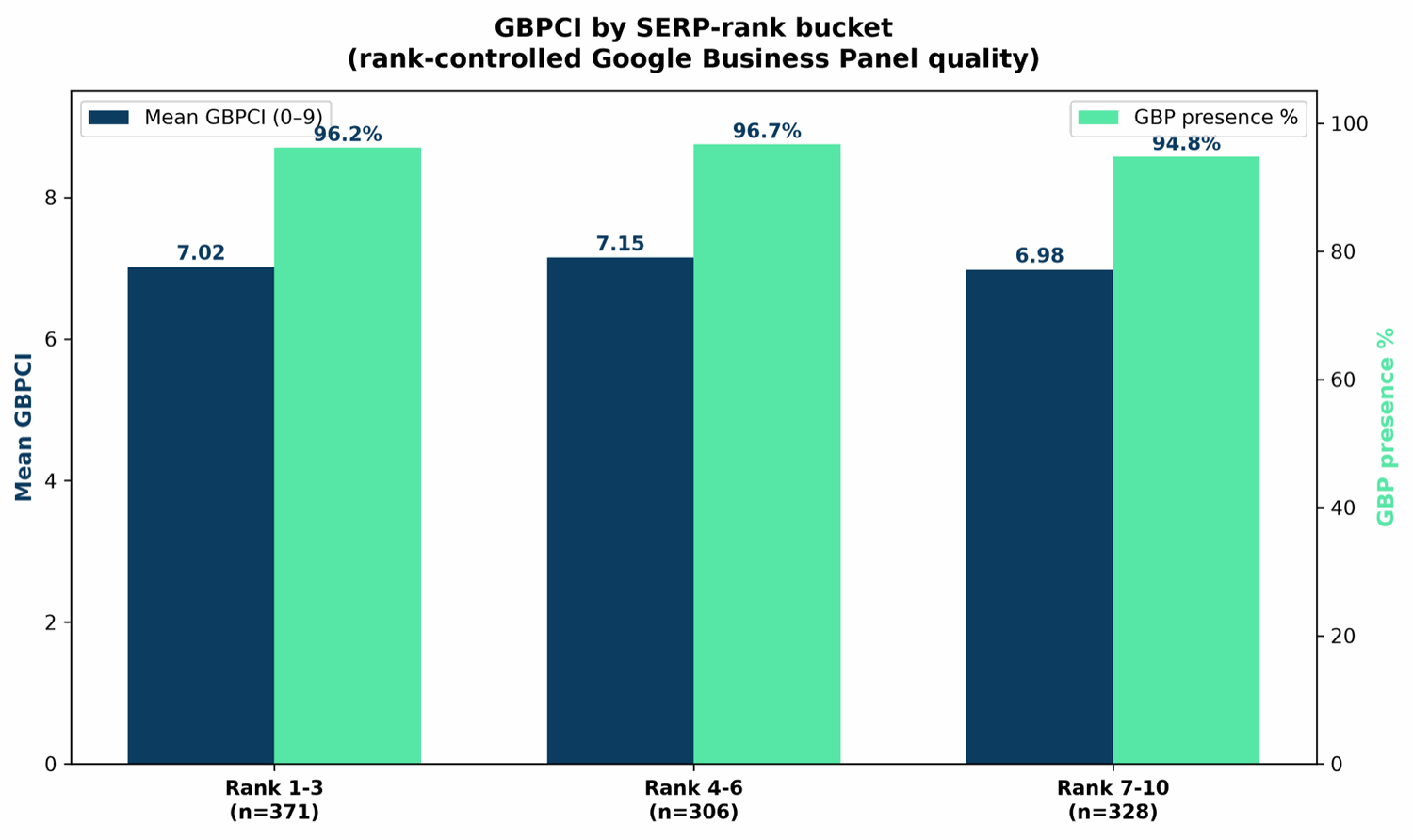
Mean GBPCI is 7.02 for ranks 1 to 3, 7.15 for ranks 4 to 6, and 6.98 for ranks 7 to 10. The rank correlation is negative 0.011, statistically indistinguishable from zero.
Will completing my profile lift my organic rankings? Not the rankings of your website’s content pages, no, and any vendor who sold you Business Profile work as an organic ranking lever sold you the wrong pipeline. Google runs two distinct ranking systems here. One ranks your website’s pages in the organic results. The other ranks your Business Profile in the local pack, the three map results that sit above the organic list for a local commercial query. Business Panel completeness feeds the second system, not the first, and Google says as much in its own local ranking guidance, which names relevance, distance, and prominence as the local factors and tells you plainly there is no way to pay for a better local ranking.
That does not make completeness irrelevant. It makes it relevant to a different surface. The local pack is where a “car accident lawyer near me” search resolves for most people, and it renders above your organic listing. A complete, specifically categorized, richly reviewed panel is how you compete there. Treating GBP as an organic rank lever is a category error I see priced into retainers all the time, and it sets a firm up to judge the work against the wrong scoreboard. I have watched a firm fire a perfectly good local vendor because “our rankings did not move,” when the vendor had tripled their map pack impressions and the firm was only looking at organic positions. Two pipelines, two scoreboards. If you measure the local work by the organic number, you will cancel the thing that is actually working.
Inside that local pipeline, Google names three factors: relevance, distance, and prominence. Relevance is how well your profile matches the search, which is where category specificity does its work. Distance is how close your office is to the searcher, and it is the one factor you cannot edit, which is exactly why the firms that win the pack lean harder on the two they can. Prominence is your reputation across the web, and reviews are the loudest input into it. Six of the nine GBPCI attributes feed those two levers directly: the category pair drives relevance, the rating and review pair drives prominence, and panel presence plus the website link establish the entity those signals attach to. That is the honest reason to complete the panel: not to move an organic ranking it does not touch, but to compete in the surface it does.
The two entity loops most personal injury firms never connect
On page schema and off site panel completeness are two independent loops, and nothing in my sample suggests any firm is running them as one deliberate practice. I joined each firm’s GBPCI to its Schema Completeness Index, the on page structured data score from my July study of the same 1,005 firms. The correlation between the two is positive 0.036, indistinguishable from zero: knowing a firm’s schema score tells you nothing about its panel score. A few firms do sit high on both charts, but statistically that is coincidence, not coordination. A firm that invested in structured data on its website did not, as a rule, also invest in Business Panel completeness, and vice versa.
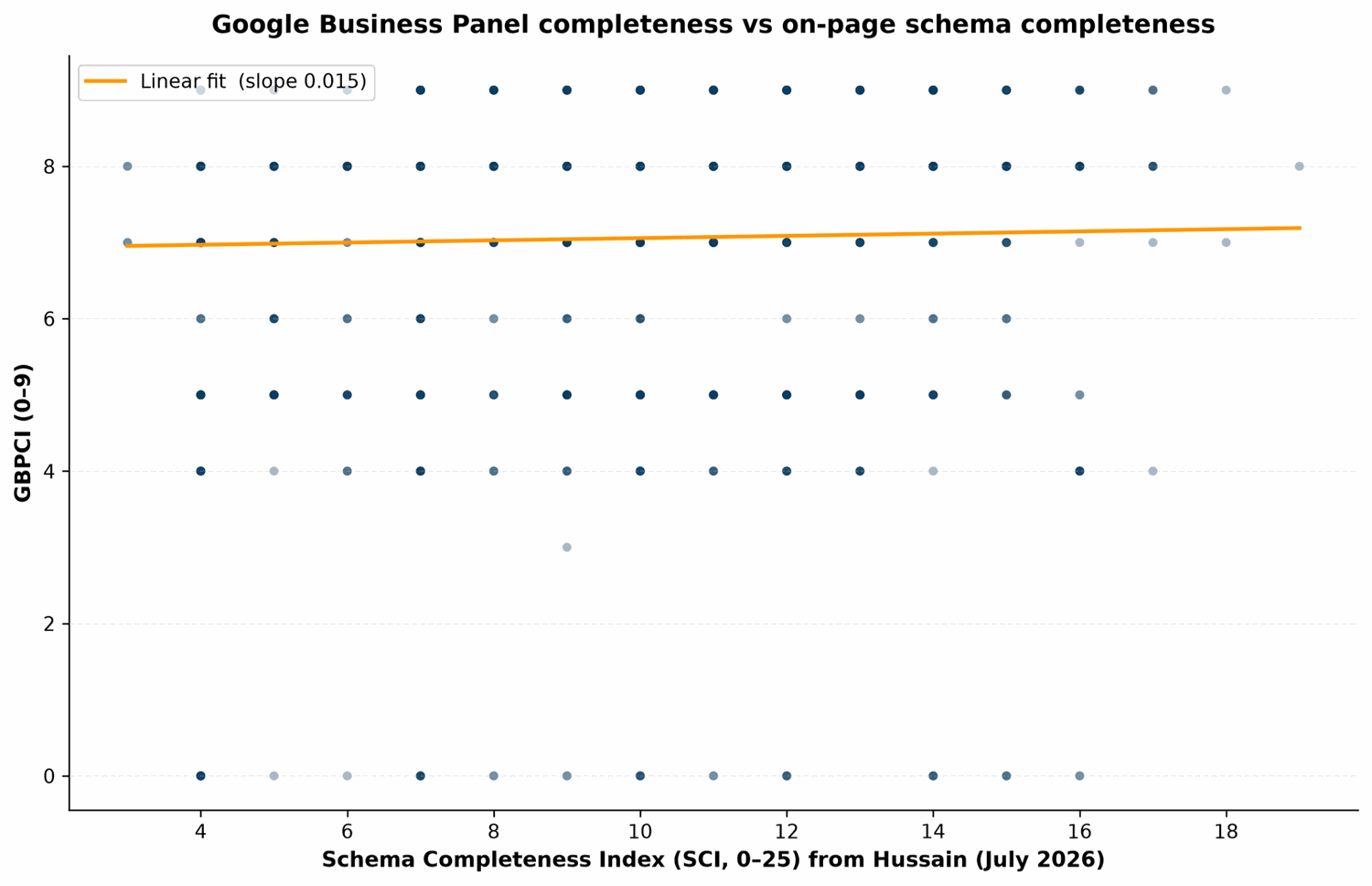
The reason is organizational, not technical. On page schema markup for personal injury law firms is usually owned by whoever builds the website, a developer or a technical SEO. The Business Profile is usually owned by whoever handles marketing or the outside agency. Those two people rarely talk, so the two signals drift independently. The firm ends up telling Google one story on its site and a different, thinner story on its profile, and Google notices the seam. I have sat in meetings where the web team did not know who had the login to the Business Profile and the marketing team did not know the site had schema at all. That disconnect is the norm, not the exception.
Those two loops are worth picturing as what they are: two separate circles that almost never overlap, with the corroboration you want sitting in the gap between them.
That gap is the opportunity. When your on site declaration and your off site verified profile say the same thing, the same name, the same address, the same practice focus, you hand Google two sources that corroborate each other. Google’s patent Corroborating Facts Extracted From Multiple Sources, US-8682913-B1, describes exactly that overlap: facts confirmed across independent sources carry more confidence than facts asserted once. Almost nobody in the vertical is running both loops on purpose, which means the firm that does gets a signal its competitors are leaving on the table. In the Personal Injury Organic Authority Engine, this is the authority reinforcement phase, where entity consistency across your site and your profile becomes a single, mutually reinforcing signal rather than two disconnected chores. “Pick one person to own the entity,” I tell firms, “the version of you that lives on your site and the version that lives on your profile should be the same firm, down to the suite number.”
How a complete Business Panel feeds AI Overviews and answer engines
A complete Business Panel is increasingly the raw material for AI answers about local firms, not just the local pack. When a searcher asks Google’s AI Overviews for the “best personal injury lawyer in [city],” the system assembles the answer from local entities, and those entities are your Business Profiles. Third party answer engines behave the same way. ChatGPT search sends its own crawler, OAI SearchBot, and Perplexity sends PerplexityBot, and the local commercial answers they assemble draw on the same public Business Profile surfaces and review data that feed Google’s local graph.
I want to be honest about the evidence line here. No search engine publishes a documented table of which profile attributes make a firm eligible for AI citation, so the mechanism connecting panel completeness to AI answer inclusion is my practitioner assessment from watching client results, not a figure from the study. What the study does establish is the substrate: the firms with complete, specifically categorized, richly reviewed panels are the entities an answer engine has enough structured signal to name, while sparse panels leave the engine to fall back on directory listings. A firm that is a thin entity in Google’s local graph tends to be a thin entity everywhere the local graph is consumed, and the local graph is now consumed by more engines every quarter.
Think about what the fallback costs you. When an answer engine cannot resolve a firm as a distinct, well described entity, it does not skip the question. It answers with whatever it can retrieve, which usually means a directory page, a “top ten personal injury lawyers” listicle, or an aggregator that ranks you next to nine competitors and takes the referral economics for itself. Every time your firm shows up inside someone else’s list instead of as a named answer, you have paid a tax for being a thin entity. The firms that get named directly are the ones whose category, reviews, and website all say the same specific thing, which is the same completeness the local pack rewards. You are not optimizing for two different surfaces. You are building one complete entity that several surfaces happen to read. The firms getting named in AI answers already audited both sides. The ones getting skipped never audited either.
The Business Panel fixes, ranked by the 1,005 firm data
The fixes rank cleanly by the size of the gap and the effort to close it. I sequence them the same way for almost every firm, because the data says the same thing across 1,005 of them.
Google does not take submitted business data on faith. Its patent Predicting Accuracy of Submitted Data, US-10223637-B1, describes machine learning that scores how likely a submission is to be accurate before accepting it. My practical read: inconsistent data is low trust data, which is why the first four fixes are worth less if the fifth is ignored. A complete panel that contradicts your site is a weaker signal than a slightly thinner panel that agrees with it.
Score your own firm’s Business Panel in five minutes
You can score your own Business Panel right now against the same nine attributes I scored 1,005 firms on. Search your firm’s brand name in an incognito window, find the Business Panel, and give yourself one point for each box below. The benchmark on each is the share of top ranking firms that already have it.
If you scored an 8, you are level with the largest cluster in the vertical, the 36.6% of firms sitting at exactly 8, and a 9 puts you with the 23.1% at the ceiling; the remaining gap is probably review depth or category specificity, the two attributes hardest to fake and most worth the effort. If you scored a 5 or a 6, you have a Business Panel but you are leaving the joint attributes empty, and all but the review corpus are same week fixes; the corpus is the one where you start the clock now. If you scored a 4, you have the bones and nothing else, which is the most common starting point I see when a firm first calls me. Now run the same nine boxes on the two firms beating you in the local pack, and the gap between your score and theirs is your actual roadmap. For a firm wide version of this exercise that goes past the Business Panel into your site structure and authority signals, the PI Authority Scorecard runs the same diagnostic logic across the rest of your organic footprint.
What this 1,005 firm study does not claim
The study measures completeness, not revenue, and it is worth being precise about the limits. GBPCI captures the attributes exposed in Google’s programmatic Business Profile response. It does not capture photo counts, hours of operation depth, service area detail, or the Q and A section, which are visible on the rendered panel but not in the data I consumed. A richer 13 or 15 attribute index would require scraping the rendered SERP.
A few other boundaries matter. Review counts and ratings are a snapshot from the August 2026 capture window, and they move as a firm operates. Firm name resolution is imperfect, so a small share of the 41 zero scores are firms whose brand name collided with another business rather than firms with truly no profile. The rank correlation is measured against organic position, not local pack position, so the null result should not be read as “completeness does not matter for the map pack,” where it plausibly matters a great deal. And the index is a completeness diagnostic, not a revenue predictor. It tells you which attributes you are under investing in. It does not, on its own, tell you what a signed case is worth to you, which is the number that should govern how hard you chase any of this.
Where a complete Business Panel fits organic case acquisition
A complete Business Panel puts your firm in the local pack and in the AI answer layer. It does not, on its own, decide whether a car accident search that lands on your website turns into a signed retainer. That is the organic case acquisition system the panel plugs into. My Personal Injury SEO Diagnostic scores your Business Panel against the 1,005 firm baseline in this study, then maps the on site structure, entity signals, and conversion path that decide whether the traffic you already earn becomes cases.
Benchmark the pipeline, not just the panel
You benchmarked your competitors on nine attributes. The Personal Injury SEO Diagnostic benchmarks the whole pipeline your case volume actually runs on, from the Business Panel to the site structure to the intake path, and hands you a prioritized roadmap.
Request a Personal Injury SEO Diagnostic Ready for the full build? See the PI Authority Growth SystemFrequently asked questions
Does changing my Google Business category reset my reviews or ranking?
Changing your primary category does not delete your reviews or your profile history. Your reviews, photos, and posts stay attached to the same Business Profile. What changes is the competitive set Google measures you against, because the category density mechanism ranks you inside your assigned category. Switching from a generic category to “Personal injury attorney” is a standard edit, not a reset.
What is the difference between a Google Business Profile and Google My Business?
They are the same product under two names. Google My Business was the older brand for the tool that manages your business listing. Google retired the standalone Google My Business app and folded its management into Google Search and Maps directly, and the product is now called Google Business Profile. If a vendor is still selling you “Google My Business optimization,” they are describing the same profile that feeds your Business Panel today.
Is a Google Business Profile free?
Yes. Claiming, verifying, and completing your Google Business Profile costs nothing, and Google states plainly that there is no way to pay for a better local ranking. The paid product in the same neighborhood is Local Services Ads, which is a separate pay per lead channel that requires its own bar license verification, not an upgrade to the free profile. Every one of the nine completeness attributes in this study is free to close.