

Google Business Profile Category Strategy for Personal Injury Firms: What My 1,005 Firm Audit Found
There is one dropdown on your Google Business Profile that decides which firms Google measures you against. Not your website. Not your ad budget. A single category field.
When I audited 1,005 top ranking US personal injury law firms for my Business Panel study, I expected the category to be a solved problem. These are firms already sitting on Google Page 1. Instead, 43.0 percent of them were not using the one specific category built for them, “Personal injury attorney.” Firms filed under “Law firm.” Firms filed under “Attorney.” Twenty three filed under “Criminal justice attorney,” two under “Non profit organization,” and hundreds carrying no category at all. Each one had quietly told Google to score it inside the wrong competitive set, or no defined set at all.
This guide is the fix. It covers the decision (which single primary category to pick and which additional ones to add), the mechanism (why that one field carries so much weight), and the defense (how anyone, including a competitor, can change your category, and how you catch it and put it back). By the end you will be able to open your own profile, read your category the way Google reads it, and decide in five minutes whether you are racing the right firms or the wrong ones.

Behzad Hussain
Organic Lead Acquisition Strategist for Personal Injury Law Firms
Behzad Hussain is an organic lead acquisition strategist for personal injury law firms in the US, UK, and Canada. He is the author of a 1,005 firm audit of Google Business Panels, the introduction of the Google Business Panel Completeness Index (GBPCI), and the schema and entity studies behind the Personal Injury Organic Authority Engine. On this page he is writing specifically about the Business Profile category: the single declaration that places a firm inside Google’s local competitive map.
On this page
- The category gap at the top of the market
- What a category actually is
- Why the primary category decides your race
- The personal injury category decision
- Building the additional set
- Read competitors’ categories
- The primary category dispute
- The defense protocol
- Make your category corroborate
- What the category does not do
- Your five minute audit
- FAQ
The category gap hiding in plain sight at the top of the market
Across 1,005 top ranking US personal injury firms, the Business Panel almost always exists; the category is where the profile quietly breaks down.
Most guides treat the Google Business Profile category as a beginner setting: pick “Personal injury attorney,” move on. If that were how the market actually behaved, my audit would have found near total adoption at the top. It did not.
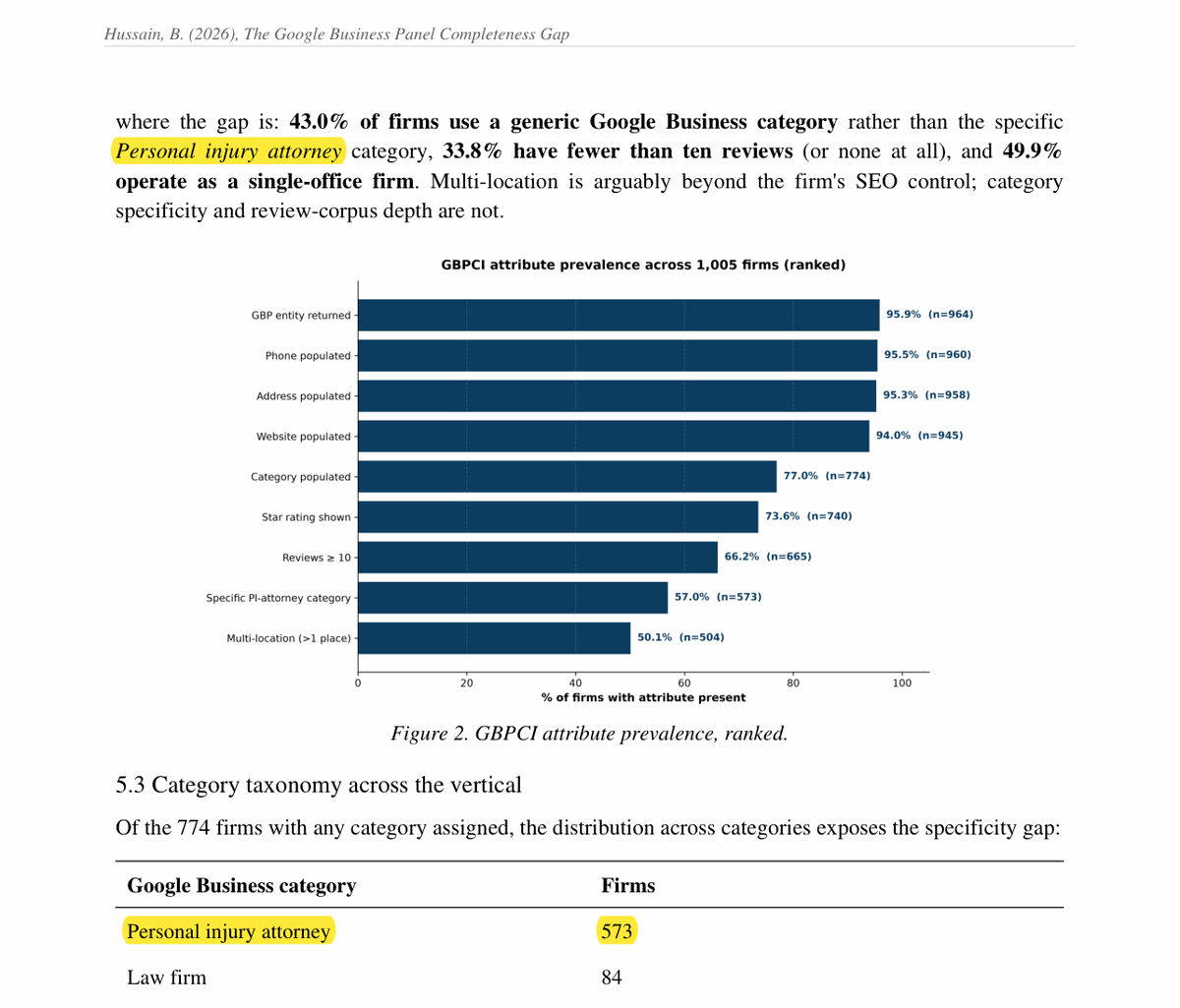
Across the 1,005 firms, the Business Panel itself was almost always present: 95.9 percent returned a panel at the firm name query. The bones were healthy too. Address, phone, and website populated at 94 to 96 percent. Then the numbers fell off a cliff at exactly the fields that take judgment rather than data entry. Only 57.0 percent carried the specific “Personal injury attorney” category. Category specificity ranked eighth out of the nine attributes I measured, the second weakest signal in the entire dataset. Only the multi office attribute was rarer. The 43 percent gap splits two ways: 20 percent of the sample sat on a generic or wrong label, and 23 percent carried no detectable category at all.
Read that again, because it is the whole reason this guide exists. The category is not missing because firms are careless with the easy stuff. It is missing because the easy stuff (name, address, phone) is obvious, and the category is a strategic choice that most firms and most agencies never revisit after the profile is first created. It gets set once, often by whoever claimed the listing years ago, and then it ossifies. My data caught firms at the very top of the results still carrying a category from a different era of the practice, or a category a well meaning stranger changed and nobody corrected.
You can find the underlying numbers in my Business Panel and schema research. The point for now is simpler: the category gap is real, it is large, and it lives among firms that otherwise look fully optimized. That makes it one of the few genuine advantages still sitting unclaimed in local personal injury search.
The gap in my own words, from the published study: the exact sentence and the category distribution behind it.
What a Google Business Profile category actually is
A category is how you tell Google what kind of place your firm is. It is not a keyword, not a tagline, and not a description. It is a selection from a fixed list that Google maintains, and it feeds directly into which searches your profile is eligible to appear for. It is also a standing fact on the panel itself: Google’s granted patent on providing knowledge panels with search results (US-11836177-B2) lists the place template’s placeholders, the map image, the place description, and place facts such as address, hours, and category. Your category is one of the facts your Business Panel exists to display.
Primary vs additional: one decides your race, nine expand your reach
Every profile has exactly one primary category and can carry additional categories on top of it. Google’s own Business Profile help is explicit about the split: you “select a primary category that best describes your business,” and if you list several, “the category in the first field will be your primary category.” The primary is the heavyweight. It is the declaration Google leans on hardest when it decides what your firm is and who it competes with. Additional categories widen the set of queries you are eligible for, but they do not carry the same weight, and they cannot rescue a wrong primary.
The split that governs every decision in this guide: one weighted primary, up to nine supporting additions.
The single declaration Google leans on hardest. It sets which competitive set you are scored inside. Get this one right before anything else.
They widen the queries you are eligible for. They never carry the primary’s weight, and they cannot rescue a wrong primary. Use a few accurate ones, not all nine.
For a personal injury firm, that hierarchy matters more than for almost any other local business, because the practice areas overlap. A firm might handle car accidents, medical malpractice, and wrongful death. Those are three defensible additional categories. But there is still only one primary, and it should be the one that names the firm’s center of gravity.
How many categories can a personal injury firm add? One primary plus up to nine additional, for ten in total. Google caps the additional set at nine, and its guidance is to use far fewer than the maximum: “Do not select a category for every product or service.” The cap is a ceiling, not a target.
You choose from Google’s list; you cannot invent a category
This is the constraint that trips up firms who think of the category as a marketing field. Google’s help documentation states it plainly: “You can’t create your own category.” You cannot type “Aggressive personal injury trial lawyer for catastrophic truck cases” and have Google accept it. You select from the categories Google already recognizes, and if the exact one you want does not exist, you pick the closest specific option that does.
Google’s own category guidance: pick the specific category from the list, because you cannot write your own.

That is not a limitation to fight. It is the point. Because the category list is a shared, closed vocabulary, every firm that selects “Personal injury attorney” is placed into the same recognized bucket, and Google can compare them cleanly. Your job is not to be creative with the field. Your job is to pick the most specific true category on the list and defend it.
The mechanism: your primary category decides which firms you compete against
Here is where generic guides stop and this one keeps going. Every guide tells you the primary category “matters most.” Almost none tell you why. The why is a mechanism Google has described in its own patent record, and once you see it, the category stops feeling like a label and starts feeling like a starting line.
Category density sizes your competitive set
Google holds a granted patent on defining a relevant content area based on category density (filed as US-2014074820-A1, granted as US-9767484-B2). In plain terms, Google sizes the geographic area it considers “relevant” for a business partly by how densely that business’s category is packed into the surrounding map. The category you declare is the input that decides which density map you are measured inside.
The same firm, two categories, two different competitive sets: this is what category density does.
Pooled with divorce, estate, and criminal firms. Wrong crowd, weak match.
Measured against the personal injury firms you actually compete with.
Think about what that does to a personal injury firm that picked “Law firm” as its primary. Google now sizes and scores it inside the general legal density of its city, alongside divorce firms, estate planners, and criminal defense shops. When a searcher looks for an injury lawyer, that firm is sitting in the wrong crowd, wearing the wrong label, waiting to be matched against queries it is only loosely eligible for. Switch the primary to “Personal injury attorney” and the firm moves onto the map where injury queries actually resolve, measured against the firms it truly competes with.
That is the difference between racing the right firms and racing the wrong ones. It is not a metaphor. It is category density deciding your competitive set.
Google names the mechanism in the title of its own patent: a relevant content area defined by category density.

Where category sits in how Google ranks local results
Google names three factors for local ranking in its Business Profile help: relevance, distance, and prominence. Relevance is how well your profile matches what someone searched for, and Google evaluates it from the information on your profile; the category is the most direct declaration in that information. Distance is how far you are from the searcher. Prominence is how well known and well reviewed your firm is. The pairing runs in both directions, too: an early Google filing on search query categorization for business listings search (WO-2004114162-A2) describes categorizing the query itself and matching it against listing categories, which is how an injury search finds a correctly labeled injury firm.
Google’s own definition of the relevance factor, from its local ranking help: how well the profile matches the search, evaluated from the business info you provide.

Of those three, distance is fixed by your office location and prominence is a long game built on reviews and citations. The category is the one relevance lever you can change today, for free, in minutes (allow for the possible re-verification step covered later in this guide). That is why it is the highest leverage, lowest cost move on the entire profile, and it is exactly the lever 43 percent of top firms are getting wrong. Category is one signal inside a larger local system, and it works best when the rest of your local SEO for personal injury firms is pulling in the same direction, but no other single field returns as much for as little effort.
The leaked schema: your categories carry a prominence value
In 2024, reference documentation for Google’s internal Content Warehouse API briefly went public and has stayed mirrored in developer archives ever since. It is a rare look at the data structures Google actually stores, and in it the category is not a text label. It is a first class object. The model that describes a place’s categories, GeostoreGConceptInstanceProto, defines a GConcept as “a category in the Geo Ontology” and gives each one two telling parts: a gconceptId, whose example in the documentation is “gcid:railway,” the same gcid identifier format the Business Profile category system uses, and a prominence value, defined as “the relative prominence of this category to this feature.” The documentation even supplies its own example: a gas station with a convenience store and an ATM is, most prominently, a gas station.
The category as Google’s internal schema stores it: an identifier plus a relative prominence value, straight from the leaked reference.

That is the primary versus additional split, written into Google’s own schema: your categories are ranked against each other, and one of them defines you. Two honest cautions before you read too much into it. The leaked documentation describes what Google stores, not how much any field weighs in ranking, and Google’s public response to the leak cautioned against out of context or outdated readings of it. I treat it the way I treat the patent record: evidence of mechanism, never a promise of weights. But mechanism is exactly what this guide has been arguing, and the leaked schema agrees with the patent record and with Google’s own help pages: the category system is built around one category that describes the place best.
Is the primary or a secondary category more important for ranking? The primary, decisively. Additional categories broaden the queries you are eligible for, but the primary is the declaration Google weighs most heavily when it decides what your firm is and which competitive set to score you in. Get the primary right first; treat the additional categories as expansion, never as a substitute. The leaked place schema makes the hierarchy literal: each category on a place carries a relative prominence value, and one is most prominent.
The personal injury category decision
Now the decision itself. The category list gives a personal injury firm three kinds of options: the specific one you want, the generic ones that dilute you, and the wrong vertical ones that actively mislabel you. My audit found firms in all three buckets.
The specific category: Personal injury attorney
For the overwhelming majority of firms reading this, the correct primary is “Personal injury attorney.” It is the most specific category on Google’s list that names what you do, and in my data it was the choice of 573 firms, 74.0 percent of all categorized firms and 57.0 percent of the full sample. It places you on the injury density map, matches you to injury queries, and reads cleanly to Google’s systems as a personal injury practice. If personal injury is your primary practice, this is your primary category. There is rarely a good reason to choose anything else.
The generic traps: Law firm, Attorney, Legal services
The generic categories are the quiet killers because they feel safe. “Law firm” (84 firms in my audit), “Attorney” (32 firms), and “Legal services” (12 firms) are all technically true of a personal injury practice, and none of them is specific enough to place you correctly. They pool you with every kind of lawyer in your market and blur the exact signal you most want to send. A firm on “Law firm” is not wrong about itself; it is just invisible as a personal injury specialist. Google’s guidance points the same way: pick the specific category, not the general one, the same way it tells a nail salon to choose “Nail salon” over “Salon.”
The wrong vertical traps: Criminal justice attorney, Divorce lawyer, and worse
The third bucket is the one that should stop you cold. In my sample, 23 personal injury firms carried “Criminal justice attorney” as their category, four carried “Divorce lawyer,” and two carried “Non profit organization.” These are not shades of generic. They are the wrong practice entirely. A personal injury firm labeled “Criminal justice attorney” is telling Google to score it against criminal defense firms and to match it to criminal defense queries. Usually this is the fossil of an old general practice, or a category someone changed and nobody caught. Whatever the cause, the firm is running the wrong race with a bib for a different event.
What is the best Google Business Profile category for a personal injury law firm? For a firm whose primary practice is injury work, it is “Personal injury attorney,” full stop. Reserve “Trial attorney,” “Medical malpractice attorney,” “Wrongful death attorney,” and similar as additional categories for the areas you genuinely practice, and never let a generic (“Law firm”) or wrong vertical (“Criminal justice attorney”) category sit in the primary slot.
The whole decision in one view: what to make your primary, what to keep as additional, and what to never let sit in the primary slot.
| Category | Verdict for a PI firm | When to use it |
|---|---|---|
| Personal injury attorney | primary | Your default primary for nearly every PI firm. Specific, correct, on the injury map. |
| Trial attorney | additional | If courtroom work is a genuine emphasis. |
| Medical malpractice attorney | additional / primary for a med-mal firm | Add if you handle med-mal; make it primary only if med-mal is your center of gravity. |
| Wrongful death attorney | additional | If you genuinely take wrongful death cases. |
| Law firm / Attorney / Legal services | never primary | Too generic. Pools you with every lawyer in town. |
| Criminal justice attorney / Divorce lawyer / Estate planning attorney | wrong vertical | Never, unless you truly practice it. Scores you against the wrong firms. |
What the top of the market actually chose: the specific category leads, but a long tail of generic and wrong labels persists among Page 1 firms.
Category taxonomy across the 774 categorized firms in my 1,005 firm audit.
Building your additional category set without diluting the primary
Once the primary is right, the additional categories are where firms either sharpen their reach or quietly sabotage it. The instinct is to add everything that might apply. Resist it. Google’s own guidance is to use a few accurate categories, not to fill all nine slots, and “not select a category for every product or service.” Its Guidelines for representing your business on Google say it even more plainly: “Choose the fewest number of categories it takes to describe your overall core business.”
The rule is simple: add an additional category only for work you genuinely and regularly do. For most personal injury firms, a healthy additional set is short. Something like “Trial attorney” if you try cases, plus the specific injury sub practices you actually handle, such as “Medical malpractice attorney,” “Wrongful death attorney,” or “Product liability attorney.” That is usually three to five additional categories, not nine.
Two anti patterns to avoid. First, do not add generic categories (“Law firm,” “Attorney”) to the additional set thinking they cast a wider net. They dilute the specificity you just worked to establish and add nothing you do not already inherit from the specific primary. Second, do not add a practice area you do not staff. If you add “Medical malpractice attorney” but have never tried a med-mal case, you are inviting queries and intake calls you cannot serve, and you are muddying the entity signal that tells Google what your firm actually is.
The medical malpractice and niche firm exception
There is one real exception to “primary equals Personal injury attorney,” and it is the specialist firm. If your practice is genuinely centered on a sub vertical, medical malpractice, or nursing home abuse, or product liability, and personal injury is the umbrella rather than the daily work, then the more specific category can earn the primary slot. A dedicated medical malpractice firm may be better served with “Medical malpractice attorney” as primary and “Personal injury attorney” as an additional category, because the specific category places it on a tighter, more relevant density map. The test is honest: what do you want to be the first firm Google thinks of for? Make that your primary. For the large majority of general personal injury firms, that answer is still “Personal injury attorney.”
Multi office firms: one primary category, every location
Half of the firms in my audit operated more than one office. Fully 50.1 percent returned multiple location entities, which means multi office is the norm for a serious personal injury practice, not the exception. It also multiplies the category problem. Each office is its own Business Panel entity, with its own category field, its own suggested edit surface, and its own way to go wrong.
Two rules keep a multi office firm clean. First, keep the same specific primary category, “Personal injury attorney,” across every location. A firm that is “Personal injury attorney” downtown and “Law firm” in the suburb is sending Google two different stories about the same practice, and the weaker listing drags on the entity as a whole. Second, treat every office as a separate thing to claim, verify, categorize, and monitor. Five offices is five category fields to set and five to watch, not one. Firms that centralize the main office and let the branch listings drift are exactly the firms I found sitting on outdated or wrong categories at the branch level.
Read your competitors’ categories to find the opening
Your competitor’s primary category is not a secret. It renders on their public Business Panel, the same panel a searcher sees. Search the name of the firm ranking above you in the local pack, read the line under their firm name, and you are looking at the exact category they chose to compete under. This is the cheapest competitive intelligence in local search, and almost nobody uses it.
Two things to look for. If every firm winning your local pack carries “Personal injury attorney,” that is your confirmation that the specific category is the price of entry, and any generic category you are still carrying is why you are underneath them. But the more interesting find is the opposite: a competitor ranking near you while carrying a generic or wrong category. That firm has ceded the specific injury density map. It is winning on other signals despite its category, which means a correctly categorized firm competing on the same street starts with a cleaner, more relevant declaration and a real opening to pass it on the local and AI surfaces.
Copy the logic, never the list. Seeing that a rival uses “Personal injury attorney” as primary tells you the right primary for the vertical. It does not tell you to clone their additional categories, because you do not know which of those practice areas they actually staff, and adding areas you do not serve mislabels your own entity. Read competitors to confirm the primary and to spot the openings. Build your additional set from your own docket.
The primary category dispute: anyone can change your category
Now the part almost no category guide covers, and the part that turns “set it once” into a dangerous habit. Your category is not locked to you. It is a contested field on a public entity, and the people who can change it include people who do not have your interests at heart.
Suggest an edit, and Google may apply it without telling you
Google’s Business Profile help says it directly: “If you find something wrong with a Business Profile that you don’t own or manage, you can suggest an edit.” That mechanism exists so the public can correct genuine errors, a wrong phone number, a moved office. But it does not check who is suggesting or why. A competitor, a disgruntled former client, a Local Guide working from bad information, or Google’s own automated systems can all propose a change to your category. And here is the sharp edge: Google can apply an accepted suggestion without asking you first, and in practice owners often get no clear notification. You can wake up to a different primary category and no alert in your inbox.
The dispute vector, step by step. The load bearing beat is the third one: there is often no reliable alert.
This is not a loophole; it is a documented feature. Google’s own help page invites anyone to suggest an edit to a profile they do not own.

It happens to PI firms
This is not theoretical. In Google’s own Business Profile community, a personal injury firm reported that its “Personal injury attorney” category had been replaced with a “law book store” category. A firm that spent years building intake around injury cases was suddenly labeled as a retail bookshop, on the entity surface Google shows when someone searches its name. That is the dispute vector in the wild: a silent swap that moves you off your density map and mislabels you to every searcher and every AI answer that reads the profile.
Can a competitor change my Google Business Profile category? They can suggest a change through the same public “suggest an edit” mechanism anyone uses, and Google may accept it. They cannot log into your profile, but they do not need to. The suggested edit path is open to everyone, which is exactly why the category has to be monitored rather than set and forgotten.
The defense protocol: claim, set, monitor, revert, re-defend
Treat the category the way you treat the lock on your office door. You set it, and then you keep checking it. Here is the protocol I give firms.
Editing a category can trigger re-verification, so plan for it
One practical warning before you go change anything. Google’s help documentation notes that “if you add or edit an existing category, you might be asked to verify your business again.” Editing the category is a meaningful change to the entity, so Google may ask you to re-confirm the business is real and yours. That is not a reason to avoid fixing a wrong category. It is a reason to do it when you have the verification materials ready and a few days of patience, rather than the afternoon before a big campaign launch. Fix the category, expect a possible re-verification, and build that step into the plan.
Make your category corroborate: profile, schema, and services in one voice
The category does its best work when it is not working alone. And this is the gap I found most striking in the data. In my audit, a firm’s Business Panel completeness and its on page schema completeness were essentially uncorrelated, a Spearman correlation of positive 0.036. The two live in different departments. The website developer owns the schema. The marketing person or agency owns the Business Profile. They almost never talk, and the numbers prove it: being good at one predicts nothing about being good at the other.
That disconnect is your opportunity. Google holds a patent on corroborating facts extracted from multiple sources (US-8682913-B1), the machinery for cross checking what a business says about itself against independent records. When your Google Business Profile primary category says “Personal injury attorney,” your website’s LegalService schema names personal injury as the service type, your Services list itemizes injury practice areas, and your practice area pages say the same thing in their headings, Google sees one firm entity corroborated across four independent surfaces. When they disagree, it sees noise.
The 2024 Content Warehouse leak showed this join from the inside. The leaked reference includes a model named LocalWWWInfo that rides along with a web document and carries slots for the business’s address, phone, and opening hours, plus a brickAndMortarStrength score and a flag asking whether the business “represent[s] a widely-distributed chain.” In Google’s own data model, your website is not a separate audience from your profile: the web document and the business facts live in one joined record, which is exactly why the two should never disagree.
Four surfaces, one declaration. When they all say the same thing, Google corroborates a single confident firm entity.
This is the off site and on site halves of a single entity clarity practice, and it is the core of the Personal Injury Organic Authority Engine. The category is the off site declaration. The schema is the on site declaration. Most firms optimize one and forget the other. Aligning them is unclaimed ground, and my data says almost nobody is standing on it.
What the right category does not do
Now the honesty that separates this guide from the ones selling category tricks as ranking magic. Fixing your category is high leverage, but it is not a lever on everything, and overselling it would cost you trust.
In my 1,005 firm audit, Business Panel completeness, category included, had essentially no correlation with a firm’s organic Page 1 position: a Spearman correlation of negative 0.011, statistically indistinguishable from zero. Across the three rank buckets I measured, mean completeness sat at 7.02, 7.15, and 6.98 on the nine point scale, a spread of less than two tenths of a point. Let me be exact about what that means and what it does not.
What the category is and is not
Not an organic-rank hack. Category completeness vs organic Page 1 position: essentially zero (Spearman -0.011). The ten blue links are a separate pipeline driven by content, links, and technical health.
A local, Maps, and AI-answer lever. The category decides your eligibility and competitive set in the local pack, Google Maps, the Business Panel, and AI answers, and keeps your entity labeled correctly everywhere Google renders it.
It does not mean the category is irrelevant. It means the category is not an organic ranking hack. The organic listings, the ten blue links, are driven by your website’s content, links, and technical health, a different pipeline entirely. The category lives on the other side of the results: the local pack, Google Maps, the Business Panel, and increasingly the AI answers that read structured local data to decide which firms to name. That is where the right category pays off. It decides your eligibility and your competitive set in local and AI surfaces, and it keeps your entity labeled correctly everywhere Google renders it.
That AI surface is the part worth sitting with, because it is where this quietly stops being a maps question. When an AI answer, a Google AI Overview or an assistant handling “who is a good injury lawyer near me,” assembles a shortlist of local firms, that shortlist has to come from the structured local record Google already holds, and your category is one of the cleanest signals in that record telling the system what kind of firm you are. A firm labeled “Personal injury attorney” is legible to that machine as an injury practice. A firm labeled “Law firm” or, worse, “Criminal justice attorney” is either ambiguous or actively miscategorized at the exact moment an AI is deciding whether to name it. As more injury searches resolve inside AI answers rather than a page of links, the category stops being a maps setting and becomes part of whether a machine can confidently describe your firm at all. That is a forward looking reason to fix it now, while 43 percent of your competitors have not.
Does changing my primary category hurt my current rankings? Changing to a more accurate, more specific category should not hurt your organic rankings, because in the data those are a separate pipeline that the category does not drive. What a correct category changes is your standing in the local pack, Maps, and AI answers, and your eligibility for the injury queries you actually want. The risk to avoid is the opposite move: leaving a wrong category in place, which quietly keeps you eligible for the wrong queries and invisible for the right ones.
Your five minute category audit
You do not need a tool or an agency to check the single most important thing on your profile. Here is the audit, start to finish, in about five minutes.
If step two surprised you, you are not alone. It surprises 43 percent of the firms already ranking above most of their market. And when you want the other eight attributes scored too, my Google Business Profile grader runs the full nine question benchmark in about three minutes.
See the whole picture, not just the category
You can run the five minute audit yourself, and you should. When you want the full picture, every field on the profile, the schema behind the site, the competitive set, and the AI surfaces, read against the firms you actually compete with, that is the diagnostic. It is written, specific to your firm, and it starts with the truth about where you stand.
Request your diagnostic Written personal injury SEO diagnostic, delivered in 7 to 10 days.Frequently asked questions
Does changing my primary category delete or reset my reviews?
No. Your reviews are attached to the Business Profile, not to the category. Changing the category does not remove reviews, ratings, photos, or your review count. You can correct a wrong category without any risk to the review corpus you have built.
Should I just copy the category my top ranking competitor uses?
You can see a competitor’s primary category on their public profile, and if they are ranking well with “Personal injury attorney,” that confirms the specific category is correct for the vertical. But do not blindly clone their additional categories. Copy the logic, not the list: match the specific primary that fits your practice, and build your own additional set from the work you genuinely do, not from theirs.
How long does a category change take to show up?
A category you set in your own dashboard usually applies quickly, though Google may hold it for review, and a change may trigger a re-verification step before it goes fully live. Plan for a short delay and possible re-verification rather than an instant switch, and confirm the change stuck by checking your public profile a day or two later.
Is “Personal injury attorney” the same as “Personal injury lawyer” on Google?
The selectable category on Google’s list is “Personal injury attorney.” Google maintains the exact wording of the category vocabulary, and you choose from what it offers rather than typing your own phrasing. Select the specific injury category Google lists; you cannot create a custom “lawyer” variant, and you do not need to, since the recognized category already places you correctly.