
Entity SEO for Personal Injury Law Firms
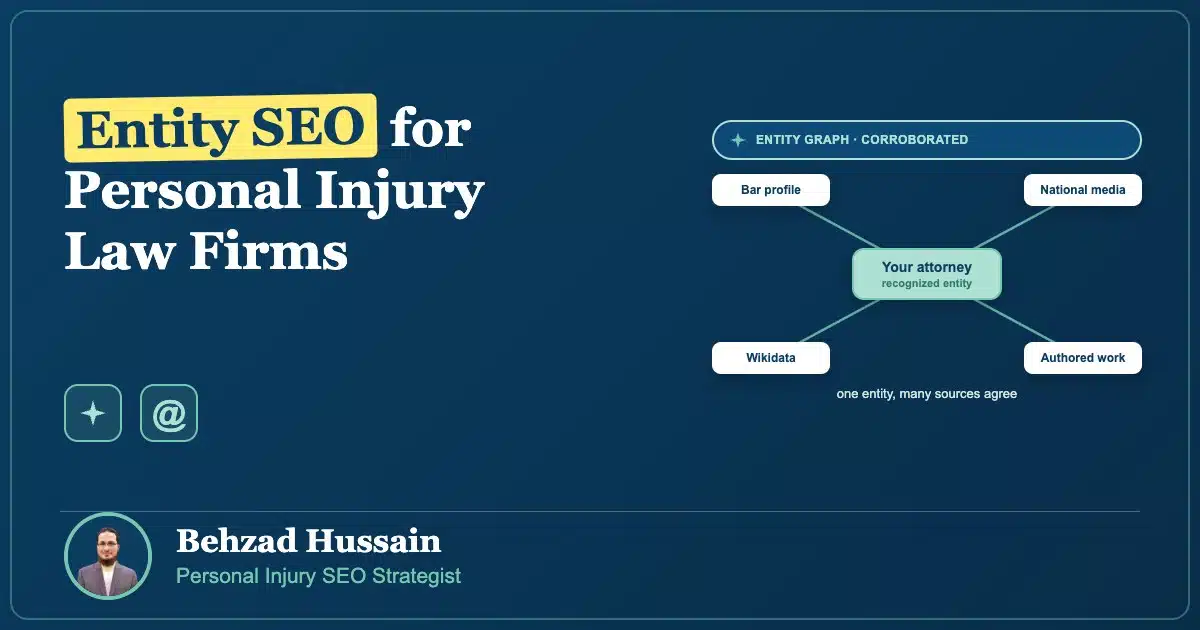
Entity SEO is the practice of making your firm and your attorneys recognized entities, things Google and AI systems can identify, disambiguate, and trust, rather than anonymous strings of text on a page. When Google understands that a named attorney is a real, corroborated person with a practice, a reputation, and a body of work, it can surface that attorney in a Knowledge Panel, trust the firm as a source, and let an AI assistant name it in an answer. When it cannot, the firm is just another blue link competing on keywords. For personal injury, where the field is crowded and trust decides the case, that recognition is the difference between being a source and being overlooked.
The gap here is enormous and measurable. In my study of 1,005 page-one personal injury firms, only 3.5 percent had earned the person-entity recognition that most strongly signals a trusted legal source, while 78.7 percent had no Knowledge Panel of any kind. This page explains, from the knowledge-graph research, Google’s own patents, and that first-party data, what an entity is to a machine, why personal injury firms are mostly invisible as entities, and how yours becomes one of the few that are not.

Behzad Hussain is a Personal Injury SEO Strategist who builds organic case acquisition systems for competitive personal injury law firms in the United States, the United Kingdom, and Canada. The data on this page is from my own study of 1,005 personal injury firms, read alongside the knowledge-graph research and Google’s patents, not from the vendor explainers that fill this results page. More about the author.
On this page
- What entity SEO is for a PI firm
- How the knowledge graph builds an entity
- The Knowledge Panel is the visible proof
- Why entity recognition moves cases
- How Google scores an entity’s authority and trust
- The signals that build a person entity
- Person entity vs organization entity
- How to build your firm’s entity
- Work with a PI SEO strategist
- Closely related topics
- Frequently asked questions
- References
What Entity SEO Is for a Personal Injury Firm
Entity SEO is a branch of semantic SEO, which is itself a branch of search engine optimization. The parent chain runs from digital marketing to search marketing to SEO to semantic SEO to entity SEO, and the shift it names is the one Google announced in 2012: moving from matching strings of text to understanding things. Amit Singhal introduced the Knowledge Graph that year with the line that captured it, a move to things, not strings, meaning Google began modeling the world as entities, people, places, organizations, with attributes and relationships, not just pages that contain matching words.
For a personal injury firm, the entities that matter are two: the organization, your firm, and the person, each named attorney. Entity SEO is the work of making both legible to a machine. It has a handful of working parts:
- Identification: the machine recognizes that a name refers to a specific real entity, not a generic phrase.
- Disambiguation: it tells your John Smith from every other John Smith, by the attributes around the name.
- Connection: it links the entity to corroborating references across the web, through consistent identifiers.
- Corroboration: it confirms the entity’s facts against multiple independent sources before it trusts them.
None of that is won on a single page. An entity is a claim the whole web makes about you, and Google’s job is to decide whether the claim is consistent and trustworthy enough to act on. Entity SEO is the deliberate work of making that claim coherent, which is why it sits upstream of almost everything else in AI-era search: a recognized entity is easier to rank, easier to trust, and far easier for an assistant to name.
Google does not rank your firm. It ranks what it understands your firm to be. Entity SEO is the work of making that understanding true, specific, and trusted.
Behzad Hussain, Personal Injury SEO Strategist
How the Knowledge Graph Builds an Entity
A machine does not take your About page at its word. It builds an entity by fusing facts it finds across many sources and scoring how confident it can be in each one. The canonical description of this is Google’s own research. The 2014 KDD paper, Knowledge Vault: A Web-Scale Approach to Probabilistic Knowledge Fusion, by Xin Luna Dong and colleagues, describes a system that gathers facts from across the web and assigns each a probability of being true, which the authors call substantially bigger than any previously published structured knowledge repository. The operative word is probabilistic: your entity is not a record you submit, it is a confidence the system accumulates.
Corroboration is the mechanism. Google’s 2014 patent, Corroborating facts extracted from multiple sources, US Patent 8,682,913 B1, describes confirming a fact by finding it, as attribute-value pairs, across multiple independent sources. A single page claiming your attorney won a landmark verdict is weak; the same fact echoed by a bar association, a news outlet, and a legal directory is strong. The entity gets built from agreement, not assertion.

A fact gets stronger as independent source types agree on it, which is why the entity you can build fastest is the one many places already attest to:
- A state or local bar association profile for the attorney.
- Independent news coverage from recognized outlets.
- A structured record in Wikidata or Wikipedia.
- A legal directory listing with consistent details.
- Authored books, articles, or talks catalogued under the name.
This is also why AI assistants favor recognized entities, and the research shows they carry entity knowledge inside the model. The 2020 paper Entities as Experts: Sparse Memory Access with Entity Supervision, by Thibault Fevry and colleagues, built a model with a dedicated entity memory and found it holds more factual knowledge than a comparably sized standard model on knowledge probes. An assistant that stores entities as first-class objects will reach for the attorney it already recognizes, which makes entity recognition the quiet prerequisite behind being named in an AI answer at all.
You do not register your entity. You corroborate it. Google believes the fact that three independent sources agree on, and ignores the one only your website claims.
Behzad Hussain, Personal Injury SEO Strategist
The Knowledge Panel Is the Visible Proof of an Entity
The Knowledge Panel is the clearest public signal that Google has accepted an entity. Google’s 2016 patent, Providing knowledge panels with search results, US Patent 9,268,820 B2, describes identifying content for display in a knowledge panel for a factual entity, which means the panel fires only once the system is confident the entity is real and corroborated. For a personal injury firm, a panel is not a vanity badge; it is Google telling you, in public, that it knows who your attorney is.

How common is that recognition among firms that already rank? I classified the Knowledge Panel status of 1,005 page-one US personal injury firms, and the result is a field almost entirely absent as entities.
| Panel class | Share | Count | What it means |
|---|---|---|---|
| No panel | 78.7% | 791 | Google holds no confident entity for the firm or its attorneys |
| Local Business | 16.4% | 165 | The firm is a place entity, but no person is recognized |
| Person Entity | 3.5% | 35 | A named attorney is a recognized, trusted person entity |
| Minimal | 1.4% | 14 | A thin or ambiguous panel, not a full entity |
Read that distribution and the opening is obvious. The person entity, the signal that most helps a machine trust a legal source, belongs to roughly one firm in thirty. The other twenty-nine are competing for the same cases without the recognition that makes an AI answer or a Knowledge Panel possible. Entity SEO is how a firm moves from the 78.7 percent into the 3.5 percent.
Why Entity Recognition Moves Cases, Not Just Rankings
The skeptical question is fair: does a Knowledge Panel actually bring cases, or is it decoration? In my study, controlling for both ranking position and schema, firms with a person-entity panel drew about 2.95 times the organic traffic of firms with no panel, while firms classified only as a Local Business entity drew about 0.68 times, below the no-panel baseline. The person entity is the one that compounds; the business-only entity, on its own, did not.
Does entity recognition matter more now than it did five years ago? Yes, and the reason is the surface. When answers were ten blue links, an entity helped you stand out. Now that an AI assistant composes the answer and names a source, the entity is the thing the assistant reaches for. A model that stores entities as first-class knowledge, as the Entities as Experts research describes, will name the attorney it recognizes over the one it has never confidently resolved. Entity SEO has quietly moved from a ranking advantage to the admission ticket for being named at all.

How Google Scores a Recognized Entity’s Authority and Trust
Recognition is only the start. Once Google holds a confident entity, it scores how far to trust it, and the signals are the same ones that have long governed ranking. Google’s 2014 patent, Reputation scoring of an author, US Patent 8,645,396 B2, determines a reputation score for the author behind content, which is exactly why the person entity, a named and credentialed attorney, is the signal that compounds: it attaches a scored, trusted author to everything the firm publishes.

Authority and trust are also scored at the topic and entity level. Google’s 2013 patent, System and method for determining topic authority, US Patent 8,458,196 B1, scores a document’s authority on a topic, and Google’s 2013 patent, Search result ranking based on trust, US Patent 8,352,467 B1, ranks results by a measure of trust tied to the entities behind them. A recognized personal injury entity with real topical depth is the one these systems keep selecting, in ordinary results and in AI answers alike.


Put plainly, a recognized and corroborated entity unlocks a chain of advantages a nameless page never reaches:
- A higher baseline of trust for every page the entity authors.
- Eligibility for a Knowledge Panel, the public proof of recognition.
- A far better chance of being the named source in an AI answer.
- Clean disambiguation from every other firm or attorney sharing a name.
An anonymous page asks Google to trust a stranger. A recognized entity asks it to trust someone it already keeps a file on. That file is the whole game.
Behzad Hussain, Personal Injury SEO Strategist
The Signals That Build a Person Entity
What separates the 3.5 percent from everyone else? I profiled the thirty-five firms that had earned a person-entity panel to see which signals they shared. The pattern is consistent, and it is mostly off your own website: the entity is built by corroboration across independent sources, exactly as the knowledge-graph research predicts.
| Signal | Present in the person cohort | Why it corroborates the entity |
|---|---|---|
| Biographical information online | 88.6% | Gives the entity attributes to anchor and disambiguate |
| Wikipedia or Wikidata presence | 67.6% | A structured, cross-referenced entity record |
| National media coverage | 59.5% | Independent corroboration from trusted outlets |
| A real photo of the person | 51.4% | Ties the name to a consistent visual identity |
| Authored books | 14.3% | A durable, catalogued body of work under the name |
| Person-nested schema markup | 11.4% | Machine-readable statement of the person entity |
Notice how low the schema number is. Here is the uncomfortable finding for the tag-first crowd: in my data, person-nested schema lifted the odds of a person panel by about 1.54 times, but schema markup for personal injury law firms on its own did not manufacture an entity. The identifier properties most vendors sell as the fix, an @id and a sameAs block, showed no positive lift in isolation. Ten firms in the set carried the full schema stack and still had zero person panels. Schema tells the machine what to corroborate; it cannot corroborate the fact for you.
Schema is the label on the jar. It tells Google what the entity is. It does not fill the jar. The filling is corroboration you earn off your own site.
Behzad Hussain, Personal Injury SEO Strategist
The firms that made it earned the entity through real-world corroboration, and the paths are concrete. Here are five of the routes real attorneys took into a person entity:
| Attorney | The corroborating anchor | The entity lever |
|---|---|---|
| Ben Crump | Wikipedia plus sustained national media | Public-figure notability |
| John Morgan | A national consumer brand and press | Brand ubiquity |
| Scott Heidepriem | Elected office in a state senate | A public record outside law |
| Ben Rubinowitz | A published, catalogued trial-advocacy book | Authored body of work |
| Alexander Blewett III | A named gift to a university law school | A durable institutional record |
Person Entity vs Organization Entity: Your Firm Has Two
A personal injury firm is really two entities, and they behave differently. The organization entity, the firm itself, is the easier one to establish, because a verified place with consistent name, address, and phone data and a Local Business record tends to be recognized as a location. The person entity, the named attorney, is the harder and more valuable one, because people require corroborated biography, authorship, and independent coverage before a machine treats them as real.
| Dimension | Organization entity (the firm) | Person entity (the attorney) |
|---|---|---|
| What it is | The firm as a place and business | A named, real attorney |
| Primary corroboration | Consistent NAP data, local citations, a verified profile | Biography, media, authorship, Wikidata |
| Panel it earns | A Local Business panel | A person-entity panel |
| Effect on traffic in my study | About 0.68x on its own | About 2.95x |
| Difficulty | Moderate | High, and the one that compounds |
The strategic point is that most firms stop at the organization entity and assume they are done, when the data says the business-only entity underperforms a firm with no panel at all. The person entity is where the compounding value sits, and it is the one almost nobody in personal injury has built. That is the asymmetry entity SEO exploits: hard to earn, rare, and disproportionately rewarded.
How to Build Your Personal Injury Firm’s Entity
Entity SEO is not a plugin; it is a sequence that makes your firm and your attorneys corroborated, consistent, and legible. I run it inside the Personal Injury Organic Authority Engine, where it lives mostly in Authority Reinforcement, and the order matters because corroboration compounds.
- Pick the entity: choose the named, credentialed attorney who will carry the firm’s person entity, and make that person the consistent author across the site.
- Build the entity home: one authoritative, detailed biography page that states who the attorney is, with the attributes a machine can anchor to.
- Mark it up: add person-nested schema with a stable @id and a sameAs block pointing to the real, independent profiles, so the machine knows what to corroborate.
- Earn the corroboration: pursue the off-site anchors that actually build the entity, authorship, independent media, a Wikidata record, verifiable credentials, not just more pages on your own domain.
- Keep it consistent: align name, title, photo, and facts everywhere the attorney appears, because a contradiction across sources lowers the confidence the whole system is scoring.
- Measure it: run an AI visibility checker for personal injury law firms and watch for the Knowledge Panel and for citations in AI answers, the public proof the entity has landed.
Because recognized entities are what generative systems reach for, this work also feeds the rest of the AI cluster. A firm that is a real entity is the one a generative engine trusts, which is the throughline of generative engine optimization for personal injury law firms, and the one an assistant names, which is the heart of ChatGPT optimization for personal injury law firms.
Work With a Personal Injury SEO Strategist on Entity SEO
If your firm ranks but Google still does not seem to know who your attorneys are, the honest first step is a clear read of where your entity actually stands. I run a scoped diagnostic that audits your Knowledge Panel status, your person and organization entity signals, your schema, and your off-site corroboration against the same Personal Injury Organic Authority Engine structure and the 1,005-firm study behind this page. You leave with a prioritized roadmap to the person entity, whether or not we work together after.
Start with a diagnosis of why Google does not recognize your attorneys
Frequently Asked Questions
Is entity SEO the same as adding schema markup?
No. Schema is one input to entity SEO, not the whole of it. Structured data tells a machine what you are claiming about your firm and attorneys, but my study found schema alone did not produce a person entity, and that the @id and sameAs properties showed no lift in isolation. Entity SEO is the broader work of making the entity true across the web, through corroborated biography, authorship, media, and consistency. Schema wires it; corroboration earns it.
How long does it take a personal injury firm to become a recognized entity?
Longer than a content fix and shorter than a career, with no fixed date. The organization entity, a recognized Local Business, can come within months once your place data and profile are consistent. The person entity takes longer because it depends on independent corroboration, authorship, media, and a durable public record, accumulating. The firms in my study that earned a person panel did so through real-world anchors that take quarters, not weeks, which is exactly why starting early is the advantage.
Does a solo attorney have a better or worse shot at a person entity than a big firm?
Often better, because a solo attorney is a single, clear person entity rather than a roster of competing names. The person-entity signal rewards a named individual with corroborated biography, authorship, and coverage, and a solo practitioner can concentrate every signal on one name. A large firm has more resources but must decide which attorney carries the entity; diffusing the signal across many names weakens all of them.
Can a firm lose its entity status once it has one?
It can weaken. Because the knowledge graph scores confidence from corroboration, contradictions across sources, inconsistent names, titles, or facts, lower the confidence the system holds. If a recognized attorney leaves, is renamed across profiles, or lets independent references go stale, the entity can degrade or the panel can thin. Keeping name, role, photo, and facts consistent everywhere is maintenance, not a one-time setup.