
Google Ads for Personal Injury Lawyers: The CPC and Quality Score Playbook for Signed Cases

Google Ads for personal injury lawyers is the paid search discipline where a keyword click can cost $100 to $500, Quality Score can cut that price by half or double it, and the state bar can pull your ad copy off the air. I have audited PI paid accounts where two firms bidding on the same “car accident lawyer” phrase pay $180 and $320 for the same click, because Quality Score compresses one and inflates the other. The mechanics below are how you land on the cheaper side of that split, sign more cases per dollar, and keep the copy inside the rule.
Table of contents
- Why Personal Injury Sits at the Top of the Google Ads CPC Curve
- The Canonical Anatomy of Google Ads for Law Firms
- Google Search Ads Versus Google Local Services Ads for Personal Injury
- The Case Type CPC and Cost Per Signed Retainer Matrix
- Campaign Architecture That Survives Bar Rule Review
- The Bid Strategy Decision Tree for PI Google Ads Accounts
- The Attribution Stack Every PI Firm Needs Before Smart Bidding Works
- The Quality Score Layer That Cuts CPCs by 30 to 50 Percent
- The Negative Keyword Discipline That Saves PI Firms Ten Percent of Budget
- The AI Overview Era Shift in Personal Injury Paid Strategy
- Speed to Lead Operational Math and Its Effect on PI Google Ads ROI
- Bar Advertising Compliance for Google Ads by Jurisdiction
- The Spanish Language and Bilingual Personal Injury Paid Search Opportunity
- Cost Per Signed Retainer Ratios Every PI Firm Should Publish Internally
- Common Google Ads Mistakes That Burn Personal Injury Budgets Fast
- The Personal Injury Attorney Google Ads Questions That Keep Coming Up
- Get the Organic Layer Under Your Google Ads Account Measured
- Closely Related Personal Injury SEO Topics
- Frequently Asked Questions
- References
Why Personal Injury Sits at the Top of the Google Ads CPC Curve
Personal injury sits at the top of the Google Ads CPC curve because a single signed case is worth $50,000 to $5 million to the firm, contingency fees are the compensation model, and hundreds of firms in every metro compete for the same twelve high intent phrases. Cost per click on the auto and truck keywords crosses $200 in most Tier 1 metros. On “best motorcycle accident lawyer” queries in Los Angeles or New York, top of page bids cross $400. The auction sits among the most expensive in Google’s US inventory because the case value math justifies it and because there is no ceiling other than what firms are willing to pay.
The Demand Side: Accident Volume and Contingency Case Value
The demand side is not the question. National Highway Traffic Safety Administration data for 2024 counts 39,254 traffic fatalities, 2.42 million people injured in police reported crashes, and 6,180,241 total police reported crashes across the country. CDC’s WISQARS system logs approximately 26.2 million emergency department visits per year for unintentional injuries. Every one of those injured people is a potential PI case. Contingency fees on personal injury cases sit at the industry standard 33 percent, so a $150,000 settlement returns $49,500 to the firm; a $2 million wrongful death or catastrophic injury settlement returns $660,000. When the ceiling on case value is measured in seven figures, the ceiling on what a firm will pay per click also stretches.
The retrieval chain below shows how a claimant query moves from search through the auction to a paid contingency fee.
- 1Claimant query on Google
- 2Google Ads auction resolves bid × Quality Score
- 3Winning ad serves above the local pack
- 4Paid click ($100 to $500 for PI)
- 5Landing page routes the intent
- 6Intake call (sub 60 seconds ideal)
- 7Retainer signed
- 8Contingency fee earned (typically 33 percent)
The Supply Side: Every PI Firm Bidding on the Same Twelve Keywords
The supply side is why the CPC is high. There is no shortage of PI firms willing to pay $200 for a click. In most Tier 1 metros, ten to thirty firms bid on the same “personal injury lawyer near me”, “car accident lawyer”, and “truck accident attorney” phrases at the same time. Auction Insights on PI accounts in Los Angeles, Miami, Houston, Chicago, or Atlanta commonly shows overlap rates above 60 percent against multiple named competitors on the top three keywords. What keeps some firms winning while others burn budget is not raw bid amount. It is Quality Score.
The Quality Score Multiplier That Changes the Effective CPC
Quality Score is the reason two firms pay wildly different prices for the same keyword. Google computes Quality Score as a composite of Expected Click Through Rate, Ad Relevance, and Landing Page Experience. It publishes the score on a 1 to 10 scale per keyword as a diagnostic; the same quality components multiply against your bid inside Ad Rank at auction time. The auction sorts ads by Ad Rank, not by raw bid. That is why an ad with a lower bid but a higher Quality Score routinely outranks a competitor with the same or higher bid.
The dollar consequence is severe. Google does not publish a discount schedule, so treat the following as modeled industry estimates rather than quoted rates: on a $150 base bid for “car accident lawyer”, a Quality Score of 8 models out to an effective CPC near $94, while a Quality Score of 3 models out near $251. On a 500 click month, that spread is $78,500 for the identical click volume. Every PI firm I audit either wins or loses this fight in the Landing Page Experience component, because ad copy tightness is easier to fix than a slow, generic homepage.
The Ad Rank formula that determines which ad wins each auction slot combines four inputs multiplicatively, not additively.
Ad Rank determines serve position, not raw bid.
Your effective CPC is 30 to 50 percent higher than it needs to be because Quality Score is capped at 5 across your best ad groups.
Book my personal injury SEO diagnostic and I will show you which landing page and entity confidence gaps are dragging the score before your next bid adjustment.
Fix the organic layer before you raise the bid.
The Canonical Anatomy of Google Ads for Law Firms
Google Ads for law firms is a family of ten campaign types running on top of one auction engine, one Quality Score system, and one measurement layer. Every top ranking guide skips the taxonomy and jumps straight to tactics. That skip is why the AI Overview extract on Google Ads queries stays thin and why paid articles all read the same. The order below is the correct entry point.
The Ten Google Ads Campaign Types PI Firms Actually Use
Google Ads is a product family, not a single campaign type. Search Ads are the text ads served on the results page for a keyword. Display Ads are image ads served across the Google Display Network. YouTube Ads are the pre roll, mid roll, and bumper video ads. Performance Max is Google’s goal based automated campaign that serves across every surface simultaneously. Demand Gen replaces the old Discovery campaign type and serves in YouTube feeds, Gmail, and Google Discover. App campaigns and Smart Campaigns exist but almost never fit PI. Local Services Ads is a technically separate Google product with its own dashboard, its own billing model, and its own verification flow, but PI paid strategy always treats it alongside Google Ads because the same lawyer bids in both auctions.
The table below maps each canonical Google Ads campaign type to its central predicate and its PI use case.
| Campaign type | PI use case | When to run |
|---|---|---|
| Search Ads | Core PI lead generation on high intent keywords | Always. This is the paid backbone. |
| Display Ads | Retargeting site visitors; brand reach | Only after Search is stable and profitable. |
| YouTube Ads | Brand awareness, bumper ads for retargeting | For firms with brand budget past the $50K monthly threshold. |
| Performance Max | Goal based automation across all Google surfaces | Controversial for legal; use only with brand exclusion lists and strict conversion goals. |
| Demand Gen | Feed placements in YouTube, Gmail, Discover | Rare in direct response PI. Awareness only. |
| App campaigns | Not applicable to most PI firms | Skip unless the firm ships an app. |
| Smart Campaigns | Simplified beginner UI | Not recommended for PI due to lack of control. |
| Video Reach / Video View | YouTube reach and view objective sub types | For firms already running YouTube campaigns. |
| Local Services Ads (LSA) | Pay per lead with Google Verified badge | Separate Google product; always paired with Search for PI. See dedicated section. |
| Call only campaigns | Historical; now folded into Search with call assets | Rarely a standalone choice today. |
The Meronyms of Google Ads: What Every Campaign Is Actually Made Of
Every Google Ads campaign is composed of the same parts. Keywords activate ad groups. Match types (broad, phrase, exact, and broad match modifier at the historical level) constrain how keywords expand. Negative keywords block irrelevant queries. Ad copy describes the offer through up to fifteen headlines and four descriptions. Ad assets (Google’s current term for what used to be called extensions) augment the base ad through sitelinks, callouts, structured snippets, call assets, location assets, price assets, promotion assets, image assets, and Lead Form assets. Landing pages convert the click. Bid strategies allocate the daily budget across auctions. Conversion tracking measures the outcome. Attribution model assigns credit across the paid journey. Auction Insights reveals share of voice against competitors. Every campaign lever you can pull sits inside one of those components.
Where Google Ads Sits in the Personal Injury Acquisition Stack
Google Ads is one channel in a stack. The American Tort Reform Association’s Legal Services Advertising Report of 2017 to 2024 counted more than $2.5 billion spent across more than 26.9 million ads for legal services in the US in 2024, spanning television, radio, out of home, print, digital display, paid search, and Local Services Ads. Out of home alone accounted for $541.6 million, up 260 percent from 2017, and radio ran 6.8 million legal service ads, up 261 percent. Google Ads is the paid search slice of that total, sitting alongside SEO, Google Business Profile, Local Services Ads, legal directories, referrals, television, radio, and out of home. The capture below is the report itself, with the $2.5 billion and 26.9 million ad figures highlighted.

I do not treat Google Ads as separate from the organic engine. Brand demand from paid boosts organic click through, and organic entity confidence lowers paid Quality Score cost. They compound; treating them as separate line items is how firms overpay in both.
Behzad Hussain, on paid and organic integration
My Brand Demand Flywheel paper on 1,000 US PI firms measured firm brand search demand correlating with organic traffic at rho equals 0.41; that same brand demand also lowers paid CPC by lifting expected CTR. My Personal Injury Organic Authority Engine (PIOAE) is an organic engine that lowers effective paid CPC by strengthening entity confidence and brand demand.
The acquisition stack diagram below shows where the paid layer sits relative to organic, referrals, directories, and traditional media.
The compound between the two is not abstract. PIOAE-driven organic entity confidence and brand demand feed Quality Score inputs directly.
PIOAE organic outputs
- Entity confidence (person + firm)
- Brand demand (branded search volume)
- Query path coverage (informational + commercial)
Google Ads Quality Score inputs
- Ad Relevance (via entity + query alignment)
- Landing Page Experience (via organic page maturity)
- Expected CTR (via brand recognition lifting click through)
Google Search Ads Versus Google Local Services Ads for Personal Injury
Google Search Ads and Local Services Ads are two separate Google products a PI firm can run at the same time. Search Ads bill per click; LSA bills per lead. Search Ads route through your landing page; LSA route through your Google Business Profile record. Search Ads have no state bar license verification baked in; LSA requires state bar license verification plus a business background check plus individual attorney identity verification before the ad serves. If you are running one and not the other, you are leaving a lead flow on the table.
The comparison table below covers the seven dimensions PI firms use to choose between the two.
| Dimension | Google Search Ads | Local Services Ads (LSA) |
|---|---|---|
| Billing model | Cost per click (CPC) | Pay per lead (PPL) |
| Auction mechanic | Bid × Quality Score | Rotation with proximity + verification + response rate |
| Badge | None | Google Verified (formerly Google Screened, renamed October 20, 2025) |
| Verification | Google account level policy check | State bar license + background check via Evident + individual attorney identity + PLI |
| Lead delivery | Click to landing page | Call or message to firm via LSA surface |
| Dispute mechanism | Not applicable | Lead dispute for out of category or bot leads |
| Typical PI cost | $100 to $500+ per click | $50 to $300 per lead ($195 to $250 typical PI band) |
The Google Verified Badge, Renamed From Google Screened as of October 20, 2025
Google consolidated the LSA badging system on October 20, 2025. What used to be “Google Screened” for professional service categories (including lawyers) is now the unified “Google Verified” badge. Every LSA guide currently ranking on Google still uses the old “Google Screened” language, which is a small tell that the article was not updated after the consolidation. Google’s own Local Services help page describes the change and the transition timeline; your ad copy, intake scripts, and firm marketing materials should use “Google Verified” as of that date.
Naming update
Google Screened → Google Verified, effective October 20, 2025. Update ad copy, intake scripts, badges on landing pages, and firm marketing materials.
The capture below is Google’s own Local Services help page announcing the consolidation, with the single badge sentence highlighted.

Your ad copy and intake scripts still reference Google Screened. That naming was retired October 20, 2025. Every stale reference reads as inattention to a client checking your firm.
My personal injury SEO diagnostic covers the local surfaces your LSA leads route through, the Google Business Profile record and the pages behind it, stale naming included.
Fix the naming, then look at the funnel.
Pay Per Click Versus Pay Per Lead: When Each Model Beats the Other for PI
Search Ads charge you every time someone clicks. LSA charges you every time someone connects with your firm through the LSA surface (call, message, or booking). On a good day for LSA on PI in early 2026, a firm pays $195 to $250 per lead in most metros. On a good day for Search Ads on the same firm, a click costs $150 to $300 and those clicks convert to leads at 8 to 15 percent on an average page, 15 to 20 percent on a tightly matched landing page. Do the math with those figures and you will find that Search Ads win when your landing page conversion rate is above 15 percent and LSA wins when your landing page conversion is below 8 percent, or when your intake staff cannot pick up the phone in under 60 seconds. The two channels rarely fully replace each other. Most mature PI firms run both; a 30 percent LSA to 70 percent Search Ads split is a common resting point, not a rule.
What does the LSA lead quality actually look like? LSA leads are qualified by Google’s own algorithm before they reach you, which means fewer wrong practice area calls than raw Search Ads, but LSA calls also skew older and more assisted, which changes how your intake staff needs to handle them. If you route them through the same script as inbound Search Ads calls, expect close rates 10 to 20 percent lower on LSA calls.
The LSA Money Back Guarantee Never Covered Legal Services
One correction before the billing comparison settles in, because this claim keeps surfacing on agency sales calls to PI firms.
I hear the LSA money back guarantee cited to PI firms as a differentiator. It never applied to legal services. That guarantee covered home services trades. For lawyers, the Google Verified badge is a rename, not an economic change.
Behzad Hussain, on the LSA guarantee myth
The Google LSA program’s original money back guarantee (formalized as the Google Guarantee) covered home services trades only (plumbers, HVAC technicians, electricians, and similar categories). Legal services always operated under a lead dispute mechanism rather than a Google backed guarantee. Google discontinued the home services money back guarantee entirely on November 7, 2025, with a final reimbursement submission window closing December 7, 2025. For lawyers, the Google Verified badge consolidation is a cosmetic naming change, not an economic change. If your marketing materials cite the guarantee, remove the citation.
The Case Type CPC and Cost Per Signed Retainer Matrix
Every PI firm should track its own cost per signed retainer (CPSR) by case type, and no ranking competitor page publishes a consolidated matrix that ties CPC to CPSR to case value across the eight or nine case types PI firms actually run. The number that matters is not CPC. It is CPSR divided by case value. Every PI firm should publish that ratio internally by case type and use it to allocate budget.
The matrix below consolidates case type economics into one view. The bands aggregate keyword planner top of page estimates and industry reporting rather than one audited dataset; treat them as directional planning ranges, not quoted prices.
| Case type | CPC (typical) | CPL (typical) | CPSR (typical) | Case value (typical) |
|---|---|---|---|---|
| Auto accident | $110 to $230 | $300 to $700 | $2,500 to $5,000 | $80,000 to $200,000 |
| Motorcycle accident | $120 to $280 | $400 to $900 | $4,000 to $8,000 | $150,000 to $500,000 |
| Truck accident | $180 to $320 | $500 to $1,200 | $5,000 to $10,000 | $250,000 to $1,000,000 |
| Medical malpractice | $200 to $400 | $700 to $1,500 | $8,000 to $18,000 | $400,000 to $2,000,000 |
| Wrongful death | $180 to $350 | $700 to $1,400 | $10,000 to $25,000 | $500,000 to $5,000,000 |
| Catastrophic / TBI / spinal | $150 to $310 | $600 to $1,300 | $8,000 to $20,000 | $500,000 to $5,000,000 |
| Slip and fall | $80 to $160 | $250 to $600 | $2,000 to $4,000 | $30,000 to $100,000 |
| Product liability | $90 to $180 | $300 to $700 | $3,000 to $8,000 | $80,000 to $500,000 |
| Nursing home abuse | $90 to $190 | $300 to $800 | $4,000 to $10,000 | $150,000 to $800,000 |
| Dog bite | $50 to $130 | $200 to $500 | $1,500 to $3,500 | $30,000 to $80,000 |
Auto Accident and Car Accident Keywords
Auto and car accident keywords are the volume backbone of PI Google Ads. “Personal injury lawyer” and “car accident lawyer” run 74,000 to 500,000 monthly searches nationally depending on estimate method. Top of page bids on “personal injury lawyer” fall in the $150 to $280 band nationally. On “car accident lawyer”, the band is $110 to $230 nationally. In the top metros the bands stretch to $250 and $310 at the top of page.
How much does a click cost for “car accident lawyer”? A click for “car accident lawyer” costs between $110 and $230 in most US metros based on aggregated top of page bid estimates, with bids in Los Angeles, New York, Miami, Houston, Chicago, and Atlanta stretching past $250 and occasionally past $400 for the most contested terms. For calibration, LOCALiQ’s Legal Search Advertising Benchmarks, drawn from 256 US legal campaigns, put the average CPC across all Accidents and Personal Injury Law queries at $9.30 with a 5.45 percent conversion rate; that average blends long tail and informational queries, which is why the high intent head terms above trade at 10x to 40x the benchmark figure.
- “car accident lawyer” (national): $110 to $230
- “car accident attorney near me”: $130 to $260
- “auto accident lawyer”: $100 to $210
- “hit and run lawyer”: $70 to $180
- “uninsured motorist lawyer”: $90 to $210
Motorcycle, Truck, and Commercial Vehicle Accident Keywords
Motorcycle, truck, and commercial vehicle keywords carry higher CPCs than auto because case severity and case value skew higher. Motorcycle accidents are disproportionately catastrophic; truck accidents introduce commercial carrier liability, driver logs, hours of service violations, and federal regulation (Federal Motor Carrier Safety Administration rules) into the case build.
- “motorcycle accident lawyer”: $120 to $280
- “best motorcycle accident lawyer in the USA”: $414 (outlier long tail)
- “truck accident attorney”: $180 to $320
- “18 wheeler accident lawyer”: $200 to $340
- “commercial trucking accident lawyer”: $180 to $310
Medical Malpractice and Wrongful Death Keywords
Medical malpractice and wrongful death keywords sit in the highest CPC tier because case complexity is highest, sales cycles are longest, and case value ceilings are highest (six to eight figures per resolved case is not unusual). Firms bid aggressively because a single won case pays for a year of campaigns.
- “medical malpractice attorney”: $200 to $400
- “medical malpractice lawyer near me”: $220 to $420
- “wrongful death lawyer”: $180 to $350
- “birth injury lawyer”: $180 to $330
Catastrophic Injury, TBI, Spinal Cord, and Burn Keywords
Catastrophic injury queries carry lower search volume but the highest case value ratios. Case values on catastrophic injury range from $500,000 to $5 million per resolved case. I have watched firms sign a single catastrophic case that paid off eighteen months of paid spend. When you bid on catastrophic terms, the mistake to avoid is treating them like auto: the volume is low, the intake conversation is long, and the landing page has to survive scrutiny from a claimant who has been researching for weeks.
- “traumatic brain injury lawyer”: $160 to $290
- “spinal cord injury lawyer”: $150 to $280
- “burn injury lawyer”: $130 to $260
- “catastrophic injury lawyer”: $170 to $310
Slip and Fall, Product Liability, Nursing Home Abuse Keywords
Slip and fall, product liability, and nursing home abuse keywords sit at the lower end of the PI CPC range but require the tightest ad copy discipline because false claims of proof or specialization are the easiest way to trip a bar rule. Product liability and nursing home cases also often overlap with mass tort litigation, which changes the intake handling.
- “slip and fall attorney”: $80 to $160
- “premises liability lawyer”: $70 to $150
- “product liability lawyer”: $90 to $180
- “nursing home abuse lawyer”: $90 to $190
- “dog bite lawyer”: $50 to $130
Campaign Architecture That Survives Bar Rule Review
Campaign architecture for PI Google Ads has to satisfy two masters at once: the Google Ads Quality Score algorithm and the state bar advertising rules. Google Ads wants tight thematic ad groups so Ad Relevance stays high. State bars want ad copy that identifies the responsible attorney, avoids misleading claims, includes past results disclaimers where they appear, and (in some states) gets filed with the bar advertising review committee within a set window. The architecture below satisfies both.
Practice Area Segmentation Weighted to Case Value
Segment your account into campaigns by practice area, weighted to case value. Auto accident and truck accident are typically the volume campaigns. Medical malpractice, wrongful death, and catastrophic injury are typically the low volume high value campaigns. Slip and fall, product liability, and nursing home are typically the specialized mid volume campaigns.
Weight budget to case value, not click volume. If auto is 60 percent of your budget because auto is 80 percent of your case count but wrongful death cases pay eight times the average auto case, you are misallocating. The correct target is revenue per campaign divided by campaign spend, with each campaign scaled until the ratio compresses to your break even ceiling.
The reference architecture below shows how a full account maps case type to campaign to ad group to keyword and landing page.
3 intent tiers, 6 ad groups
2 intent tiers, 4 ad groups
2 intent tiers, 3 ad groups
3 intent tiers, 5 ad groups
2 intent tiers, 3 ad groups
2 intent tiers, 3 ad groups
Geographic Targeting That Matches Bar Licensure
Geographic targeting has to match your bar licensure and your intake capacity. This is more constrained than in most other industries. In California you are barred from advertising services you are not licensed to provide. In multi state operations, each state’s bar governs the advertising that appears to residents of that state, so you either need a campaign per state with state specific ad copy, or you need to draft ad copy that satisfies the strictest of your target state’s rules.
Radius targeting, ZIP exclusions, and bid modifiers per city or county let you concentrate spend where your case value is highest. Auction Insights per geo tier tells you which cities are the most expensive to compete in. Some firms run county level campaigns instead of metro level because county targeting matches the venue math for filing cases and matches LSA’s county based lead targeting.
Ad Copy That Meets ABA Rule 7.1, State Bar Rules, and Google Legal Requirements Policy
Ad copy for PI Google Ads has to clear four rule sets at once: ABA Model Rule 7.1 (truthful and not misleading), your state bar’s specific advertising rules, Google Ads Legal Requirements policy, and FTC Endorsement Guides if your landing page includes testimonials.
ABA Model Rule 7.1 requires that “a lawyer shall not make a false or misleading communication about the lawyer or the lawyer’s services”. The rule reaches every Google Ads headline, description, and landing page. Google Ads Legal Requirements policy states that advertisers must comply with local laws and regulations of the areas they target, which means state bar rules become Google policy by reference.
State bar rules add specific asks. New York’s 22 NYCRR 1200.7.1 requires the “Attorney Advertising” label on the home page of any advertising website. Texas Rule 7.02, effective March 7, 2025, requires the responsible lawyer’s name and the primary practice location in every ad, plus filing with the State Bar Advertising Review Committee within ten days of dissemination. Florida Rule 4-7.13 bans past results claims unless “objectively verifiable”. California’s Rules of Professional Conduct, effective November 1, 2018, require that every ad name a responsible attorney and prohibit unsupported specialty claims.
FTC Endorsement Guides, updated in 2023, require disclosure of material connections and prohibit fake reviews or testimonials, which reaches landing page testimonial modules driven by paid clicks. TCPA consent for lead forms has its own section below, including the one to one consent rule that was vacated in 2025.
Landing Page Routing (Never the Homepage)
Every ad group in your account should land on a dedicated landing page keyed to that ad group’s practice area and intent tier. Never the homepage. Homepage landing routes are the single most common paid ROI leak I see.
Should paid traffic land on the homepage or a dedicated landing page? Paid traffic should land on a dedicated landing page keyed to the ad group’s practice area and intent tier, never on the firm homepage; a matched landing page converts at 15 to 20 percent while a homepage typically converts at 2 to 6 percent on the same click.
I audited a Chicago PI firm last year that was spending $28,000 per month on Google Ads, routing every ad group to the homepage, and generating 42 to 60 leads per month at a $500 CPL. Rerouted to matched landing pages by practice area, the same spend generated 130 to 180 leads at $180 CPL within two months. The click quality did not change. The routing did.
Every ad group in your account lands on the same homepage. You are converting at 2 to 4 percent when the same click can convert at 15 to 20 percent on a matched landing page.
Book my personal injury SEO diagnostic and I will map which pages your paid traffic should land on, and what those pages are missing, before you scale the bid.
Route the traffic before you scale the bid.
The Bid Strategy Decision Tree for PI Google Ads Accounts
Bid strategy selection is not “use Smart Bidding”. It is a decision tree keyed to how many conversions your account is generating per campaign per month, whether your CRM is feeding signed case data back to Google Ads, and whether you have per case value data to inform target ROAS. The decision tree below is the correct sequence.
- 1Is conversion tracking deployed and firing reliably? If no, fix tracking before touching bid strategy.
- 2Under 30 conversions per campaign per month → Manual CPC or Enhanced CPC.
- 330 to 50 conversions per month → graduate to Target CPA (tCPA).
- 450+ conversions with per case value data flowing via Offline Conversion Import → Target ROAS (tROAS).
- 5200+ conversions mature account → Maximize Conversions or Maximize Conversion Value.
Manual CPC as the Baseline: When Control Beats Automation
Manual CPC (or Enhanced CPC, which lets Google adjust manual bids by up to plus or minus 30 percent based on likelihood of conversion) is the baseline for new PI accounts and small accounts. Under 30 conversions per campaign per month, Smart Bidding does not have enough signal to optimize well. Under 100 clicks per keyword per month, your data is too sparse for tCPA to hold. Manual bidding is not obsolete. It is the right choice when the account is early or the campaign is small.
When to Graduate to Target CPA (tCPA)
Graduate to tCPA when your campaign generates 30 to 50 conversions per month with reliable tracking and when your CPA target is realistic based on 60 days of Manual CPC data. Setting tCPA at half of what the campaign was actually delivering under Manual CPC will pause your account. Setting it 10 to 20 percent below your current CPA is the aggressive but safe move.
Conversion volume threshold
Google’s Smart Bidding needs at least 30 conversions per campaign per month to optimize reliably. Below that threshold, the algorithm learns on noise.
When Target ROAS (tROAS) Makes Sense for PI Firms With Case Value Data
tROAS is the correct bid strategy only when you have per case value data flowing into Google Ads through offline conversion imports. If your Smart Bidding target is “signed case value” instead of “signed case count”, the algorithm optimizes for the case types that produce the highest revenue per campaign. That means the algorithm will spend more on catastrophic and med mal and less on volume auto when the ratios support it. No PI firm can run tROAS without offline conversion imports feeding case revenue back into Google Ads.
Maximize Conversions and Maximize Conversion Value for Mature Accounts
Maximize Conversions is the “spend the budget and get as many conversions as possible” strategy, useful when the CPA is not a constraint and your goal is lead volume. Maximize Conversion Value is the equivalent for revenue, useful when your account has case value data. Both belong in mature accounts with 200 plus conversions per campaign per month and clean signal.
The Attribution Stack Every PI Firm Needs Before Smart Bidding Works
Smart Bidding is only as smart as the conversion signal it receives. The attribution stack that closes the loop between a paid click and a signed retainer has four components: dynamic call tracking on phone conversions, GA4 event modeling for form and call events, Enhanced Conversions and Consent Mode v2 for privacy compliant hashed data transmission, and Offline Conversion Imports from your case management CRM back to Google Ads. Skip any one of those and your Smart Bidding optimizes on the wrong signal.
Dynamic Number Insertion via CallRail or Invoca
Dynamic number insertion (DNI) shows each paid visitor a unique tracking phone number so calls are attributed to the ad source. CallRail is the dominant vendor in PI legal, with Invoca as an enterprise alternative. Without DNI, a phone call from a paid click looks the same as a phone call from any other source, and Smart Bidding cannot optimize.
I have watched firms disable DNI to save the $200 per month CallRail subscription and immediately lose 40 percent of their attribution confidence. On the same firm’s next quarterly campaign audit, they could not answer “which ad group generated the last five signed cases” without opening ten browser tabs. DNI is cheap compared to what it prevents.
GA4 Event Modeling for PI Firms
GA4 replaced Universal Analytics as the required Google analytics platform, and its event based model requires deliberate configuration for PI firms. The core events every PI firm should track fire on specific triggers and pass as conversion events to Google Ads if configured correctly.
| GA4 event name | Trigger | Google Ads conversion event |
|---|---|---|
phone_call_initiated | Click on tel: link or DNI tracked call | Yes (primary) |
form_submit | Contact form submission | Yes (primary) |
chat_started | Chat widget opened | Yes (secondary) |
contact_click | Click on any contact CTA button | Yes (secondary) |
page_scroll_75 | 75 percent scroll depth on landing page | Yes (soft, for engagement) |
Enhanced Conversions and Consent Mode v2 for Attorney Advertising
Enhanced Conversions send first party hashed user data (email or phone) alongside every conversion event to Google Ads. This recovers attribution signal that iOS 14.5+ Intelligent Tracking Prevention and the broader cookieless shift have degraded. Consent Mode v2 conditions the transmission on user consent, which is required in California under CPRA, in the EU under GDPR (relevant for firms serving expat or cross border clients), and increasingly under emerging state privacy laws.
Privacy impact
Enhanced Conversions plus Consent Mode v2 typically recover 15 to 30 percent of attribution signal on modern browsers. Both are Google Ads help documented capabilities that most PI firms have not deployed.
Offline Conversion Imports From Litify, Filevine, or Lawmatics to Google Ads
Offline Conversion Imports (OCI) close the attribution loop between a paid click and a signed retainer. When a click generates a GCLID, that GCLID rides through the form submission or DNI call to your CRM. When the client signs a retainer in Litify, Filevine, or Lawmatics, the CRM sends the GCLID plus the signed status plus the case value back to Google Ads via CSV upload or API webhook. Google Ads then knows which click generated real revenue and Smart Bidding optimizes on signed case value, not just form fills.
Without OCI, Smart Bidding treats every form fill and phone call as equal weight, so it will happily spend more on volume auto keywords than on high value catastrophic keywords because form fills are more frequent. That is why Smart Bidding tuning fails so often in PI: the signal is wrong.
Smart Bidding is optimizing on form fills, not signed cases. Google’s algorithm is chasing the wrong signal in your account right now.
Before you spend another quarter tuning bids on bad signal, book my personal injury SEO diagnostic and I will show you where your organic engine is leaking the cases your paid budget then has to buy back.
Close the attribution loop first, then let Smart Bidding do its job.
The Quality Score Layer That Cuts CPCs by 30 to 50 Percent
Quality Score is the single largest lever on effective CPC that most PI firms ignore. Google publishes a keyword level Quality Score on a 1 to 10 scale in the Google Ads UI, and the score compounds into Ad Rank multiplicatively. The three inputs are Expected CTR, Ad Relevance, and Landing Page Experience. Fix the inputs, and the effective CPC drops 30 to 50 percent within a few weeks.
Expected Click Through Rate: The First Quality Score Input
Expected CTR is Google’s prediction of how often your ad will get clicked for a given query, holding position constant. Google labels the diagnostic as “Below Average”, “Average”, or “Above Average”. The lever that lifts Expected CTR is ad copy tightness to the keyword. Tight ad groups (5 to 15 keywords all sharing the same intent, mapped to ads that literally use the keyword tokens in the headline) beat sprawling ad groups (50 to 200 keywords with generic ads) on Expected CTR every time.
Ad Relevance: The Ad Copy to Keyword Tightness Test
Ad Relevance is Google’s measure of how directly your ad copy addresses the query behind the keyword. Google labels this diagnostic identically to Expected CTR. The lever is Single Keyword Ad Group (SKAG) discipline or the modern Single Theme Ad Group (STAG) practice. If your ad group is “car accident lawyer”, “car accident attorney”, “auto accident lawyer”, and “auto accident attorney” (4 keywords, 1 theme), and your ad copy uses “Car Accident Lawyer” in the headline, Ad Relevance sits at Above Average. If the same ad group also includes “motorcycle accident lawyer” and “truck accident attorney”, Ad Relevance drops to Below Average because the ad copy no longer matches every keyword.
Ad group tightness rule
Every ad group carries 5 to 15 keywords sharing one intent and one theme. Ad copy uses the keyword tokens in at least one headline. Break this rule and Ad Relevance drops.
Landing Page Experience: What Google Measures and Why PI Pages Fail It
Landing Page Experience is Google’s measure of whether your landing page is relevant, transparent, and fast. It is the input where most PI firms lose their Quality Score battle. Google’s Search Quality Rater Guidelines, in the September 11, 2025 version, classify legal representation as Your Money or Your Life content, which raises the quality bar applied to every page a paid click lands on.
In my published 2026 PI SERP Authority Report of 1,005 US PI firms, median homepage mobile Largest Contentful Paint was 5.5 seconds, more than double Google’s 2.5 second good threshold, and 98.5 percent of firms failed the report’s stricter 1.5 second target. The median PI landing page fails Google’s own Page Experience benchmark, which flows directly into Landing Page Experience Quality Score.
Behzad Hussain, from the 2026 PI SERP Authority Report
The capture below is the report’s first page, with the median mobile render finding highlighted in the abstract.

The fixes are unglamorous. Compress hero images to under 80 KB. Defer non critical JavaScript. Route each ad group to a landing page that literally matches the ad copy. Put the phone number, the form, and the trust signals (bar admission, decades of experience, verdict history if compliant with your bar’s past results rules) above the fold. Skip the video hero. Ship a mobile version that loads in under 3 seconds on a 4G connection.
The Negative Keyword Discipline That Saves PI Firms Ten Percent of Budget
Negative keywords block irrelevant search terms from triggering your ads. Ignoring negatives is the fastest way to burn budget in PI Google Ads. Most PI firms operate with 20 to 50 negatives when they should be operating with 300 or more. The three high leverage categories below capture the bulk of the waste.
The Career, Salary, and DIY Query Blockers Every PI Account Needs
Career and salary queries are the biggest negative miss. Every day, hundreds of law students search “personal injury lawyer salary”, “how to become a personal injury lawyer”, “personal injury lawyer job description”. If those queries trigger your ads, you pay $150 to $300 per click for zero conversion probability. DIY queries (“how to sue an insurance company myself”, “small claims court personal injury”, “represent yourself in an accident case”) behave the same way. Add “salary”, “job”, “how to become”, “career”, “school”, “degree”, “MBE”, “bar exam”, “job description”, “yourself”, “DIY”, “small claims”, “pro se” as negative keywords across every campaign.
Competitor Firm Names You Should Not Bid Against (and When You Can)
Competitor firm name bidding is legal but sits in a gray zone shaped by ABA Model Rule 7.2 Comment [5] (adopted August 2012, permitting paying nonlawyers for client leads under specific conditions) and Google’s trademark policy. Google’s trademark policy allows bidding on competitor trademarked terms as keywords but prohibits using the competitor’s trademark in ad copy without permission. Your bar’s rules may add additional constraints, especially if the competitor bidding results in misleading impressions of affiliation.
Can I bid on my competitor’s firm name? You can bid on a competitor’s firm name as a keyword in Google Ads under Google’s trademark policy, but you cannot use the competitor’s trademark in your ad copy without permission, and you must comply with your state bar rules on truthful communication under ABA Model Rule 7.1 and equivalents; some firms treat competitor bidding as legitimate positioning while others treat it as poor form, and the decision depends on your firm’s reputation strategy.
If you decide against bidding on competitor names, add the competitor firm names as negative keywords across your account so partial match phrases do not accidentally trigger your ads.
The Starter 300 Plus Negative Keyword List for PI Campaigns
A starter negative keyword list for PI Google Ads accounts should include roughly 300 terms grouped into: career and education queries, DIY and pro se queries, medical treatment queries (where a claimant wants a doctor not a lawyer), insurance queries (where the searcher wants to file with an insurer not hire counsel), specific unrelated legal categories (divorce, criminal, immigration, family), state and city terms that fall outside your service area, generic informational queries (“what is personal injury”, “definition of tort”), and celebrity or news queries that surge around specific incidents and inflate PPC waste for a few days.
The seed table below covers the eight categories; the full 300 term list expands each category with metro specific and practice specific variants.
| Category | Seed negatives |
|---|---|
| Career and education | salary, job, jobs, career, how to become, school, degree, bar exam, internship, paralegal |
| DIY and pro se | yourself, DIY, pro se, small claims, without a lawyer, demand letter template, how to file, represent myself |
| Medical treatment | doctor, chiropractor, urgent care, physical therapy, treatment, symptoms, x ray, hospital near me |
| Insurance self service | file a claim, claim status, adjuster, insurance login, policy number, coverage check, carrier brand names as a group |
| Unrelated legal categories | divorce, criminal, DUI, immigration, family, custody, bankruptcy, estate, will |
| Out of area geography | every neighboring metro and out of state city you do not serve, added as exact negatives |
| Generic informational | what is, definition, meaning, statistics, examples, wikipedia, history of |
| News and celebrity surges | news, today, video, famous, viral, plus incident specific terms during coverage spikes |
Every PI account should audit search term reports weekly and add negatives from unqualified impressions before the next auction cycle.
The AI Overview Era Shift in Personal Injury Paid Strategy
AI Overviews compress paid ad click through rate on the queries where they appear. Every PI firm running Google Ads is fighting for a smaller share of a shrinking paid click volume on informational queries. The strategic response is not to defund; it is to concentrate paid spend on the high commercial intent queries where AIOs are less likely to appear and to shift budget from research phase queries to bottom of funnel intent queries.
The chart below visualizes the paid CTR compression measured on AI Overview queries.
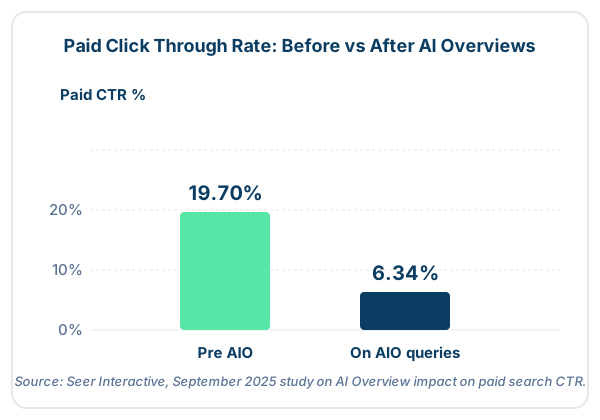
The Seer September 2025 Finding: Paid CTR Compression on AIO Queries
Seer Interactive’s September 2025 measurement of AI Overview impact on paid search CTR found paid ad click through rate dropping from 19.70 percent pre AIO to 6.34 percent on AIO queries. On informational queries in PI (“what is personal injury”, “do I need a lawyer after an accident”, “how much is my case worth”), AIOs surface first and consume attention before the paid slot loads. On transactional queries (“car accident lawyer near me”, “hire personal injury attorney”, “free consultation personal injury attorney”), AIOs are less likely to appear because the intent signals purchase not research.
What Survives in an AI Overview SERP: High Intent Slots Only
What survives in an AIO SERP is the paid slot immediately above the local pack on high commercial intent queries. Everything else compresses. Your budget shift is out of informational queries (where the AIO answers before the click) and into transactional queries (where the AIO does not fire). Your bid adjustment is downward on any keyword whose SERP frequently shows an AIO, and upward on transactional keywords that pull local pack + paid slot without AIO interruption.
How to Rework Budget and Bid Targets for AIO Presence
The rework is procedural. First, run a report of every keyword in your account and note which queries trigger AIOs. Second, pause or reduce bids on the AIO heavy keywords. Third, reallocate the freed budget to transactional keywords and to LSA. Fourth, add landing page content that satisfies the AIO extraction requirements (front loaded direct answer, structured data, entity confidence) so that when the AIO fires, your page is a source.
Your paid click volume is down and you cannot tell whether the culprit is AI Overview compression or a bid strategy problem.
Book my personal injury SEO diagnostic and I will show you whether your pages are eligible AI Overview sources while competitors lose paid clicks to the same feature.
Win the AI Overview citation instead of bidding around it.
Speed to Lead Operational Math and Its Effect on PI Google Ads ROI
Speed to lead is the single highest ROI operational lever for PI Google Ads. It is not a bid strategy. It is not a keyword. It is picking up the phone. The mechanics below are why the intake floor of your firm determines the ceiling of your paid ROI.
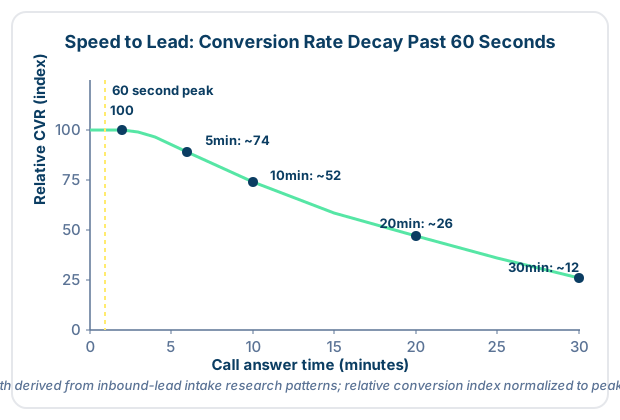
The 7 Percent Per Minute Conversion Rate Drop Past 60 Seconds
Inbound conversion rate on PI leads drops approximately 7 percent per minute past the 60 second call answer threshold, an industry approximation drawn from inbound intake research patterns rather than a controlled study. At 60 seconds you are close to peak conversion probability. At 5 minutes you have lost approximately 30 percent of that conversion probability. At 30 minutes you have lost the majority. On a $300 paid click, every minute of delayed answer costs real close rate. On a firm handling 60 paid calls per month, a 5 minute average answer delay costs 12 to 18 signed cases per year compared to a 60 second average.
24/7 Intake Staffing Versus After Hours Answering Services
The staffing model is the fork in the road for paid ROI, and my position on it is not subtle.
The single highest ROI operational lever for PI Google Ads is not bid strategy. It is picking up the phone in under sixty seconds.
Behzad Hussain, on the speed to lead threshold
Firms that run 24/7 in house intake typically outperform firms that use after hours answering services by 15 to 25 percent on signed case conversion. The reasons are boring: an in house intake specialist knows the practice, can pre qualify a case, and can book a follow up with a paralegal or attorney immediately. An answering service takes a message. A message loses close rate.
If 24/7 in house is not viable, the mid tier option is an answering service that follows a firm specific script, escalates urgent calls to on call intake, and books consultations directly into a shared calendar. The lowest tier option is voicemail, which for PI Google Ads is a budget destroyer.
Mobile Call Routing Patterns for Accident Search Traffic
Mobile share of PI search sits at 63.8 percent to 70 percent per most industry measurements. Accident related search skews even higher because searches often happen at the scene, in the ambulance, in the hospital waiting room, or during the first 24 hours post incident. Mobile call routing has to be flawless: a click to call button above the fold, a dedicated inbound tracking number per ad group, and an intake team that answers in under 60 seconds.
Mobile share
63.8 percent to 70 percent of PI search happens on mobile devices; accident related search skews even higher because searches often happen at the scene or in the first 24 hours post incident.
Bar Advertising Compliance for Google Ads by Jurisdiction
Bar advertising compliance for Google Ads is a state by state responsibility. ABA Model Rules set the floor; every state adopts, modifies, or replaces the ABA rules for its own jurisdiction. Ad copy that clears one state’s rules may fail another’s. Firms operating in multiple states either draft ad copy to the strictest state’s requirements or run separate campaigns per state with state specific copy.
Rule 7.1 / 7.2 (effective November 1, 2018) + Rule 7.4 specialty trap
Responsible attorney named in every ad. Specialty claim (“personal injury specialist”) is a trap because PI is not a State Bar certifiable specialty in California.
Rule 7.01 / 7.02 (effective March 7, 2025)
Responsible lawyer name + primary practice location in every ad. File with State Bar Advertising Review Committee within 10 days of dissemination.
22 NYCRR § 1200.7.1
“Attorney Advertising” label required on landing page. Case results require “Prior results do not guarantee a similar outcome” disclaimer. 3 year ad retention.
Rule 4-7.13 (Handbook 2025 approved December 10, 2025)
Past results claims banned unless “objectively verifiable”. Actor or model voices creating the impression they are the firm’s lawyers are banned.
ABA Model Rules 7.1, 7.2 (With Comment [5] on Lead Generation), and 7.3
The ABA Model Rules are the national baseline. Rule 7.1 requires that “a lawyer shall not make a false or misleading communication about the lawyer or the lawyer’s services”. Rule 7.2 governs communications, specific rules, and (via Comment [5], added in the August 2012 amendments adopted by the ABA House of Delegates) permits paying nonlawyers for client leads (including internet based leads) as long as the lead generator does not recommend the lawyer, the payment is consistent with Rules 1.5(e) and 5.4, and the lead generator’s communications comply with Rule 7.1. Rule 7.3, amended in 2018 and further clarified by Formal Opinion 501 (issued April 13, 2022 by the ABA Standing Committee on Ethics and Professional Responsibility), prohibits live person to person solicitation for pecuniary gain and holds lawyers responsible when nonlawyers solicit on their behalf.
Named authority correction
The pay per lead permission under Rule 7.2 Comment [5] is what makes LSA legal. It is not a “Formal Opinion” as some vendor materials describe. It is a rule comment adopted August 2012. Cite it correctly.
California Rule 7.1 and 7.2 and the Specialty Claim Trap Under Rule 7.4
California’s Rules of Professional Conduct, effective November 1, 2018, adopt Rule 7.1 (truthful communications) and Rule 7.2 (specific advertising rules) that broadly mirror the ABA framework. Every California ad must name a responsible attorney. California Rule 7.4 restricts specialty claims: personal injury is not a State Bar certifiable specialty in California, so ad copy or landing page copy that claims “personal injury specialist” or “specializes in personal injury” is potentially exposed under Rule 7.4 unless the firm holds an appropriate certification (which for PI is a common trap because there is no such certification available for the practice area in California).
The safer California ad copy phrasing uses “focused on personal injury”, “concentrating on personal injury cases”, or “personal injury representation” instead of “personal injury specialist”.
Texas Rule 7.02 Filing Requirement Effective March 7, 2025
Texas revised its Disciplinary Rules of Professional Conduct with an effective date of March 7, 2025. Rule 7.01 governs communications concerning a lawyer’s services. Rule 7.02 governs advertisements. Both require the responsible lawyer’s name and the primary practice location in every ad. Rule 7.02 also requires filing the ad with the State Bar of Texas Advertising Review Committee within ten days of dissemination. A PI firm running new ad copy in Texas needs a filing workflow that captures every ad copy variant and routes it to the Advertising Review Committee within the ten day window.
New York 22 NYCRR 1200.7.1: Attorney Advertising Label and Three Year Retention
New York’s 22 NYCRR 1200.7.1 governs attorney advertising and requires the “Attorney Advertising” label on the home page of any advertising website. Case result claims require the “Prior results do not guarantee a similar outcome” disclaimer. Ads must be retained for three years after their last publication. A PI firm running Google Ads in New York needs a compliant landing page with the “Attorney Advertising” label prominent and every case results page carrying the disclaimer.
Florida Rule 4-7.13 and the Past Results Objectivity Requirement
Florida’s Rule 4-7.13, in the Florida Bar Handbook 2025, approved December 10, 2025, bans past results claims unless the results are “objectively verifiable”. It also bans the use of actor or model voices that create the impression they are the firm’s lawyers. A Florida PI firm running ad copy that references verdicts or settlements needs documentation ready to substantiate the claim on request from the Bar.
The Bates v. State Bar of Arizona Precedent That Made Every PI Google Ad Legal
Every compliance rule above traces back to one 1977 decision, and it is worth naming plainly before the case citation.
Every PI Google Ad you have ever seen is legal because five Supreme Court Justices decided in 1977, over four dissents, that truthful lawyer advertising is protected commercial speech. Reading the Bates opinion changes how you write ad copy.
Behzad Hussain, on the Bates precedent
In Bates v. State Bar of Arizona, 433 U.S. 350 (1977), decided June 27, 1977, the US Supreme Court held that truthful, non deceptive lawyer advertising is commercial speech protected by the First Amendment. States cannot categorically ban lawyer advertising. Every subsequent case (including Rubenstein v. Florida Bar, 72 F. Supp. 3d 1298, decided December 8, 2014 in the Southern District of Florida) has narrowed or clarified specific state restrictions under the Central Hudson intermediate scrutiny framework, but the core Bates holding remains: your ad is protected speech as long as it is truthful and not deceptive. The capture below is the case record with the anti suppression holding highlighted in the syllabus.

FTC Endorsement Guides and TCPA Consent for Lead Forms
FTC Endorsement Guides, updated in 2023, require disclosure of material connections and prohibit fake reviews or testimonials. A PI landing page that features paid testimonials without disclosing the compensation, or that runs a “review” from a person who is actually an employee, violates the Guides.
The TCPA lead form story changed twice in two years. The FCC adopted a one to one consent rule in December 2023 that would have required consent naming one seller at a time, but the US Court of Appeals for the Eleventh Circuit vacated that rule in Insurance Marketing Coalition v. FCC, decided January 24, 2025, before it took effect, and the FCC formally eliminated the requirement later in 2025. What still governs is the TCPA’s baseline prior express written consent standard for marketing calls and texts, plus state mini TCPA statutes that can run stricter than federal law. The defensible pattern for PI lead forms has not changed: consent language that names your specific firm, because shared consent sold across multiple firms is the pattern most exposed in TCPA litigation with or without the vacated rule. Lead vendors that sell PI leads to multiple firms remain the frequent point of failure. The capture below is the statute itself, 47 U.S. Code § 227, with the prior express consent prohibition highlighted.

You have 40 live ads across five states and you do not know which are exposed to a bar complaint under the current version of Rule 7.1, Rule 7.2, or your state’s ad filing requirement.
My personal injury SEO diagnostic reviews the public surfaces where most of that exposure lives: your landing pages, your Google Business Profile record, and your LSA profile.
Review the surfaces before your next campaign push.
The Spanish Language and Bilingual Personal Injury Paid Search Opportunity
One market gap deserves its own section because no ranking competitor page even mentions it.
The Spanish language PI paid market in Texas, California, Florida, New York, and Arizona is the largest underserved paid opportunity I see across the vertical. English keywords are contested. Spanish keywords are quiet.
Behzad Hussain, on the Spanish language paid opportunity
A bilingual PI firm that runs a separate Spanish campaign with Spanish landing pages and Spanish speaking intake staff will consistently deliver lower CPCs, lower CPLs, and lower CPSRs than the same firm’s English campaigns.
I worked with a Miami PI firm that had never run Spanish campaigns despite serving a majority Spanish speaking metro. Two months after we launched a mirror Spanish campaign with dedicated Spanish landing pages and a bilingual paralegal handling first call intake, the Spanish account was delivering 40 percent of the firm’s paid signed cases at 55 percent of the CPSR of the English account.
Spanish Keyword Volumes for PI in Texas, California, Florida, New York, and Arizona
Spanish keyword volumes for PI in the top bilingual markets are substantial. In Miami, Los Angeles, Houston, Phoenix, and New York, “abogado de accidentes” and “abogado de lesiones personales” and “abogado de accidentes de auto” carry meaningful monthly volume. The specific volumes vary by metro and change over time; a paid competitive analysis of the Spanish PI keyword set is a separate exercise from an English analysis.
| Spanish keyword | US Spanish speaking metro relevance |
|---|---|
| abogado de accidentes | High volume, low competition relative to English equivalent |
| abogado de lesiones personales | Medium volume, low competition |
| abogado de accidentes de auto | High volume, low competition |
| abogado de accidentes de motocicleta | Medium volume, low competition |
| abogado de muerte injusta | Low volume, low competition |
| abogado de negligencia medica | Medium volume, low competition |
| abogado de resbalones y caidas | Medium volume, low competition |
Separate Bilingual Landing Page and Intake Staffing Requirements
Running a Spanish campaign that lands on an English page is worse than not running a Spanish campaign at all. The Spanish landing page needs Spanish copy, a Spanish speaking intake staffer or answering service option, a Spanish speaking attorney to close the retainer, and every piece of legal disclaimer language translated into Spanish. Google’s Enhanced Conversions and Consent Mode v2 do not care about language; they care about signal, so the same tracking stack applies.
Cost Per Signed Retainer Ratios Every PI Firm Should Publish Internally
Every PI firm should track and publish (internally, to the partners and marketing team) its Cost Per Signed Retainer by case type, and every marketing decision should route through CPSR, not CPL. CPL tells you what you are paying to get an intake conversation. CPSR tells you what you are paying to get a signed case. The gap between them is where intake conversion, case qualification, and attorney closing rate live.
The CPSR to Case Value Ratio That Defines a Profitable Campaign
A profitable campaign has a CPSR that is less than roughly 10 to 15 percent of average case value net of costs. On a $150,000 auto accident case with 33 percent contingency (net firm revenue $49,500), a CPSR of $4,500 to $7,000 is healthy. On a $500,000 catastrophic case (net firm revenue $165,000), a CPSR of $15,000 to $25,000 is healthy. On a $2 million wrongful death case (net firm revenue $660,000), a CPSR of $30,000 to $60,000 is healthy.
What is the minimum monthly Google Ads budget for a solo PI attorney? The minimum monthly Google Ads budget for a solo PI attorney serving one Tier 3 metro is $3,000 to $5,000, sufficient to sustain one campaign with 30 to 60 clicks per month, but below the threshold where Smart Bidding produces reliable optimization; a viable competitive budget for solo PI in a Tier 2 metro is $7,000 to $15,000 per month.
| Case type | Median CPSR (2026) | Median case value | CPSR to case value ratio |
|---|---|---|---|
| Auto accident | $2,500 to $5,000 | $80,000 to $200,000 | ~5% |
| Truck accident | $5,000 to $10,000 | $250,000 to $1,000,000 | ~3% |
| Motorcycle accident | $4,000 to $8,000 | $150,000 to $500,000 | ~4% |
| Medical malpractice | $8,000 to $18,000 | $400,000 to $2,000,000 | ~3% |
| Wrongful death | $10,000 to $25,000 | $500,000 to $5,000,000 | ~2% |
| Catastrophic / TBI | $8,000 to $20,000 | $500,000 to $5,000,000 | ~2% |
| Slip and fall | $2,000 to $4,000 | $30,000 to $100,000 | ~5% |
| Product liability | $3,000 to $8,000 | $80,000 to $500,000 | ~3% |
Breakeven Case Count Math for a Given Monthly Google Ads Budget
Breakeven case count is monthly budget divided by (average case value times contingency percentage times average close rate on paid consultations minus your cost per consultation minus staff overhead per consultation). For a firm spending $30,000 monthly on Google Ads, with a $150,000 average auto case value, 33 percent contingency ($49,500 net revenue per case), and needing to cover all campaign costs plus intake and marketing overhead, the campaign needs to sign 3 to 5 cases per month at $150,000 average value to reach a healthy 5x to 8x return on ad spend.
How long before Google Ads becomes profitable for a new PI firm? A new PI firm running Google Ads reaches contribution margin profitability in 6 to 12 months on a healthy account, depending on how quickly landing page conversion rate reaches 15 percent, how quickly intake speed to lead drops below 60 seconds, and how quickly offline conversion imports close the attribution loop; before 6 months the account is typically still tuning bid strategy, Quality Score, and CPA targets.
Common Google Ads Mistakes That Burn Personal Injury Budgets Fast
The four mistakes below account for most of the wasted PI Google Ads spend I see across audits. Fix these before you optimize anything else.
Sending Every Click to the Homepage
Every ad group in your account routing to the homepage is the number one paid ROI leak in PI. A homepage converts at 2 to 6 percent because it is designed for organic navigators, not for a paid click with a specific intent. A dedicated landing page for that ad group converts at 15 to 20 percent because it matches the ad copy, the practice area, and the intent. The Chicago firm I mentioned earlier tripled its lead count on the same spend by rerouting ad groups to matched landing pages. Every firm has this available.
Using Broad Match Without Aggressive Negatives
Broad match without aggressive negative keywords is the second most common leak. Broad match now includes semantic and intent based expansion, which means your “car accident lawyer” keyword will trigger on “how to be a lawyer”, “car accident lawyer salary”, and dozens of other unrelated queries unless you block them. Every account needs a starter negative keyword list of 300 or more terms, and every account needs weekly search term report audits that catch new negative candidates before the next auction cycle.
Setting Smart Bidding Before Conversion Tracking Is Deployed
Smart Bidding requires conversion tracking to work. Deploying tCPA before conversion tracking fires reliably is asking Google to optimize on random noise. Deploy the tracking stack (dynamic call tracking, GA4 events, Enhanced Conversions, Consent Mode v2, and eventually Offline Conversion Imports) before you touch bid strategy. On a new account, run Manual CPC or Enhanced CPC for the first 60 to 90 days to accumulate clean conversion data. Then graduate to tCPA once volume supports it.
Ignoring Ad Copy Bar Compliance Until a Complaint Arrives
Ignoring ad copy compliance until a bar complaint arrives is the mistake that gets a firm suspended. I audited a Texas PI firm that had never filed a single ad copy variant with the State Bar Advertising Review Committee despite the March 7, 2025 rule requiring filing within ten days of dissemination. Their 47 live ad copy variants were all technically noncompliant. The Bar had not yet noticed. When a competitor files a complaint (which happens), the firm faces a per ad enforcement decision. Every firm running paid ads in Texas needs a filing workflow. Every firm in Florida needs a past results documentation workflow. Every firm in New York needs an Attorney Advertising label on every landing page. Every firm in California needs a “responsible attorney named” pass on every ad.
The Personal Injury Attorney Google Ads Questions That Keep Coming Up
Three questions come up over and over in PI Google Ads discussions online. I have collected them here without answering them because your answers, based on your firm’s specific market, budget, and case mix, are more valuable to other readers than mine.
Get the Organic Layer Under Your Google Ads Account Measured
Every part of this guide compounds only when the organic layer underneath it is built. Quality Score prices your landing pages. AI Overviews reward entity confidence. LSA leads route through your Google Business Profile record. If your CPCs sit above the benchmarks in the case type matrix, or your Quality Score sits below 6 across your top ad groups, the tax is usually coming from the organic side of the stack. My personal injury SEO diagnostic measures that layer and sends back the specific organic mechanisms your site is missing, and which paid dollars they are silently taxing, before the next campaign cycle.
Book the diagnosticFrequently Asked Questions About Google Ads for Personal Injury Lawyers
Is Google Ads worth it for a solo personal injury attorney?
Google Ads is worth it for a solo PI attorney when the monthly budget clears the $3,000 to $5,000 threshold that allows one campaign to accumulate enough conversion data for optimization, when intake capacity clears the sub 60 second answer bar, and when the landing page is dedicated to the ad group’s practice area. Below those thresholds, Google Ads becomes a budget drain for a solo practice. LSA is often the better starting paid channel for solos because pay per lead billing is more predictable than pay per click.
What is the difference between tCPA and Maximize Conversions?
Target CPA (tCPA) sets a specific cost per acquisition target and Google optimizes bids toward that number. Maximize Conversions removes the CPA constraint and Google spends the entire budget generating as many conversions as possible. Use tCPA when you have a firm CPA target derived from case value math. Use Maximize Conversions when you have budget flexibility and want maximum lead volume. Both require at least 30 conversions per campaign per month to produce reliable optimization.
Should I hire an agency or run Google Ads for my personal injury firm in house?
Hire an agency when your total monthly spend crosses $10,000 to $15,000 and your team does not include a dedicated Google Ads operator with legal advertising expertise. Run in house when your budget is smaller, your team includes a dedicated marketing lead who can commit 10 to 15 hours per week, or when your firm’s bar advertising rules require close firm level control over every ad variant. Hybrid models (agency runs the account, in house marketing owns compliance and landing pages) are common in mid sized firms.
What is a good Quality Score for a personal injury keyword?
A good Quality Score for a PI keyword is 7 or higher. At 7 or above, your effective CPC discount is typically 15 to 30 percent below your peers on the same keyword. Below 5, your effective CPC premium is typically 30 to 60 percent above your peers. Every PI account should have a weekly Quality Score audit and a plan to lift any keyword sitting below 5.
Do I need a separate Google Ads campaign per office location?
Separate Google Ads campaigns per office location are the correct architecture when each office serves a distinct metro (Chicago and Denver, not Chicago and suburban Chicago), when case handling and intake staff differ per office, when case type mix differs per office, or when bar rules differ per office (multi state firms). Consolidate into one campaign with location targeting when the offices share a single service area and intake team.
What happens to my Google Ads if a bar complaint is filed against me?
A bar complaint against a firm does not automatically affect Google Ads accounts. Google Ads Legal Requirements policy does not require disclosure of pending bar complaints. However, if the complaint results in disciplinary action affecting your bar license, LSA verification will fail on the next license verification cycle and Search Ads may be affected under the Legal Requirements policy if your license status changes. Firms with active complaints should notify their agency and prepare compliant ad copy variants that reduce exposure to further complaints.
Does Google Ads accept my law firm if I am a solo without a bar rating?
Google Ads accepts law firm advertisers regardless of bar rating (Martindale Hubbell rating, Avvo rating, Super Lawyers listing). A rating is not a Google policy requirement. Only an active state bar license is required to advertise legal services, and only for LSA does Google directly verify the license through Evident (or equivalent third party). For Search Ads, Google verifies the advertiser at account setup and monitors for policy violations but does not verify individual bar credentials.